Monday, November 26, 2012

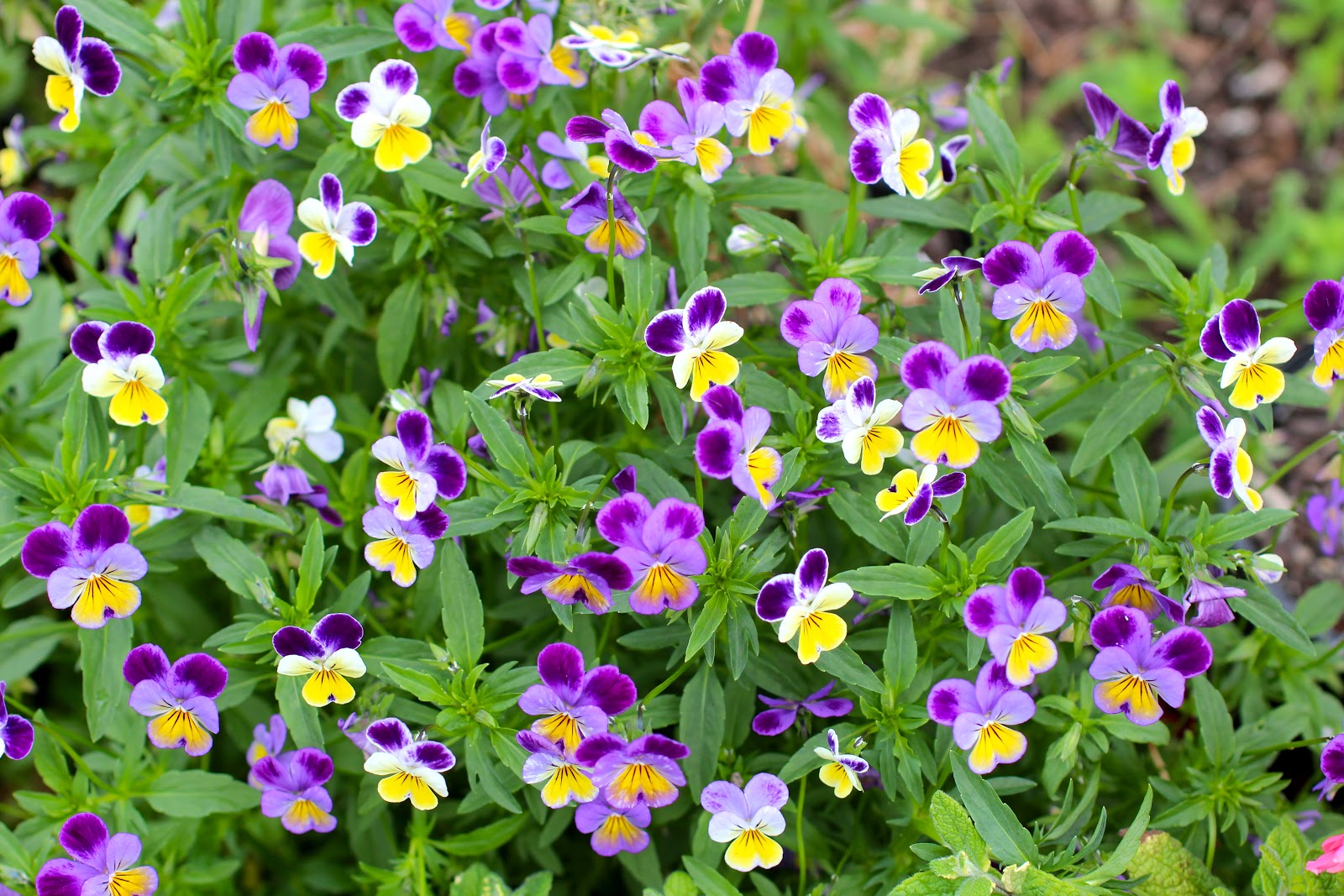
Viola tricolor, Heartsease


 The Violas go into panic mode at this time of year and put on a last hurrah of masses of flowers to ensure they leave enough seed behind to complete their life cycle. It is on dull cloudy days they look the best and the plants which grow in poorer soil in full sun have the most compact habit and more flowers. There are even tiny plants covered in flowers which grow through the cracks of pavement. However once the really hot days of December arrive it will be time to pull them out, though I usually scatter the spent plants around, as this most pleasant of 'weeds' is always welcome back in the garden. They usually don't make another appearance till winter, mainly in my vegetable garden. As soon as I see the young seedlings emerge I dig them up and nurture them in pots till big enough to plant out uncongested and where I want them to go. I love the many and varied common names given to this plant which include Johnny-Jump-Up, Call-me-to-You, Love-in-Idleness, Three-Faces-under-a-Hood as well as the most common one of Heartsease which may refer to use as a love- charm especially in a Midsummer Night's Dream. Good old Shakespeare loved his flowers.
The name Heartsease also refers to its many and varied uses in herbal medicine. These days the flowers are a favourite decoration on plates of food or added to salads. No episode of the series Masterchef was ever without these little beauties making an appearance and I assume that in the more temperate parts of the country they may just go on flowering for most of the year.


Saturday, November 24, 2012

Turmeric and Galangal

Tumeric (Curcuma longa)

Galangal (Alpinia galanga)
Coming out of their long winter hibernation after being placed in boxes and covered in a mix of sand and perlite, these Asian spice plants are ready to plant out.The pointed buds are starting to swell and are changing colour from pink to pale green. In less than a month new leaves will start to push their way through the earth and thereafter growth will be rapid. The galangal will soar up to one and a half metres by the end of summer.


Friday, November 23, 2012

Fiskars shrub rake

Fiskars 'shrub rake'
Gardeners can spend a lifetime acquiring their tools of the trade. Some of the best garden tools I have found have been for sale at local market stalls , old tools re-fashioned or made-over by weather beaten men of European extraction who look as if they have spent a lifetime tilling the soil.Their callused hands caress the wooden handles as part of the sales pitch while I ponder what use I can put to an ancient scythe more at home on the Russian steppes of a previous century. Occasionally I get excited about a new tool and marvel about how well designed it is. This Finnish designed shrub rake is so called because in the northern hemisphere, where lawn does not grow like stink as here, it finds a use for removing leaves which fall over beds of ground cover and for reaching up over hedge plants to remove the spent prunings. To a certain extent these uses make it ideal for any part of the gardening world but in Australia rakes are mostly associated with lawn care and in this use it does not disappoint either. This is the perfect small rake with a 140mm wide head for use in narrow tight garden corners. The handle is lightweight aluminium, strong and long for hard raking over lawn or for reaching up onto the top of shrubs to retrieve pruned branches. Ten out of ten thanks Fiskars.

Houttuynia cordata 'Chameleon'

Houttuynia cordata 'Chameleon'
The plain green form of this plant is more commonly known as Vietnamese fish mint, giap/diep ca or phak khao tong in Thailand. Leaves are added to soups, used in salads or in rice paper rolls. As it has quite a strong flavour it has not become well known or popular amongst 'foodies' here. In the world of ornamental horticulture however this 'chameleon' cultivar is regarded as a hardy herbaceous perennial suitable for boggy or wet sites or for brightening shady corners of the garden. It grows across a range of climates forming a dense spreading ground cover and can become invasive in some climates. As the weather warms up it puts on a wonderful display of intensely marked leaves which range in colour from yellow to hot pink and cream. Best kept in a pot with a deep saucer of water underneath or in a pond if you don't want the hard work of keeping it under control.
2017 update: I usually have stock available in early summer.

Thursday, November 22, 2012

The Chameleon Rose

Miniature rose 'Chameleon' (Bob Dylan 'Blonde on Blonde' 1966)
Actress Cate Blanchett gave a very interesting interview on the radio today in which she  gave an insight to her role playing Bob Dylan in the Todd Haynes 2007 film 'I'm not there', describing Dylan as 'chameleon'.
As it happens the Chameleon rose is if flower at the moment. It starts life as yellow, changes to vibrant red flushed with yellow before turning pink and white. Lovely, but a bit prone to black spot on the leaves though fairly easy to remedy with Eco rose fungicide.
 And from Dylan's Blonde on Blonde I like 'Stuck inside of Mobile with the Memphis Blues Again....'


Wednesday, November 21, 2012

Seedling Buddleja

Most nurseries  have plants which have been sitting too long in the one spot and before you know it, roots have been sent down and the plant has decided to anchor itself to the spot regardless of the constrictions of the pot surrounding it.This Buddleja started life as a tiny seedling which had come up close to another plant in a pot . I recognized the grey foliage so carefully removed it and placed it in a pot of its own wondering what flower colour it might have. Buddlejas are fairly tenacious and quick growing when they find the right spot and this one was no exception. It looks very much like B. davidii 'Ile de France' which has huge flowers of 30 cm or more in length topping a plant which is now more them 2 metres in height. It looks a bit ridiculous emerging from a 20 cm pot and will no doubt collapse with wilted foliage when I eventually move. I am just going to wait until the flowers finish.

Monday, November 19, 2012

Pelargonium cucullatum

Often I will acquire a plant without knowing much about  where it is from or how big it grows and what sort of conditions it likes to grow under. I guess one of these days I will get myself a mobile device so I can do a 'net search while out and about. This Pelargonium seduced me with the fragrance of its small crinkly cupped shaped leaves which emit a rich complex scent when crushed. The leaves in fact remind me a bit of a cup cake patty pan.
 Apparently it grows to be quite a large shrub, with a woody base, of a couple of metres in height, in its native habitat of the Western Cape region of South Africa. As it prefers a sandy free draining soil, something which I don't have, it may have to live in a large pot. The magenta coloured flowers, which are just starting to appear, have dark purple feathery markings on the upper petals. and sit like a crown on top of the foliage. This species was used as a parent in the breeding of the 'Regal' Pelargoniums which are a vibrant part of the spring garden scene, though their popularity seems to have waned in recent years perhaps because they are fairly short lived and become woody and sprawling with age. Many of the hybrids have splendid dark almost black flowers.