Wednesday, April 6, 2022

Aloe distans 'Variegata'


 Aloe distans 'Variegata'
 
Variegated forms of plants often have slower growth rates { It's a lack of chlorophyll in the leaves thing} which can be an advantage when growing succulents such as this one as the plain green form is more likely to sprawl over the sides of the pot and develop unsightly dead leaves along an elongated stem in no time.
Avoiding a position full sun is probably advisable for this plant as it can be prone to leaf scorch but is otherwise easy care and can be left to its own devices with the occasional water as required.
As for the species name 'distans' , it may also be known as A mitriformis

Sunday, November 14, 2021

Agave isthmensis


 Agave isthmensis: Dwarf Butterfly Agave

Having a shadowy zigzag imprint on its powdery grey leaves gives this small 30cm Agave a distinctive look. It is easy to grow requiring little water and though slow growing, there are few congested "pups" around the base to detract from the neat rosette shape.
Hardy to -3C and worth considering for decorative container growing or semi shaded garden position under trees. 


Thursday, November 4, 2021

Reseda odorata 'Machet Ruben' (Mignonette)

 Reseda odorata 'Machet Ruben'

(Resedaceae) 

I have not grown this spring flowering annual for a number of years and came across it in a seed catalogue while ordering summer vegetables.  August here is the month when you can start seeds indoors in a bright location. Germination was quick and they were ready for potting on in no time. While most gardening books say it can be difficult to transplant into garden beds, I had success with placing three or four seedlings close together in 175 mm pots which was to be their flowering 'home'.

 I placed the pots along a low wall in full sun to help kickstart them during the normal cold early  spring days. Growth was slow at first but they responded to some liquid fertilizer and they soon became bushy plants to about 30cm with flower spikes appearing in late September at which time I moved the pots to bench height to better enjoy the sweet perfume released from the flower spikes in late afternoon. You don't have to stick your nose up close either as the fragrance is in the air from a distance away. It is described as ambrosial so no wonder the French in the southern perfume industry region called this plant Mignonette or 'little darling'. 

Bill Simpson in his book Growing Annuals (Kangaroo Press 1988) described the flower as having orange red bell clapper stamens protruding like grapes from insignificant white-yellow 6mm wide flowers accompanied by smooth spoon shaped plain green leaves. The leaves wilt quite quickly on hot days or when the plants are lacking water so the ideal location is in a semi shaded garden position with moisture retentive soil.

It is a North African plant in origin and it must have caught the eye of 19th Century naturalist Charles Darwin who used it to study self-fertilized plants published as The effects of cross and self fertilization in the vegetable kingdom.

Mignonette is not showy but as perfumed flowers go it is up there with the best.


Thursday, October 21, 2021

Trichocereus bridgesii 'Monstrose'

Trichocereus bridgesii 'Monstrouse'
Given the common name in German Frauengluck or Women's Joy this small compact growing cactus has been in cultivation for many years and that common name is always a source of amusement for those who view the smooth cylindrical segments with their distinctive cleft for the first time. "Oh I see...."
it was formally known as Echinopsis lageniformis and may be given a further taxonomic shift given the current advances in plant molecular DNA.
The lower sections of this cactus have quite long spines which make repotting or weeding close by a minor problem but it is otherwise very hardy and decorative.
I grow some in larger pots so it has more room to show off its interesting form.


Sunday, April 1, 2018

Finding the perfect chilli

Last year I saved seed from what I thought was the perfect chilli. By that I mean one which has the right amount of heat for my taste and one which can be used either whole and green in say a vegetable curry or chopped and red in sauces and marinades.
The bonus with this one is it dries well even on the bush and produces enough for year round use.
Don't know what variety or origin this one is but would be interested to know.

Sunday, March 25, 2018

Hibiscus rosa-sinensis 'George Harwood'


Hibiscus rosa-sinensis 'George Harwood'
photo by Arthur Gulliver (Your Garden magazine)
This full page colour photo of 'George Harwood' appeared in the second edition of the book Garden Trees and Shrubs in Australia  by Harold Sargeant (Macmillan of Australia 1968) 
The first edition of this book was published in 1951 with the title including Asia as in Australasia. ( Colorgravure Publications )
 Described as 'a new pink variety' for Melbourne gardens, it had made its way south from Sydney where it made its first appearance way back in 1902 having been bred by the George Harwood who at the time was a propagator, overseer and superintendent at the Royal Botanic Gardens. His tenure there was from 1883 to 1914. 
Of note is the watercolour painting of it now in the Mitchell Library (State Library of NSW) by Essex born Margaret Flockton who would go on to be described as 'the most accomplished botanical artist in NSW'. Her legacy is ongoing and today she inspires a new generation to pursue botanical illustration.

So where can this Hibiscus be found today?
While not available commercially it is probably still around in an old garden as Hibiscus are great survivors always flowering despite years of drought and neglect.
Recently I thought I might have found it in a 1960's/1970's planted garden growing just a metre away from a huge peppermint gumtree which was probably planted at the same time.

Hibiscus rosa-sinensis 'George Harwood' ??
I will leave the question marks in place until someone can confirm my naming.


Margaret Lilian Flockton (1861-1953)
Botanical Artist

Wednesday, March 21, 2018

Epipremnum aureum 'Frosty'


'Devil's Ivy' Frosty
Epipremnum aureum 'Frosty'
I have been growing this white variegated form of Devil's Ivy for several years now and find it more appealing than the yellow/gold form which has much larger leaves. I have several plants of it growing in different positions both indoors and out and at this time of year it is looking at its best, responding well to warm humid days.
The leaves are somewhat stiff in appearance and when unblemished it could be said the whole plants looks plastic or artificial. Perfect! Of course it does not stay that way for long and during winter many leaves develop burnt edges or drop off as a response to cold.
This is when the plant needs a rest, given minimal water and kept in a warm sheltered location, preferably out of sight as the temptation to bin a tired looking plant may overtake you.

Frosty......

Cephalophyllum sp


Cephalophyllum sp
This small South African "pigface" family succulent came to me with a wrong name and after a bit of searching I came across a good match as to what it might be.
I used 'The Timber Press Guide to Succulent Plants of the World' by Fred Dortort as reference.
Pinning it down to a species is proving more difficult and at the moment it is a toss up between alstonii, stayneri or framesii. 
There are about 30 species in the Genus and they display a wide range of jewel like flower colours. Growth occurs mainly in winter, no doubt as a response to rainfall.
The parent plant has spread to about 30 cm across and is quite decorative even when not if flower as the leaves resemble small grey green birthday candles with bright pink tips.
These flowers came out during the last few days and I like the way they stand above the leaves on short stems.

Tuesday, February 27, 2018

Orthophytum gurkenii

 Orthophytum gurkenii
I have been growing this unusual Bromeliad for a number of years and it seems never to be without one or two flower stems. The 40cm tall arching inflorescence is a striking chartreuse green in colour which contrasts well with the bronze powder coated foliage.
New plantlets appear at the end of these green bracts which have the unfortunate attribute of being edged with razor sharp spines and as they mature these spines can detach and lodge in the fingertips if you handle them without protection.
It is one of those easy care plants however preferring a dry location in sun or semi shade.
Apparently there are quite a number of different forms of this plant including ones with striped leaves.

 From a couple of flower stems I cut more than a dozen new plants though they probably would have been quite happy staying attached to the mother stem for many months to come.
And now comes the tricky part. Underneath these dried razor sharp bracts at the base of the plant tiny nobbly roots are forming and need to be exposed to give them a good start in life. With gloved hand I hold the top and peel away using small flower snips all the while taking in a lung-full of white fluff being shed form the leaves.
I will plant them into small pots using an open bark/Perlite mix and by the end of the year they should be ready for a new home.


Sunday, February 25, 2018

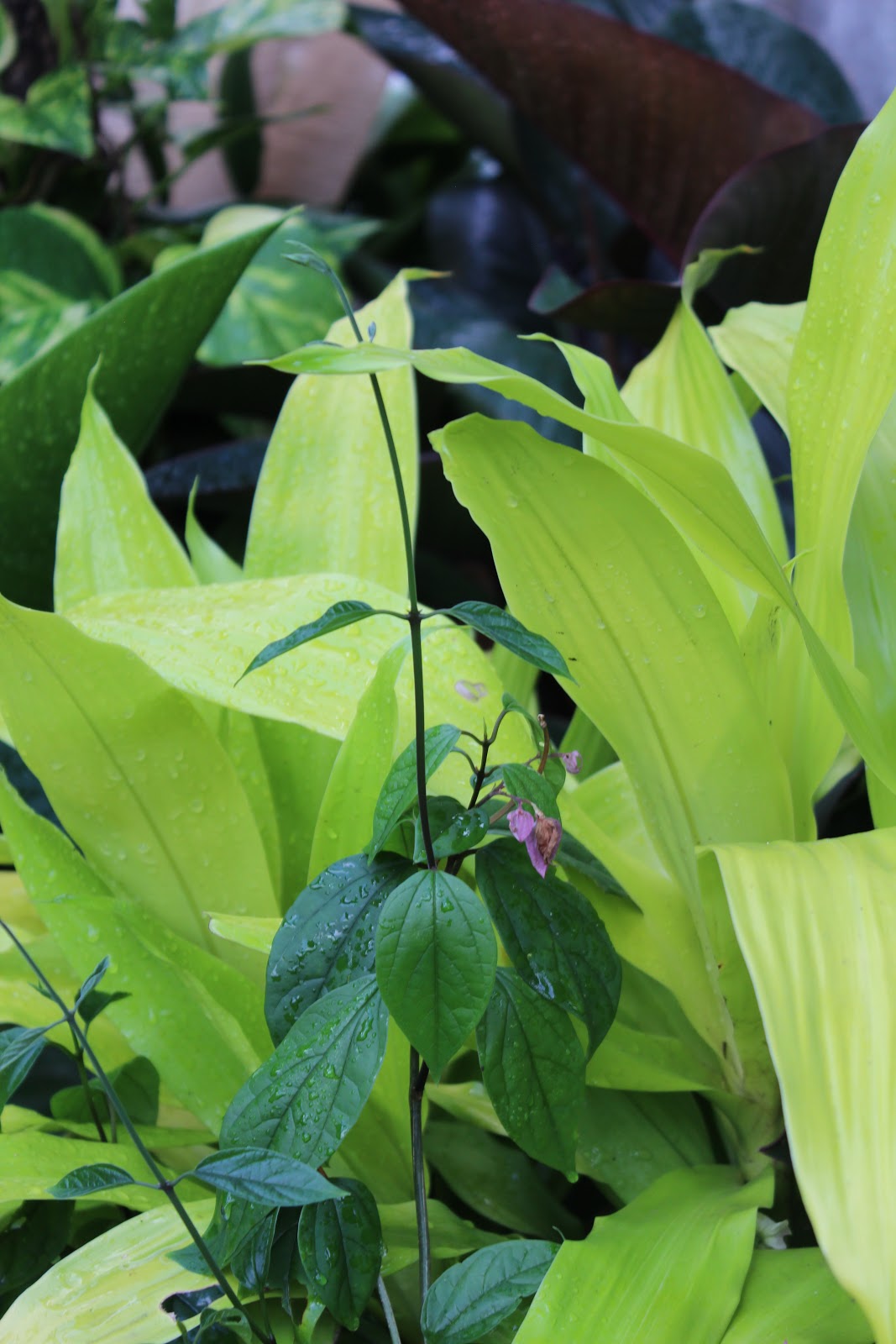
Dracaena deremensis 'Janet Craig Limelight'


 Dracaena deremensis 'Janet Craig Limelight'
The multi-branched garden planted specimen of this plant is now about three metres tall and growing under house eaves in a shady spot. It does not look half as good as the potted specimens I have pictured here which are in a greenhouse and sheltered from the elements.
 A few years back a large branch of the garden one toppled over in a storm so I cut it up into 30 cm lengths so I could propagate some new plants.
Stems cuttings from a mature plant take root quite easily though they require a free draining mix with lots of Perlite as part of the propagation mix. After a couple of years they have now grown to about 120cm in a 200 mm pot and I can almost say they thrive on neglect as they don't seem to mind a low water and fertilizer regime.
 I placed one of these indoors several months ago and though it has lost its very bright yellow leaves it still has attractive shiny pale green foliage.
With a bare trunk it has an elegant palm tree like appearance in a red ceramic container.
Outdoors the leaves rarely stay unblemished by strong winds or insects.
I am reminded of that other Dracaena (fragrans) which gets shredded by grasshoppers when grown outdoors in a warm climate. Many so called indoor plants just don't make the transition well when planted as garden specimens ,though some rejoice in their freedom and turn into monsters such as Ficus/'Rubber Plants'.


Platykelba insigne

Platykelba insigne (Ascelepiadoideae)


Simplicity itself is the appeal of a plant which goes through life as a mass of cascading stems while producing (allegedly) perfumed flowers. I have yet to see any flowers so I can't comment on that and it is always a little annoying when you read about a perfume with no description of the fragrance. Coconut? Vanilla? Honey? keep me guessing.
This is an easy care hanging basket or vertical garden plant and probably better in shade as mine has thrived under shade cloth. The hanging basket version is a bit lopsided as it was kept on a shelf for too long.

Orbea variegata

Orbea variegata syn Stapelia variegata
Developing seed pods in "V for Victory" mode

This spreading ground cover succulent has fleshy stems which resemble in size and shape crinkle-cut potatoes. Container grown plants quickly fill the space with these stems/leaves and new growth tends to hang upside down over the edge of the pot. These can be trimmed off and used to propagate new plants if required.
I have not tried growing it in a garden bed but I imagine it would form a dense weed suppressing mat and would be ideal to grow in a dry spot under trees particularly ones providing summer shade and winter sun.
The 8cm diameter flowers resemble puffed balloons in bud and when open exude the characteristic carrion smell to attract  flies as pollinators. Working close by to them I often forget this unfortunate aspect of their being and assume there is a dead rat somewhere under the bench.
The purple striped seed pods produced even while new flowers are still in bud are most attractive. Eventually they turn brown and scroll back to release fluffy seeds in much the same way as its cousin the Oleander does, both being in the family Apocynaceae.
Container grown plants can be brought indoors and placed in a bright location though this is not recommended during the summer flowering season. It is definitely a winter thing especially if you live in a frost prone location.


Saturday, May 20, 2017

Senecio barbertonicus


                     Senecio barbertonicus
I have been growing this succulent sub-shrub for about a year now and it has reached posssibly its mature height and spread of about a metre. The pointed leaves are an unusual colour green, changing from chartreuse in winter to olive green in summer. The daisy like flowers are said to be perfumed though I will have to wait and see as none have been produced as yet. Senecio flowers tend to be fairly insignificant daisies which end their life as balls of fluff at the end of the stems. 
The species name relates to the region of South Africa where it hails from, with its more famous cousin being the Barberton daisy or Gerbera.

Sedum adolphii 'Firestorm'


           Sedum adolphii 'Firestorm'
This Mexican groundcover succulent is putting on a display of intense orange and red leaves at the moment. The other two forms of this Sedum, the more familiar 'Golden' and 'Pat's Pink' are equally appealing but just not quite so bright.
As a trailing plant, leaves are prone to drop off exposing bare stems as it matures. If this is not appealing pruning back closer to the centre of the plant will result in a more compact specimen. New plants can be propagated from these stems or from the leaves themselves if placed on the surface of potting soil.

Wednesday, May 17, 2017

My seed packet history


Seed Merchants of yesteryear.........
I have to confess to being something of a gardening hoarder. If by definition that refers to someone who has kept all packets of seed, plant labels, gardening magazines and newspaper clippings, as well as an assortment of rusting no longer in service tools that have ever crossed my path during the past forty years or so. 
Then you wake up one day and ask yourself why am I keeping all this? So before the old seed packets went into the recycle bin I took a few photos of a range from various companies some of whom are no longer trading. 
Not much changes however......
It is impossible for me to walk past a seed rack in a Nursery or Hardware store without picking out a couple of packets of something I would like to try. As well, these days it is seeds saved from cross pollinated prize shrubs which hold my attention. What will the resulting seedling turn into?

These lines from the V Sackville-West poem The Garden convey the wonder and reward of growing plants from seed.
'He is a millionaire for a few pence.
Squandering nature in her gift exceeds
Even her own demands.
Consider not the lily, but her seeds
In membrane tissue packed within the pod
With skill that fools the skill of human hands;
The poppy with her cracking pepper-pot
That spills in ripened moment split asunder;
The foxglove with her shower as fine as snuff.
Consider these with thankfulness and wonder.'


An Autumn Gazania


 This Gazania was in flower a few weeks back which surprised me as they normally do their thing in spring and summer. It is an American bred variety whose name escapes me. What was most unusual about it was the number of flowers which appeared, forming a crown across the entire top of the plant growing in a squat six inch pot. Now if only I had a hundred or so they would have been a sure fire winner in the plant markets. Definitely one to set aside and try to build up the numbers of.

Agave weberi 'Arizona Star'


              Agave weberi 'Arizona Star'
This Agave was in need of a repot which also gave me the opportunity to remove some of the smaller plants growing around its base. Easier said than done when it comes to handling Agaves as it is often difficult not to damage the soft succulent leaves and get spiked in the handling process. The plain green form of this species has always been a slow grower for me so I was surprised at just how quickly this variegated form filled out the pot. Though it looks similar to an A americana the leaves are certainly much thinner and have that 'Grey Nurse' shark skin texture to them. 
This cultivar originates in the United States as the name suggests.
I don't have any plants of it for sale at present but will do at some stage in the future.