Showing posts with label Salvias. Show all posts

Sunday, May 7, 2017

Salvia involucrata 'Bethelli'


            Salvia involucrata 'Bethelii'
Some Salvias turn into monsters overnight and before you know it they have covered three metres of ground and have even taken on the likes of a big clump of Miscanthus  'Cosmopolitan'.
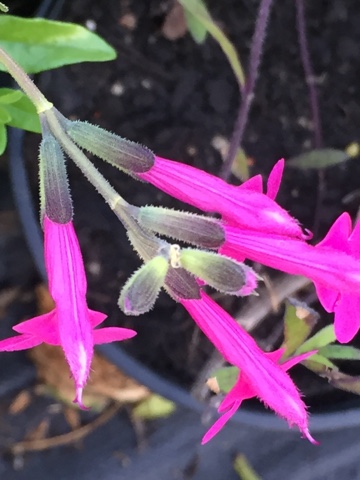
Bethelli is doing its thing most succesfully at the moment and is producing loads of bright cerise pink flowers on the ends of long arching branches. It must be all the rain we had a month or so ago that set off on this growth spurt. Once flowering has finished it can be trimmed back and even given a harder prune next spring so the whole process can start again. It's a ten out of ten shrub for quick growth, hardiness and brilliance of flower.
 

Sunday, April 23, 2017

Salvia microphylla 'Pink Blush'


                Salvia microphylla 'Pink Blush'
There is nothing blushing about the flower colour of this Salvia. It is a strong dark cyclamen  pink which really stands out in the garden. Like others in the 'microphylla' group, such as the ever popular 'Hot Lips', this is a tough long blooming plant which forms a small rounded shrub to about a metre. If it gets too untidy it can be sheared off almost to ground level and it will return with renewed vigour in no time.

Tuesday, April 18, 2017

Salvia muelleri


               Salvia muelleri 'Royal Purple Sage' 
There is much debate among Salvia enthusiasts as to whether this species is the real deal or an imposter. There is certainly nothing very 'Royal Purple' about the flower colour. 
Native to Mexico and thus one of the dry hardy small twiggy plants, it is certainly one of the bright sparks in an autumn garden. It is a useful filler in front of taller shrubs or half hidden with just the bright magenta purple flowers poking out from surrounding foliage.


Wednesday, March 22, 2017

Salvia azurea 'Grandiflora'


           Salvia azurea 'Grandiflora'
This is in flower now and has graceful tall stems up to a metre in height, clasped with tiny linear leaves and topped with pale lavender blue flowers.
It is a true herbaceous perennial from the American prairies and not your typical shrubby Salvia from say Mexico or South Africa.The prairie type plants often have a deep root system which go off in search of water during dry spells and give it the ability to survive the ground freezing over winter. It also makes for a sturdy plant with stems that stay upright during windy conditions.
This Salvia usually never makes it into the commercial nursery scene but remains readily available from mail order specialists.
From my experience of growing a batch in pots its appearance during spring was typical of many herbaceous plants, awakening after winter by presenting tiny neat shoots followed by a few straggly stems. By the time the weather had warmed up the root system had outgrown the pots and the advancing upright stems were crying out for water and wilting rapidly when not getting enough. Fortunately it did sell well before many had got to that stage to some gardeners or landscapers in the know about this easy care hardy perennial.
 

Tuesday, March 21, 2017

Salvia guaranitica 'Black and Blue'


             Salvia guaranitica 'Black and Blue'
This is said to be a smaller growing cultivar of the species which I have written about before as being a bit of a garden thug spreading far and wide with a thick tuberous root system.
I am keeping it in a large pot where it can be more easily managed. That said it would make a great addition to a garden position in the light shade of trees where shrubs may be difficult to establish as it is not fussed as to soil and water requirements. 


Salvia 'Amistad', The Friendship Sage


                                  Salvia 'Amistad'
This is a very dark purple Salvia which I planted last year in front of a giant orange sun loving Bromeliad Aechmea blanchetiana. I am hoping for a good colour contrast when 'Amistad reaches the 2 metres it is said to. So far it is a well behaved small shrub with bright green foliage and masses of flowers. No damage to the branches from nectar feeding birds either.
The story goes that this plant was found in a market in Argentina and released to the garden scene in Australia in 2013. Plant Breeders Rights apply to this plant.

Salvia 'Black Knight'


     Salvia 'Black Knight' above Salvia leucantha
This Salvia is thought to be a hybrid of S. guaranitica x S. gesneriiflora and has been on the garden scene for a number of years.
It forms a scruffy shrub to just under two metres high with flowers so dark you have to be up close to really notice them. From a distance they appear as a dark smudge above pale green foliage. That said it is a hardy shrub which requires no special attention to do well. Perhaps with some judicious pruning in spring a well shaped shrub could be achieved.
The birds love it !

Thursday, March 9, 2017

Salvia greggii 'Crimson and Black'


               Salvia greggii 'Crimson and Black'
The greggii salvias grow from a central stem with branches topped with flowers emerging from quite low down. Herein lies a problem, as some of the bigger nectar feeding birds such as Wattle birds are liable to snap off the somewhat brittle stems during their quest for food. 
Several weeks ago I sheared off all the flowers from this batch to stop the bird damage but to no avail as the flowers reappeared in no time.
This crimson and black flowered variety is quite a striking colour combination and really stands out in a garden. The shrub grows to about 60cm and is hardy over a range of conditions and climates.


Sunday, February 1, 2015

Cadel's Day

Fernery at Geelong Botanic Gardens 1890's

Place to be today for the final event in the career of champion cyclist Cadel Evans, that is the Cadel Evans Great Ocean Road Race. Congrats to him on a stellar career.

Geelong Botanic Gardens is worth visiting for those with a passion for Salvias and Pelargoniums as the national collections of those plants are held there.

Saturday, October 11, 2014

Salvia canariensis

 Salvia canariensis (Lamiaceae)
'The violet-mauve flowers emerge from large reddish calyces, underpinned by long coloured bracts which remain on the plant for a long time after flowering'; a description of this 1.5 metre shrub according to Oliver Filippi in his book The Dry Gardening Handbook.
I am having a crack at growing this Canary Island beauty but I suspect it may be short lived if we experience a rainy humid summer.The leaves have quite an acrid smell when crushed and remind me of turpentine mixed with fish oil. Flowers are large and prominent and this shrub would look good as a background plant to a Mediterranean herb border or mixed with succulents and grasses.
2017 update: I no longer have this plant.


Tuesday, December 10, 2013

I (can't) grow sage

Garden Sage, Salvia officinalis affected by root rot
Out of my current batch of a hundred or so sage seedlings I am hoping to get at least a few which go on to reach maturity and become large healthy bushes. I think the trick is to avoid overhead watering if possible as moisture around the base of the plant and on the leaves creates ideal conditions for the spread of the fungus which causes the rot. (Fusarium solani and Rhizoctonia solani) Living in a cool dry climate with zero humidity also helps, as well as providing an alkaline, gritty, free draining soil.
The old Arabian proverb "How can a man die who has sage in his garden?" and the fact that sage is traditionally the herb which has a centuries old track record for helping shield against declining faculties and failing memory has stirred me into the task of growing it
successfully.   Sharp as a tack at eighty you bet....
 I am also growing the red leaf sage (S. officinalis 'Purpurascens') pictured below. It is a bit of a gloomy looking plant, though in a good light the leaves have that purple bloom of a summer sugar plum.
The name Salvia is from the Latin salveo or "I am well" and the colloquial corruption of the name became sange in old French and sauge in old English. Midwives in France were known to use sage leaves macerated in a liquore to be given "aux femmes qui vont prochainement accoucher." Expectant fathers probably needed a swig as well.

Sunday, November 24, 2013

Salvia uliginosa Bog sage

Salvia uliginosa Bog Sage
During the Scotland V Wallabies Rugby game this morning, which was played at Murrayfield Stadium in Edinburgh, the commentators gave some tongue in cheek gardening advice on the state of the boggy turf, citing that it was perhaps caused by nematodes which could be fixed with garlic spray. No, I thought, it's the bleeding Scottish rainy weather and a really good place to grow this Salvia
I am in two minds about recommending this plant. The sky/cyan blue flowers are adorable as they sit on thin wispy stems to 1.5 metres and wave about in the breeze all through summer but underground there is a lot of sinister action from a vast network of spreading roots which literally stink when dug up. The plant pictured here is actually in a pot and the roots have gone down into the surrounding soil which means it can be contained in a more manageable way. During my younger garden maintenance days I was once faced with removing this Salvia from the edges of a creek bank which ran through a property and even with digging out and spraying it proved difficult to remove; so plant it with caution. It will grow quite happily in a dry location as well and can also be stopped in its tracks if planted in combination with other robust plants such as a contrasting tall orange Canna or a foreground of Shasta daisies which provide a barrier to its spread.

Wednesday, June 5, 2013

Maroon


Leaf: Ipomoea barbatus, Flower: Salvia involucrata x 'Timboon'

The name Maroon was originally derived from the Italian marrone and French marron, meaning Chestnut, but the name Maroon today refers to the colour here shown.
It was adopted by the State of Queensland, Australia as their official colour in November 2003 and is an especially popular colour to wear during sporting events involving rival teams representing other States.
In the garden the colour is well represented by the tall 3 metre shrub Salvia Timboon. It is in full flower at the moment and is providing a magnificent display of flowers at the ends of its long arching branches. There is some confusion as to the origin of Salvia Timboon and it is currently thought to be a hybrid between S. involucrata and S. karvinski.

Saturday, March 9, 2013

Salvia splendens 'Dark Purple'

Salvia splendens Dark Purple 

Some flowers can be just too dark, am thinking of the all black Pansy for example, which can make them difficult to place in a garden. They need a bright companion, as shown here where they are planted with Tithonia 'Fiesta del Sol', to lift the mood from the sombre tone which they evoke.
Silver foliage plants make for a sophisticated match also, so this Salvia could look good surrounded by the old silver dust bush, a Senecio or Cineraria species. Salvia splendens have few pest or disease problems though snails are partial to young seedlings. They tolerate heat and dry well but need regular removal of spent flowers to keep blooming for months.

Salvia splendens 'Salmon'

Salvia splendens 'Salmon'
This is one from last summer which was a left over from plant sales and was lurking in the throw out pile. It redeemed itself by putting on a show of flowers to get my attention. 
The salmon orange calyxes clasp pale pink flowers which are made to appear more delicate from the more vibrant companion above.
Hardy? Yes This went through frost in the plant market and regrew from the base in spring.

Salvia splendens 'Salsa Plum'


Salvia splendens 'Salsa Plum'
Flowering for months, as I have been cutting back each batch of flowers when they finish and more are produced within no time. The flower colour varies from plum to maroon or cranberry, depending on the weather and light conditions. The individual flared trumpet shaped flowers below the papery calyx have an orange throat a bit like like a mango salsa combo. So an aptly named short lived perennial or annual summer bloomer. Seed is best sown in spring, though germination can be erratic and it is best to wait until days are consistently warm for success.

Wednesday, October 3, 2012

Salvia discolor, Andean sage

 The 30 cm long Salvia discolor inflorescence showing near black flowers held in a pistachio green calyx. 
This Peruvian native plant, which forms a loose, sprawling and untidy shrub to about 1 metre, has held on to a carnivorous gene as the flower stems exude a sticky substance which traps unwary insects. Today when I was potting on some of my plants there were plenty of black thrips caught along the way. Is this an additional adaptation to a harsh environment, as its leaves already have protection from white felt on their lower surface, as well as having an unpleasant smell when crushed. The stems are brittle and easily broken so perhaps this sage could be described as lazy, relying on other plants to weave and scramble upon in the search for best position.
This Salvia is becoming better known, the benchmark for this being the availability of a pictorial nursery label, though it remains in the collectors' plant category. I was having a conversation about untidy plants the other week with a nursery person at 'Tulip Time' in Bowral who was saying how many such plants are ignored because they are not neat enough for the commercial market. In a garden situation Salvia discolor can be grown in a sunny or semi shaded position, as a ground cover or spilling over the edge of a wall or raised garden bed. Placing it near clipped box or topiary, especially ones which have dark green or shiny leaves, will compliment it nicely. It will tolerate moderate frost and needs well drained average soil.

Thursday, May 10, 2012

Strange plant associations

 
Salvia 'Phyllis Fancy' with a Silver torch cactus Cleistocactus species
 When you live in a climate which is relatively benign it is possible to grow a really broad range of plants though this often makes for some strange plant combinations. These are a couple of examples I saw recently. Salvia 'Phyllis Fancy' is a hybrid shrub Salvia which is continually in flower until you give it a rest by pruning back hard in late winter. It is named for Phyllis Norris and it originated in the arboretum at the University of California Santa Cruz. It is a fairly tough plant and copes well with dry conditions so is perfectly at home clasping a clump of the silver torch cactus which originates in Bolivia.
 
Silver Birch, Betula pendula, with Spanish Moss, Tillandsia usneoides
This is a case of Scandinavia meeting the Florida everglades. Silver birch growing in warm climates invariable suffer from premature leaf drop. The leaves turn crispy very early in summer and are shed thus leaving a dead looking tree for months on end. I have driven past a very attractive grouping of birches for years; they were placed just so right and were quite mature in size. Then recently I saw them chopped up and laying in a heap on the nature strip. Perhaps the message has got out that they are a better cool climate tree. As for the Spanish moss it has had a great season and has tripled in size over recent months and is happy to grow on any tree limb it takes a fancy to.

Thursday, May 3, 2012

Salvia guaranitica

Salvia guaranitica


 Salvia guaranitica gone wild in dry shade under trees
 Salvia guaranitica is one of the hardiest Salvias even if you live in a climate where the winters go down to below -12C. It is a rampant grower with a suckering habit. You could plant it in a difficult site, such as the one pictured here and be delighted by the continual display of rich blue flowers over summer and autumn. My suggestion is to try some of the cultivars which may be more well behaved than the straight species. These include 'Argentina Skies', 'Black and Blue', 'Costa Rica Blue' and 'Violet Eyes'
2017 update: I currently have stock of 'Black and Blue'

Monday, April 2, 2012

Salvia mexicana 'Lime Calyx' and Salvia 'Meigan's Magic'

Salvia mexicana 'Lime Calyx' with purple Salvia 'Meigan's Magic'

In the garden with the vibrant Salvia mexicana 'Lime Calyx' side by side Salvia 'Meigan's Magic'.