Showing posts with label Hibiscus. Show all posts

Sunday, March 25, 2018

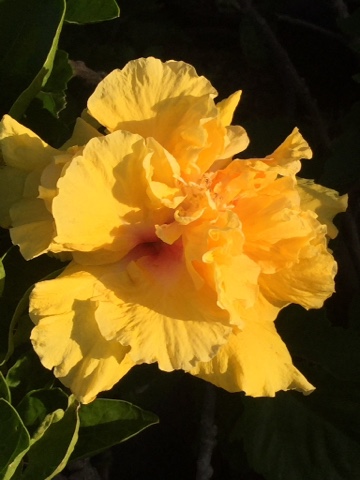
Hibiscus rosa-sinensis 'George Harwood'


Hibiscus rosa-sinensis 'George Harwood'
photo by Arthur Gulliver (Your Garden magazine)
This full page colour photo of 'George Harwood' appeared in the second edition of the book Garden Trees and Shrubs in Australia  by Harold Sargeant (Macmillan of Australia 1968) 
The first edition of this book was published in 1951 with the title including Asia as in Australasia. ( Colorgravure Publications )
 Described as 'a new pink variety' for Melbourne gardens, it had made its way south from Sydney where it made its first appearance way back in 1902 having been bred by the George Harwood who at the time was a propagator, overseer and superintendent at the Royal Botanic Gardens. His tenure there was from 1883 to 1914. 
Of note is the watercolour painting of it now in the Mitchell Library (State Library of NSW) by Essex born Margaret Flockton who would go on to be described as 'the most accomplished botanical artist in NSW'. Her legacy is ongoing and today she inspires a new generation to pursue botanical illustration.

So where can this Hibiscus be found today?
While not available commercially it is probably still around in an old garden as Hibiscus are great survivors always flowering despite years of drought and neglect.
Recently I thought I might have found it in a 1960's/1970's planted garden growing just a metre away from a huge peppermint gumtree which was probably planted at the same time.

Hibiscus rosa-sinensis 'George Harwood' ??
I will leave the question marks in place until someone can confirm my naming.


Margaret Lilian Flockton (1861-1953)
Botanical Artist

Wednesday, May 17, 2017

Two Autumn Hibiscus


Hibiscus rosa-sinensis 'Shelley'
Hibiscus rosa-sinensis 'Spring Song'
A couple of iPhone pics in passing and a nice reminder that Hibiscus blooms can be found at almost any time of year. The flower colours are often more distinct now compared to mid summer when they can fade in the strong sun. 

Sunday, April 2, 2017

Hibiscus heterophyllus Variegatus


      Hibiscus heterophyllus 'Variegatus'
The bonus of having a shrub with variegated foliage is that you get year round interest when the flowering time has finished. Variegation is sometimes not a very stable trait however and the appearance of green branches can sometimes indicate that the plant is fighting to caste off its gaudy party frock and return to being a 'plain Jane'. Such is the case here though the variegation is remaining on the uppermost stems and leaves which are vividly marked with white and cream; with this style of variegation being easier on the eye than yellow or gold which can look quite harsh in our Australian sun.
The flowers are produced from a very early stage as the top photo attests and are the typical Hibiscus big one day pale pink to white ones. 
This is a good quick growing screen shrub with a long summer blooming time. The only downside to the native Hibiscus is that the stems may be prickly and the slightly hairy stems and leaves may be a bit irritating to the skin. Given a position in sun or semi shade it may reach a height of three to five metres.
I currently have stock of this in 140 mm pots.

Hibiscus rosa-sinensis 'Emerald Isle'


         Hibiscus rosa-sinensis 'Emerald Isle'
A difficult one to describe the colour of ,Emerald Isle changes during the day from tan to biscuit while offset with a rich ruby centre. When first in flower I imagined that there had to be a greenish tinge to reflect the name but perhaps the grower Peter Van Duyn had his tongue in cheek and the 'Isle' was experiencing drought. This flower glows and really stands out from some distance away. It was bred from 'Tammy Faye' x 'Silver Rose' and registered in 2004. 

Wednesday, March 22, 2017

Hibiscus rosa-sinensis 'Frank Aland'


          Hibiscus rosa-sinensis 'Frank Aland'
First time in flower for me and it is certainly a very bright vermillion. The flower size is average and the recurving petals give it a slightly ruffled appearance.
It has been around for awhile,1982 when registered, having been bred by Jim Howie from John Massie x Nathan Charles.
At this stage I have no other information on it growth habits. 

Hibiscus rosa-sinensis 'Mystic Hue'


          Hibiscus rosa-sinensis 'Mystic Hue' 
I have been growing this Hibiscus for a couple of years now and am very impressed with both the flower colour and the compact growth habit. How to describe the colour?..probably lavender blue with pink margins though this will vary depending on time of day or month.
For example the first photo appears more pink and was taken early one morning.
It is a small flowered Australian variety bred by Allan McMullen from 'Elena Mia' x 'Blue Toy'.
I hope to be able to propagate from this one when it gets a little larger. 


Sunday, March 12, 2017

Hibiscus trionum, Bladder Ketmia


         Hibiscus trionum,  Bladder Ketmia
It is always interesting when a new weed makes an appearance in the garden as you wonder not only as to how it got there but also its origins in the plant world.
Apparently this is a fairly widespread summer annual weed occurring along much of the mainland Australian coastline as well as inland. It is of Middle Eastern origin but is widespread in cultivated land throughout America and parts of Europe (eastern Spain). 
I think this came from a bird dropped seed or from potting soil of a newly planted adjacent Lilly-Pilly. Either way it has a fairly innocuous presence as it is only about 17cm high and quite fragile in appearance. The pastel coloured flowers are quite pretty and give rise to the common name of 'flower-of-an-hour', while the seed pods are bladder or balloon shaped.
 

Tuesday, March 7, 2017

Hibiscus rosa-sinensis 'Bowen Special'


       Hibiscus rosa-sinensis 'Bowen Special'
A new one for me this year and flowering for the first time and it certainly is a beautiful shade of pale pink. As it is an unregistered cultivar I have no information as to its origin.

Monday, March 6, 2017

Hibiscus rosa-sinensis 'Cheer Leader'


            Hibiscus rosa-sinensis 'Cheer Leader'
This is a new variety for me and a first time flower. It is not a registered cultivar so I have no information as to its background.
 

Hibiscus rosa-sinensis 'Cooperi' var. 'Rose Flake'


     Hibiscus rosa-sinensis 'Cooperi' 'Rose Flake'
Flushed with nearly all pink leaves and the odd small red flower, this Hibiscus is at its best right now. However as this is a heat loving variety, a true tropical, it loses form as soon as the weather cools down. Last winter it became almost leafless and took awhile to regain vigour in the warmer months. As such I have yet to get enough suitable growth from which to take cuttings and propagate new plants of it. I might have to bring it indoors over winter this year.
 

Sunday, March 5, 2017

Hibiscus rosa-sinensis 'Edith Parsons'


              Hibiscus rosa-sinensis 'Edith Parsons'
This is a fairly old variety which originated from India and is noteworthy for the luminous semi-double chrome yellow flowers which revel a red centre on closer inspection.


Saturday, March 4, 2017

Hibiscus rosa-sinensis 'New Idea'


Hibiscus rosa-sinensis 'New Idea'
This is a 1990's Australian Hibiscus of Greg and Julie Lindsay (Hibiscus Paradise Nursery) from 'Pro Legato' x 'Harvest Moon'.
The carmine red flowers are occasionally splashed with white and they last for 2 to 3 days.
It needs to be grafted for best growth.
I currently don't have any stock of it available  

Monday, June 22, 2015

a few winter Hibiscus

 June is still a good month to have Hibiscus coming into flower particularly if the days are sunny and there is no wind chill factor. The surprising thing is the blooms often take on richer and darker colours and they may last for several days instead of the normal one or two. Here is a small selection of flowers from the past week or so.


Saturday, June 6, 2015

Hibiscus paramutabilis

 Hibiscus paramutabilis (Malvaceae)
Yep, it's as bright as the photo depicts, visible from a hundred metres away like a beacon. Fuchsia pink or cerise pink, hot pink take your pick.This Hibiscus is now starting to become more widely known perhaps because it is suitable for a wide range of climates owing to its frost tolerance. Deciduous in cold climates and perhaps not in mild coastal ones. This photo was taken a couple of weeks ago and note the grub having a chew on both the bud and open flower.
Taking the prefix para to mean allied to, this is a close relative of the other China native Hibiscus mutabilis, that old fashioned garden shrub with the big double flowers which change colour from white to pink. I think it gets called cotton rose. This one does not change colour but may do in cold climates for according to Barbara Perry Lawton in her book Hibiscus (Timber Press) the flower petals open white and darken to rose-pink during the day. It is supposed to grow to about 4 metres but I think 2 might be a more reasonable estimate. Still only available from specialist nurseries, it will no doubt become a popular garden shrub in years to come as it is continually in flower during the warmer months. 
2017 update: I can't get enough suitable wood to take cuttings. Nice flowers but not flourishing.

Sunday, May 17, 2015

Hibiscus rosa-sinensis 'Outstanding'

 Hibiscus rosa-sinensis 'Outstanding'
All my Hibiscus have been through hell during the past few weeks, not appreciating the cold windy weather and thus suffering from leaf scorch and bud drop. And then along comes a few fine sunny days and they buck up and start to send out more flowers. Flowers are getting smaller with the approach of winter and the colours of some are entirely different from the pictures of type, though at least the flowers last for a few days as opposed to just one or two like in the middle of summer. 
There is not much information available about 'Outstanding' as the International cultivar register lists it as being of unknown origin which means it could be an Aussie.The colour also appears more orange than golden but I am not complaining. The bud opens with a delightful crimped edge to the petal and then turns wavy and folds back as the flower opens fully. Ten out of ten.


Thursday, April 23, 2015

Hibiscus rosa-sinensis 'Boondah'

 Hibiscus rosa-sinensis 'Boondah'
The name 'Boondah' is an Aboriginal word which refers to the native tree Angophora floribunda found in local bushland of the Sydney suburb of Warriewood where Hibiscus breeder Les Beers produced this classic pink Hibiscus many years ago. It is a hardy prolific variety growing to average height. A sport of it called 'White Wave' was introduced by David and Vicki Ponman and registered in 2002. It retains a slight blush pink in the centre of the bloom.
 Hibiscus rosa-sinensis 'White Wave'
  
The word 'Boondah' was used by Indigenous Health Services in their successful quit smoking campaign 'Butt out Boondah' and a terrific ad showing two young footy players talking about why they don't smoke was shown on TV earlier this year.

Brisbane residents may be familiar with the historic house 'Boondah' in the suburb of Rosalie. It was built in 1907 and designed by architect Richard Gailey who is remembered for the elegant Regatta Hotel in Toowong.
In 1915 Boondah hosted a fete raising money for the 'Wounded Soldiers' Fund' led by Lady Elsie Goold-Adams the wife of Queensland Governor Sir Hamilton Goold-Adams

Lady Elsie Goold-Adams

Sunday, April 19, 2015

Hibiscus in cooler weather

As the weather cools down Hibiscus flowers often change colour slightly and this 'Surfrider' is showing two tone orange/pink most noticable on the top petals which were probably exposed to more sun.

Sunday, February 1, 2015

#FKA Hibiscus species

 Jacob Peter Storck (1836-1893)
Botanist and Nurseryman
Berthold Carl Seemann (1825-1871)
Botanist and Plant Hunter 
'Formerly known as' or 'name unresolved' applies to two interesting Hibiscus species which have an Australian connection and they are Hibiscus storckii and Hibiscus denisonii.
In 1859, German born Jacob Storck was working at the Botanic Gardens in Sydney where he met fellow German Berthold Seemann. The following year, on April 20th they set sail for Fiji on a plant hunting expedition where they discovered a pink flowered Hibiscus growing in the wild. Seemann named it Hibiscus storckii for his companion. Following this initial discovery it was never sighted again but later a Hibiscus which matched the description was found in Sydney and was named Hibiscus denisonii after Sir William Thomas Denison (1804-1871) who was a Governor of New South Wales from 1855-1861. Are they one of the same and where can I get my hands on one.? In the meantime they have been lumped together as just forms of Hibiscus rosa-sinensis.
The video below is an interesting retelling of some adventurous 19th Century garden and plant history.

Sunday, December 21, 2014

Hibiscus boryanus

 Hibiscus boryanus (Malvaceae)
Native to the Mascarene Islands of Mauritius, La Reunion and Rodrigues this tall shrub is an endangered and protected plant as it succumbs to habitat loss from the invasion of weed species such as Hiptage benghalensis, a plant on the 100 'Global Invasive Species' list.
I bought this Hibiscus earlier in the year from the Growing Friends Nursery at the Royal Botanic Gardens in Sydney and it has just started to flower. Flowers can be red or orange and this one looks like a combination of the two. The common names for it are fairly awful and make no sense to me as to their meaning : Le foulsapate marron or 'brown foulsapate'
and 'bastard mahot'. While the common name for Hibiscus on the islands is 'mandrinette', this is normally associated with other species such as H. liliflorus and H. fragilis.
Much of the plant conservation work associated with this and other plants is carried out by the organisation 'Conservatoire Botanique National de Mascarin'


Sunday, October 5, 2014

Hibiscus Cuttings


For the past few weeks I have been working my way through my stock of Hibiscus rosa-sinensis.......... pruning them and using the cut stems of pencil thickness as propagation material.
 These hardwood cuttings are about 12.5 to 15cm or 5 to 6 inches in length and are cut at a 45 degree angle. I use a specific hardwood rooting hormone powder to dip the cuttings in before placing them together in a 14cm pot.
 The propagation mix I use has a large portion of perlite and added coarse river sand.
 Containers, secateurs and knives are all sterilized before proceeding with any of the steps and when taking cuttings from different varieties.
 The sharper the better
 Completed cuttings are kept in a sheltered shady location or in a propagation unit under mist, if you have one, though success can be achieved without.
 Cuttings with well developed root system ready for potting on.
 Trim back any roots which have a kink or twist to them.
Planted out into a 10cm maxi pot (4 inch pot) allows for good root and shoot development