Showing posts with label exotic trees. Show all posts

Sunday, January 11, 2015

The village 'Crepe Myrtles'

 The Crepe Myrtle trees (Lagerstroemia indica) at the local shopping village have been flowering their heads off for weeks and I particularly like this red/dark pink one. The branches are being weighed down by the amount of flowers. A terrific small tree for gardens and parks.


Sunday, December 21, 2014

Hibiscus boryanus

 Hibiscus boryanus (Malvaceae)
Native to the Mascarene Islands of Mauritius, La Reunion and Rodrigues this tall shrub is an endangered and protected plant as it succumbs to habitat loss from the invasion of weed species such as Hiptage benghalensis, a plant on the 100 'Global Invasive Species' list.
I bought this Hibiscus earlier in the year from the Growing Friends Nursery at the Royal Botanic Gardens in Sydney and it has just started to flower. Flowers can be red or orange and this one looks like a combination of the two. The common names for it are fairly awful and make no sense to me as to their meaning : Le foulsapate marron or 'brown foulsapate'
and 'bastard mahot'. While the common name for Hibiscus on the islands is 'mandrinette', this is normally associated with other species such as H. liliflorus and H. fragilis.
Much of the plant conservation work associated with this and other plants is carried out by the organisation 'Conservatoire Botanique National de Mascarin'


Thursday, November 20, 2014

the library jacarandas


The local library building is painted a vibrant shade of burnt orange and has contrasting Jacarandas planted as street trees outside as well as in the adjacent park. They are at their peak right now.
2017 update: Trees have been removed by Council and not sure why?

Sunday, October 27, 2013

Neem tree, Azadirachta indica

I have been using Neem oil as an insecticide on and off for years.
It sticks to the leaves and continues to work for some time after spraying. It is especially good to repel white fly which congregate on the underside of cabbage or broccoli leaves.
 Recently I came across this book, Neem: A tree for solving global problems which was published in the early 1990's by The National Academy Press in Washington D.C. It is a comprehensive guide to the use of Neem worldwide up to the date of publication. 
 Now it seems that the current opinion is that the Neem tree has serious weed potential in most regions of the dry tropics where it has been planted, including Australia. Birds find its fruit desirable and thus spread the seed far and wide.
 Pest plant risk assessment:Neem tree—Azadirachta indica - IPA-Neem-Tree-Risk-Assessment.pdf

Thursday, October 24, 2013

A pink Brugmansia

 Pink Brugmansia and Grass tree, Xanthorrhoea sp.
Brugmansias or Angel's Trumpets are greedy for water and fertilizer and if they are given both they are almost continually in flower. This one is at the lowest point of the garden so gets the run-off from all the water directed at plants on higher ground. It rests for two weeks in between flowering. The flowers start off yellow and change to bright pink after a couple of days.

Thursday, September 5, 2013

Looking up at Trees

 The paintings of Australian artist William Robinson invite us to look at trees in a fresh way. They are not painted face on or in profile as we are used to seeing in traditional landscape paintings but from the inside looking up into the canopy and sometimes from above with a birds eye perspective looking down to earth. Their forms are lush and sinuous, writhing and jostling for space to grow.
These days many gardens have become too small to include large spreading trees so it is a delight to visit a botanic garden or park where you can gaze up into the branches and get an understanding of what Robinson is trying to convey in his work. 
 

Saturday, June 1, 2013

Acer buergerianum, Trident Maple


 Acer buergerianum Trident Maple
For the last few weeks many of the big exotic trees in my neighbourhood have been putting on a spectacular display of coloured leaves, of red overlaid with orange and yellow or russet tones of ruby red and gold. If you don't have the space to plant one of these colourful trees you can still get to enjoy them by planting a bonsai or penjing version. Many of the maples such as this Acer do well in both small pots and large containers and are fairly hardy as long as they receive adequate water over summer. If the pots dry out the leaves may fall prematurely and you will miss out on the autumn colour.
Acer buergerianum is native to eastern China and is known as the three-toothed maple or Sanjiao Feng.


Wednesday, August 29, 2012

Chinese Elm, Ulmus parvifolia 'Lang Yu'

The Chinese Elm, native as well to Korea and Japan, is one of the perfect smallish (10metre) trees which can be safely planted in medium to large gardens without fear of it blowing down in one of the regular gales which now feature as part of our more extreme climate.  It is relatively low and spreading with graceful, flexible and pendulous branches and small leaves which means it is better able to cope with strong wind gusts. It is usually regarded and grouped with deciduous trees but in warm climates this may only partly be the case. Some blanches facing away from cold winds may retain most of their leaves throughout winter. 
My attention has been drawn to this tree because I have a bonsai version of it which has a new flush of tiny scalloped leaves emerging like tiny fans along the branches and delightfully shaded a silvery pea green. 
For landscape use this elm is ideal when planted in a raised garden bed or above a wall so the attractive orange and brown patchwork bark can be seen to best advantage. A local housing development has used them as an avenue planting on top of a retaining wall which allows visitors to walk under the arching canopy.  There is always a worst case scenario when it comes to tree placement and from my observation the Sydney suburb of Rockdale takes the cake for the street planting on a main road. There is clearly not enough room for the branches to spread on a narrow footpath or across parked cars, and, to make it doubly ugly the trees have been given a flat top haircut just in case a branch dared to reach a power line.
This tree is a good choice for situations where a wonderful shade tree is required which is both hardy and of low maintenance. There is no massive leaf drop requiring the overuse of a blower and the seeds which occur in autumn make minimal mess.

Monday, June 18, 2012

Mexican Weeping Pine, Pinus patula

Pinus patula, Mexican Weeping Pine
Growing to about 15 or 20 metres in height, this pine tree is only really suitable for large gardens and parks . It is a not an uncommon tree in the coastal cities and towns of Australia from Brisbane to Melbourne and is always quite eye-catching because of the shiny curtain or shawl of needle foliage which sways in the slightest breeze. It is naturally occurring in central and eastern Mexico and found growing on mountain slopes at elevations from 1500 to 3000 metres. This region receives abundant summer rainfall and experiences high humidity over summer which will account for it thriving in Brisbane and Sydney.
Apart from the decorative leaves, the tree produces attractive conical cones which are about 10cm long by 5cm across. These persist on the tree for many years but can be cut off easily if required for indoor decoration.

Thursday, May 10, 2012

Strange plant associations

 
Salvia 'Phyllis Fancy' with a Silver torch cactus Cleistocactus species
 When you live in a climate which is relatively benign it is possible to grow a really broad range of plants though this often makes for some strange plant combinations. These are a couple of examples I saw recently. Salvia 'Phyllis Fancy' is a hybrid shrub Salvia which is continually in flower until you give it a rest by pruning back hard in late winter. It is named for Phyllis Norris and it originated in the arboretum at the University of California Santa Cruz. It is a fairly tough plant and copes well with dry conditions so is perfectly at home clasping a clump of the silver torch cactus which originates in Bolivia.
 
Silver Birch, Betula pendula, with Spanish Moss, Tillandsia usneoides
This is a case of Scandinavia meeting the Florida everglades. Silver birch growing in warm climates invariable suffer from premature leaf drop. The leaves turn crispy very early in summer and are shed thus leaving a dead looking tree for months on end. I have driven past a very attractive grouping of birches for years; they were placed just so right and were quite mature in size. Then recently I saw them chopped up and laying in a heap on the nature strip. Perhaps the message has got out that they are a better cool climate tree. As for the Spanish moss it has had a great season and has tripled in size over recent months and is happy to grow on any tree limb it takes a fancy to.

Friday, April 20, 2012

Arbutus unedo, Irish Strawberry Tree


Arbutus unedo, The Strawberry Tree
It is flowering now in Autumn sunshine
Arbutus is from southern Europe, Ireland and the Canary Islands but it is especially popular in the Algarave province of Portugal where they turn the fruit into a mean hard spirit with a kick called Medronho. In Spain, the city of Madrid was once surrounded by Arbutus trees and the city's coat of arms shows a bear and an Arbutus tree.
Here it grows across a range of climates but does better in cool districts. I am not aware of the fruit being popular here for use in the making of liqueurs but it is an exceptionally decorative large shrub to small tree with dense green foliage absolutely smothered in white waxy flowers at this time of year. I no longer attempt to grow it here on the coast as it was fairly susceptible to spider mite which turned the leaves a silvery colour.


Friday, December 16, 2011

Citharexylum spinosum, Jamaican Fiddlewood tree

Fiddlewood, Citharexylum spinosum

I used to plant this quick growing tree for screening purposes and then regretted having done so as the space turned out to be too small for it...... a common problem in city gardens. It easily reaches 12 metres after a couple of years especially if it receives plenty of water and the soil is reasonably fertile. The summer born flowers are sweet though not particularly spectacular but the foliage is something worth talking about as it goes through a stage when the entire tree turns a vibrant orange, usually during November. If you want a real colour show in your garden plant one next to a Jacaranda, an Illawarra Flame tree and grow a Bougainvillea 'Magnifica Trailii' through them or close by. I have seen this orange, mauve, red and magenta combo in an old Sydney garden and it is quite a sight.
2017 update: I am currently out of stock but will have more at some stage in the future.

Sunday, October 16, 2011

Brownea macrophylla


Brownea macrophylla in flower now
(All photos courtesy B. Maslen)


It is always amazing to see flowers which emerge from a tree trunk. It seems to be a characteristic of tropical trees, perhaps as a way of ensuring pollination from ground dwelling animals or low flying insects which are unable to navigate to the tall rainforest canopy. Brownea species are from Venezuela and Colombia and have been introduced to other wet tropical regions of the world adding exceptional ornamental value to parks and gardens.
2017 update: I do not grow this tree.


Emerging new foliage hanging like a handkerchief
Brownea macrophylla growing amongst palm trees in Far North Queensland

Thursday, July 28, 2011

Bark like satin


Largerstroemia indica 
Crepe Myrtle
One of trees which really shines in the winter sunlight is the Crepe Myrtle. The satin smooth bark reflects light onto the surrounding garden and contrasts well with the sombre green clipped star jasmine planted underneath.

Sunday, January 30, 2011

Cool & green: the heatwave solution


Browsing the weather forecast for the rest of the week, it looks like the mercury is going to go sky high and we are in for a real heatwave. I love to find a cool spot amongst lush shady plantings of palms, ferns and foliage plants such as bromeliads. The so called self cleaning palms always leave an interesting pattern of stripes on their trunks as the old fronds are shed. Planting strap leaf or vertical plants nearby makes for a wonderful contrast of form and pattern.

Monday, January 10, 2011

Variegated Cottontree, Hibiscus tilaceous Albo-Variegatus

Variegated Cottontree, Hibiscus tilaceus Albo-variegatus
under-planted with Iris japonica
It was a steamy tropical shirts off kinda day with more rain but fortunately not the deluge disastrous kind which is happening up north. This South Pacific beach tree sums up the weather when Mother Nature is in more of a party mood. It has stunning leaves which vary from white to hot pink. I have not grown this form but I would love to propagate it.The dark purple leafed species (atropurpurea) is more commonly seen here and its yellow flowers stand out well against the foliage. Like many Hibiscus, this one takes pruning into more formal or hedge shapes and is tolerant of salt laden winds and cooler growing conditions.
The plant taxonomists have been busy reclassifying some of the Hibiscus Family, Malvaceae. This one now goes by the name of Talipariti tiliaceum. The common name of Cotton tree is given because the fibre from the inner bark is used to make ropes or tapa cloth in Polynesia.
2017 update: elusive... but I have a couple of the purple leafed species in stock.

Tuesday, November 16, 2010

Pine Tree Pest, Pine Adelgid insect

White woolly secretion around the base of the needles of Pinus thunbergii indicates the presence of the pine adelgid insect (Pineus pini). This pest is related to aphids which suck the sap from plants. In my nursery both Pinus mugo and Pinus thunbergii have been affected possibly due to the plants being placed too close together and from an uneven watering regimen. I use an oil based spray to remedy it.

Saturday, September 18, 2010

Salix cinerea, Pussy Willow


Salix cinerea: Pussy Willow

It is rare to see a Pussy Willow tree at all these days since most Salix species have been put on the weed list. This one was growing in the grounds of the local German Club and appeared to have been cut to the ground some years back and was regrowing as a multi-trunked specimen. It did look wonderful silhouetted against the bright spring sky. Checking out the Wikipedia info about it, there is a northern hemisphere tradition of using pussy willow as part of Easter celebrations especially on Palm Sunday.

Tuesday, March 30, 2010

Postcards from Madras

The Conch Flower Creeper
 Clitoria ternatea

Madras is now known as Chennai and is the capital of the south Indian State of Tamil Nadu. A must see place to visit in the region is the Vedanthangal Water Bird Sanctuary about 75km to the south of Chennai. It comes alive with migratory birds from November to February.
These brightly coloured postcards are from the Madras Government Museum and feature common flowers of the city.

The Indian Laburnum
Cassia fistula

The Indian Madar
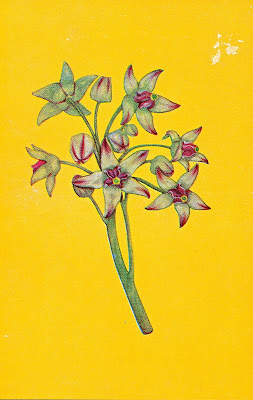
 Calotropis gigantea

Manoranjitham
 Artobotrys odoratissimus

Coral Jasmine
 Nyctanthes arbortristis

Thursday, January 14, 2010

3 Michelia

Michelia champaca,Yellow Orchid Tree


Michelia alba, White Orchid Tree

Michelia figo, Port Wine Magnolia

Michelia are in the Magnolia family and are native to the southern parts of China through to India but are widely grown in gardens throughout the warmer regions of the world. Though their flowers are often inconspicuous and small, they are intensely perfumed especially during the heat of the day. The fragrance is unique in that it resembles overripe Bananas and has an almost chemical note to it, something like acetone. In Hong Kong the flowers were once sold by street hawkers to use as hair adornments or for the making of garlands and Temple offerings.This perhaps accounts for them being grown in the local Nan Tien Temple garden . Both M champaca and M alba grow into large well shaped trees with pale green leaves and a pyramid/conical form. In the Temple garden they have been grown in a small grove and underplanted with Gardenias, a combination which gives a double hit of sweet perfume and makes you want to linger to enjoy the scent.
Michelia figo is an excellent garden or container plant as it forms a dense rounded shrub to about 5 metres making it ideal to use as a screen or hedge.The leaves are small and glossy and the small purple streaked yellow flowers, which are produced in great abundance, are often hidden behind the closely packed leaves. Cultivars with larger more conspicuous flowers have become available with names such as 'Coco' and 'Bubbles'. It is a reliable shrub to grow in areas where winter sun fails to reach such as between buildings but requires a reasonably rich moist soil for good growth. Insect pests such as scale and mealy bug will often attack water stressed plants and low nutrient soils will give the leaves a yellow appearance and often sparse growth. It will tolerate a light frost.
2017 update: I don't have any stock of these available.