Saturday, August 24, 2013

Geranium sessiliiflorum x traversii 'Sea-Spray'

Geranium x 'Seaspray'
 It's sea-spray of the the wild north of Scotland variety which is where this little Geranium hails from; the Orkney Islands to be precise, a place with a climate tempered by the Gulf Stream which means it stays consistently cool but not freezing. Ground hugging as a defense against wind and with pale pink flowers on short stems and pewter coloured scalloped leaves this is a delightful garden plant for a partly shaded garden spot or as a hardy pot plant which can cope with drying out.
I grew this many years ago and have decided to give it another go because the colour combination of the foliage and flowers is quite unique.

Monday, August 19, 2013

The Cat Grass Kit

 'Feline Groovy' Sammy
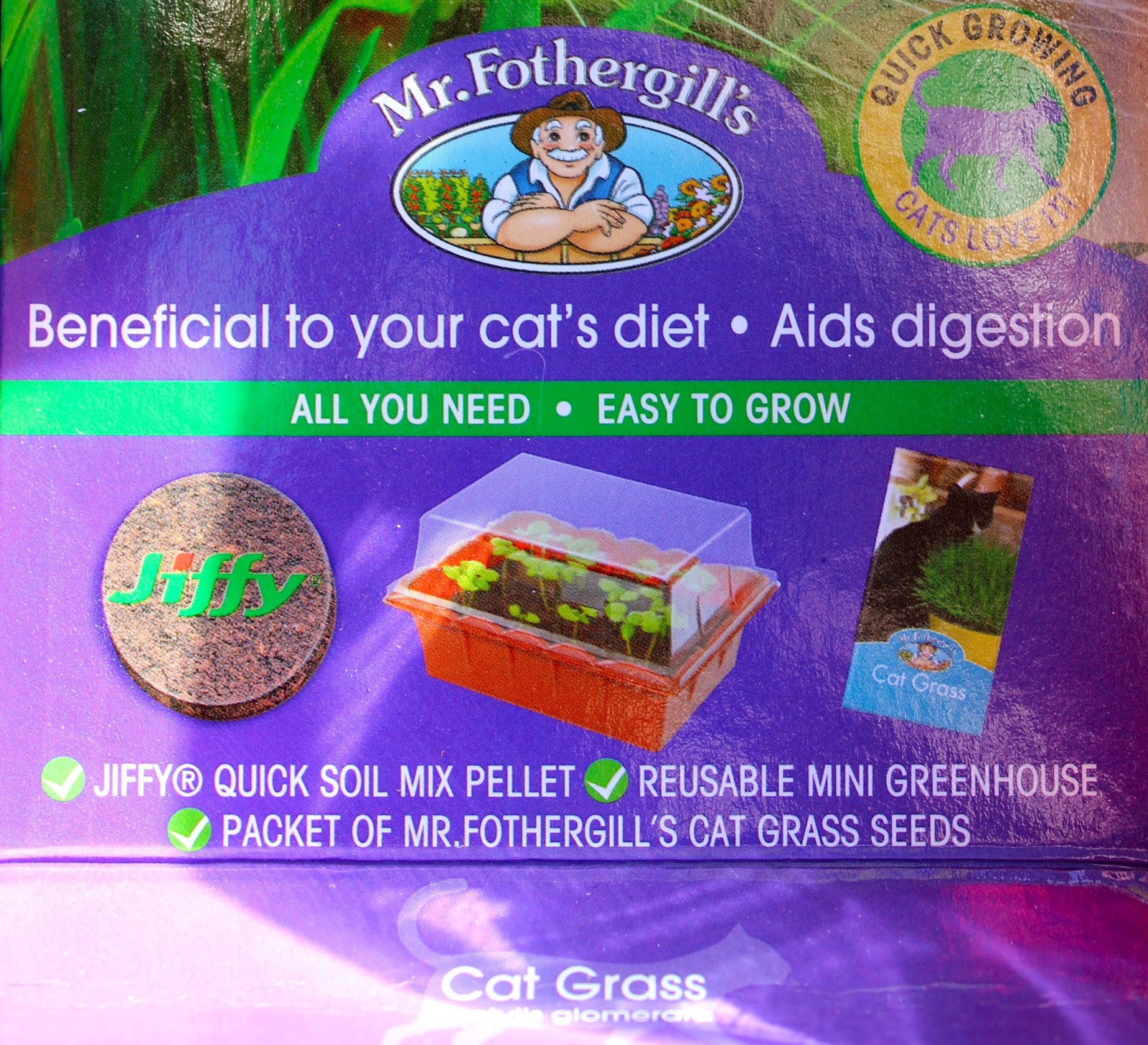
 Over the weekend I planted out the very neat Mr Fothergill's Cat Grass Kit.
 It's 'neat' in the cool, well designed sense of the word, a perfect package for apartment dwellers or for those who keep their cats indoors like we all should. Interesting to see a 'Made in Canada' label on this product which made me think of all those snow bound cats in a Canadian winter dreaming of green grass.
So this kit consists of a packet of cat grass seeds, and a mini greenhouse with an expandable Jiffy pot of instant growing medium of the just add water variety. The pictures below explain how it works. The packet of seeds is generous so that consecutive sowings can be made over many months.


 You add 300ml of warm water to the Jiffy pot and wait a few minutes for it to absorb all the water. Then you poke a couple of holes in the base of the container and spread out the soil with a little knife. Now the instructions say to poke the holes in first but you may end up with a big puddle on your kitchen bench if you do.
 Seed planted
 Completed, this little greenhouse generates enough moisture so you don't really need to water the seed again but just keep an eye on it. This is not the end of the story and I will update the post as the seed grows and develops. This kit retails for $5.95 and would make a terrific present for cat lovers. It is available from the Mr Fothergill's website as per this link:
Seeds, Vegetable Seeds, Flower Seeds and Herb Seeds
 Update: This is the germinated seed after a couple of weeks. This can be given to your cat as is or potted into larger pots so it has a chance to grow bigger. Impress your friends by giving them the botanical name for it: Dactylis glomerata

Sunday, August 18, 2013

Norman J Sparnon

 Norman James Sparnon OAM (1913-1995)
Ikebana Master
 Norman Sparnon was born in Melbourne and is remembered there by a plaque in Jells Park, Glen Waverley, where he planted a tree in 1984 to celebrate 25 years of Ikebana International in Australia. As a young man he became absorbed by the learning of written and spoken Japanese and following his service as an Army Major during World War 2, he went to Japan to serve in peace time redevelopment, eventually living there from 1945 to 1958.
One day he went along to an Ikebana class his wife Mary was attending, to act as an interpreter, and became hooked on all aspects of Japanese floral art. "I was captured by the art right from the beginning. I felt I'd found something that matched up with my personality" he recalled later at the launch of one of his books. On return to Australia he lived in the Sydney suburb of Darling Point where he had a studio and ran an Ikebana school in the 1960's and 1970's , teaching both the classical Ikenobo and modern Sogetsu styles of the art. For Norman it was always far more than just flower arranging,"You become so very close to nature and understanding it." he said.
These days his timeless  books are fetching high prices and his last from 1970 The Poetry of Leaves sells for about $250.00. Trouble is you may just have to go to New York City to buy a copy, such is his influence outside this country.


 His first book from 1960
The illustrations below are of his use of camellias. In 1968 he wrote a book called The Magic of Camellias with E G Waterhouse
 Modern 'moribana' arrangement of quince and camellia

 Window arrangement with camellia and fasciated willow

 Red-lacquer plate with lichen covered pine and camellia

 Shoka arrangement of Ikenobo School
Single flower 'Ichirin' with incense burner

 Nagiere arrangement of quince and camellia
by Sofu Teshigahara founder of the Sogetsu School

 Pine and camellia in 'shin' arrangement

'tsubaki' = Camellia japonica
'to-tsubaki' = Camellia reticulata
'sazanka' = Camellia sasanqua
To prevent camellia flowers from falling in an arrangement, apply damp salt to the base of the stamens by means of a match.

The 'true blood' Camellia

 Earlier this year The University of Adelaide offered The Art of Aubrey Beardsley (1872-1898) as a free 'ebook' available for digital download. It was interesting to become reacquainted with this decorative artist who saw things as a pattern of black and white, influenced by, among other things, the Japanese woodblock print and who used the 'Japanese rose' or camellia as a motif in his work, for decorating voluminous kimono style clothes or as background wallpaper.
 'The Dancer's' Reward' from Salome
In feudal Japanese culture, the camellia was associated with beheading by a samurai. It was given this association because the flower drops to the ground intact,with the ground below a big camellia bush often littered with still perfect flowers as if after a battle. The short vase life of the flower still has some modern superstition attached to it, in that it is not given to a hospital patient or used in a flower arrangement unless accompanied by a longevity symbol plant such as a pine.

 La Dame aux Camelias 
Volume 3 of 'The Yellow Book'
Beardsley had another reason to have the camellia as his favourite flower. He had met Alexandre Dumas, the author of La Dame aux Camelias at Puy in France and was smitten with the subject matter of the book; about a young courtesan who dies young. Beardsley already knew his days were numbered and he died of Tuberculous at the age of 26. A copy of La Dame aux Camelias was placed in his coffin.


 'The Black Cape' from Salome
 In the 1960's there was a revival of interest in Beardsley as much of his subject matter had appeared too shocking for previous generations. Life Magazine in 1967 included some fashion shots with his work as background.
Mrs Harilaos Theodoracopulous wears an Adolfo camellia hat with a Bill Blass cocktail dress.....

Saturday, August 17, 2013

A Camellia garden


The Camellia garden at the Illawarra Rhododendron Gardens
What I like about this garden is that the Camellia japonica varieties are semi hidden behind a Camellia sasanqua hedge. There is a gap in the hedge where you enter into a shady nook with a winding path so the big C japonica varieties can be seen up close. In the background, the tall gum trees provide some shade and valuable leaf litter mulch.
Though they are very nice to enjoy when in flower, these Camellias present a fairly gloomy and stiff picture for most of the year. I have come around to thinking it is the Camellia reticulata varieties which are the most desirable, though as scarce as hen's teeth in the nursery scene. They are more open in habit as shrubs and more flamboyant in their appearance as flowers. 
The camellia as a symbol of worldly vanities as apposed to humble virtue, is shown in this Victorian era English picture. The actress Ellen Terry (1847-1928) is tempted by the bold but scentless Camellias while holding violets in her hand.

 
'Choosing' 1864
George Frederic Watts (1817-1904)
National Portrait Gallery, London
Ellen Terry is wearing her wedding dress in a very fetching colour ! She married Watts in that year but stayed married to him for less than a year.

Tuesday, August 13, 2013

Pelargonium sidoidies


Pelargonium sidoidies
This small shrubby geranium (H 30cm W 60cm) leads something of a double life as it is regarded here as a promising low water use ground cover or 'path edger', while in its African homeland it has a long history as a medicinal plant. In Zulu it is known as Umckaloabo which roughly translates as 'heavy cough' referring to its use for respiratory complaints. The small deep maroon flowers appear on the ends of wiry stems which zigzag from the centre of a neat mound of scalloped grey leaves. Frost hardy and tough, it would be home amongst succulents or as balcony pot plant unfazed by strong wind or salty air.

Saturday, August 10, 2013

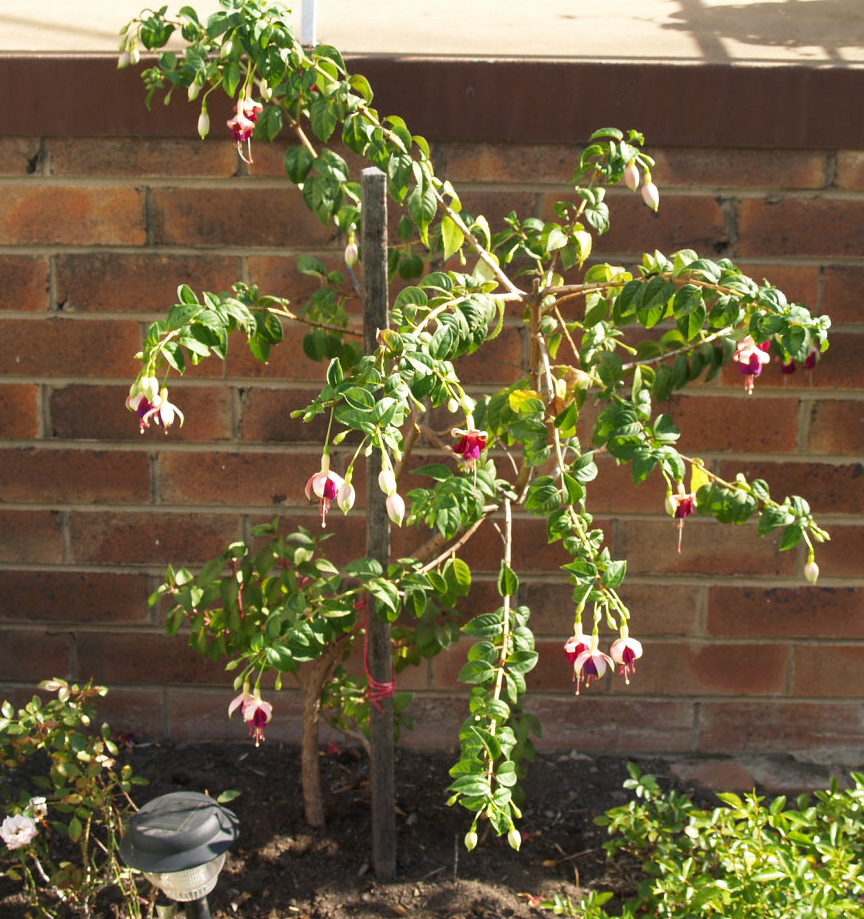
The Bogan Fuchsia

The inclusion this year of the humble garden gnome in the RHS Chelsea Flower Show could be seen as a sign that any expression of gardening from whatever class or background you come from is justified and should not be judged on matters of taste. In Australia the celebration of the suburban bogan is certainly welcome on our TV screens.
In Australian literature, Patrick White had great affection for bogan characters in his dusty suburban Sarsparilla of the late 1950's and early sixties. In the short story Down at the Dump, the garden of Wal and Isba Whalley has a big Camphor Laurel tree (Cinnamomum camphora) which is 'lopped back every few years for firewood', its trunk scarred by son Lum who slashes at the bark with a knife 'because it was something you did'. Out back standing in knee high paspalum grass is the two-tone Ford Customline...'it looked stolen and almost was ...the third payment overdue' while the twins Barry and Garry, looking like a couple of 'taffy brumbies', play in a rusty boiler they use as a cubby.
Across the road in a liver-coloured brick home with a cream Holden Special in the driveway lives Councillor Les and Myrtle Hogben and their daughter Meg. On the cool side of the house grow tall fuchsia bushes with a ground cover of aluminium plant (Lamium galeobdolon) Meg, dressed in her brown school uniform, is thin and freckly with the eyes of a 'mopey cat'. She hides from her mother, 'standing amongst the fuchsia bushes looking out from their greenish shade. Her skin was green except where the war between light and shade worried her face into scraps: and the fuchsia tassels trembling against her unknowing cheek, infused something of their own blood, brindled her with shifting crimson. Only her eyes resisted.'
White wrote later of these characters in 'Letters' (edited by David Marr) ....but Meg Hogben and Mum Whalley are the pure, the truthful, those of whom we may have hopes in the future.'