Wednesday, March 31, 2010

Stipa tenuissima, Mexican Feather Grass

Nassella tenuissima syn Stipa tenuissima

Mexican Feather grass made a brief appearance in gardens and nurseries here over ten years ago, until it was discovered that it had enormous weed potential. It was withdrawn from sale never to be seen again. I took this photo in Wisley Gardens in the UK where it remains a popular garden plant given its tolerance of cold conditions (minus 15C). It has incredibly soft flowing seed heads in summer and these move in the slightest breeze.
It is native to Mexico, New Mexico and Texas.

Tuesday, March 30, 2010

Postcards from Madras

The Conch Flower Creeper
 Clitoria ternatea

Madras is now known as Chennai and is the capital of the south Indian State of Tamil Nadu. A must see place to visit in the region is the Vedanthangal Water Bird Sanctuary about 75km to the south of Chennai. It comes alive with migratory birds from November to February.
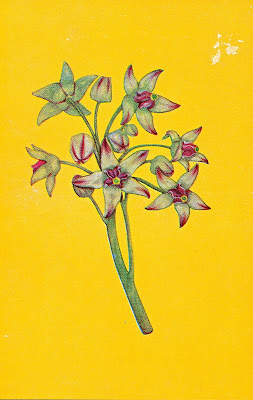
These brightly coloured postcards are from the Madras Government Museum and feature common flowers of the city.

The Indian Laburnum
Cassia fistula

The Indian Madar
 Calotropis gigantea

Manoranjitham
 Artobotrys odoratissimus

Coral Jasmine
 Nyctanthes arbortristis

Monday, March 29, 2010

Anemone japonica, Japanese Windflower

Anemone japonica 'Alba' syn A.hupehensis 'Honorine Jobert'
I am growing a batch of the white 'Windflowers' as it is one of those classic garden plants which is fool-proof to grow; reliable and hardy, tolerating cold or dry soils and always putting on a great display of flowers every autumn. I prefer the white form because of its simplicity and it makes such an impact when grown in the shade of trees or in a dull garden corner. This Anemone gets ready to flower in late summer by firstly sending out a batch of new leaves which even have a slight gloss to them, then follows the flower stems which can eventually reach 1.5 metres in height. In the slightest breeze, the flowers wave and bend adding to their impact in the garden.
They can be propagated by division or by root cuttings taken at this time of year.

Anemone japonica, Pink form

Sunday, March 28, 2010

I collect Floras

Grevillea floribunda, photo by Peter Althofer

Halgania preissiana photo by Beth Williams

The Lifeline Big Book Fair, on in town this weekend always turns up long out of print books.I am always on the lookout for Floras about particular regions I may visit someday. Floras always contain interesting information on history, geology and land formation, ecology as well as descriptive 'keys' to the plant life. The one pictured above is from the town of Wellington in New South Wales.
The other interesting one I found was from the Northern Territory Conservation Commission about Plants of the Tropical Woodland and in the introduction you are invited to 'feel, rub, squeeze, bend, smell and even taste certain plants so that you may get to know them better'.

Saturday, March 27, 2010

Agave americana medio-picta alba


Agave americana medio-picta alba

The plain green form of Agave americana grows into a bit of a monster and needs lots of space to show it off to its best advantage. This variety which has a white stripe down the centre of the leaf is a much more well behaved and is slower growing eventually forming a small rosette to about 1 metre across. 'Pups' appear around the base of the plant and it also sends off runners to establish new plants about a metre or so from the parent.This is one of the choice Agaves to grow and it is both cold and drought hardy.
2017 update: I always have plenty of stock in 140mm, less in larger sizes.

Thursday, March 25, 2010

Scabiosa atropurpurea

Scabiosa atropurpurea
 Pincushion Flower or 'Mournful Widow'
There are about 16 species of Scabious native to France, Spain and Portugal and this is one species which always gets attention because of the almost black flowers. In gardens it likes well drained, gritty or sandy soil and is best treated as a short lived perennial or summer annual. I have grown it in years gone by, and recently its name came up in a book I am reading where it was used to decorate the table for a 'mock funeral feast to mark the most ludicrous of personal misfortunes' by the decadent main character. The book is A Rebours by J.K. Huysmans and it was published in Paris in 1884: 'The dining room, draped in black, opened out on to a garden metamorphosed for the occasion, the paths being strewn with charcoal, the ornamental pond edged with black basalt and filled with ink, and the shrubberies replanted with cypresses and pines.The dinner itself was served on a black cloth adorned with baskets of violets and scabious'


Aechmea 'Foster's Favorite'

   Bromeliad Aechmea 'Foster's Favorite' 
 This is is certainly one of the very hardy varieties and is most suitable for wall planting or training up tree trunks as in this photo. These are growing in the Roma Street Parklands in Brisbane.
2017 update: I have stock available.