Showing posts with label Seeds. Show all posts

Wednesday, May 17, 2017

My seed packet history


Seed Merchants of yesteryear.........
I have to confess to being something of a gardening hoarder. If by definition that refers to someone who has kept all packets of seed, plant labels, gardening magazines and newspaper clippings, as well as an assortment of rusting no longer in service tools that have ever crossed my path during the past forty years or so. 
Then you wake up one day and ask yourself why am I keeping all this? So before the old seed packets went into the recycle bin I took a few photos of a range from various companies some of whom are no longer trading. 
Not much changes however......
It is impossible for me to walk past a seed rack in a Nursery or Hardware store without picking out a couple of packets of something I would like to try. As well, these days it is seeds saved from cross pollinated prize shrubs which hold my attention. What will the resulting seedling turn into?

These lines from the V Sackville-West poem The Garden convey the wonder and reward of growing plants from seed.
'He is a millionaire for a few pence.
Squandering nature in her gift exceeds
Even her own demands.
Consider not the lily, but her seeds
In membrane tissue packed within the pod
With skill that fools the skill of human hands;
The poppy with her cracking pepper-pot
That spills in ripened moment split asunder;
The foxglove with her shower as fine as snuff.
Consider these with thankfulness and wonder.'


Sunday, March 5, 2017

Rudbeckia hirta 'Cherry Brandy'


 Rudbeckia hirta 'Cherry Brandy' with a Gomphrena doing a 'photo-bomb'
As a summer annual which lingers on into autumn courtesy of decorative seed heads, Rudbeckias are hard to beat.
I had some seed left over of this variety after growing a batch years ago so thought I should give it another try. Very viable seeds resulted in a huge batch of seedlings which were fairly easy to handle as they are characterized by tough raspy leaves and a strong root system.
Individual plants hug the ground for awhile and their broad leaves can provide shelter for snails so that is something to watch out for when growing them. By mid summer a tall flower stem starts to appear topped by many individual buds. The strong stem makes them ideal as a cut flower but it also gives them an ability to withstand any stormy windy days. The flowers were not affected by extremes of heat and the strong root system these plants have meant that they were able to seek out moisture well below the soil surface.
I look forward to trying some of the other colour forms of this hardy annual in years to come.

Monday, December 30, 2013

Nigella damascena

Nigella damascena (Ranunculaceae)
 Earlier this month I tried to grow a batch of Nigella in 140mm pots as a commercial plant for sale in the nursery trade markets. This proved difficult as it is a plant which resents being transplanted once the seeds have germinated. Losses were high so I abandoned the project and it proved that it really prefers to hangout in a semi shaded garden corner in moderately rich garden soil where it can do its thing without disturbance, usually self seeding and returning each year if it happens to like the location. A cooler more temperate climate than mine may have helped in successful growing of it also.
The 'Persian Jewels' mix of Nigella contains some wonderful colours including a true sky blue , a deep purple, a crushed strawberry pink and of course white as shown here. The bonus with growing it is for the seed pods or capsules which are also decorative and these can be picked and used in dried flower arrangements.
Common names abound for this plant and include the English, Love-in-a-Mist or Devil-in a-Bush, the latter name referencing those horny little protuberances which top the flower. Other common names reference the veil of delicate, spidery or lacy foliage bracts which surround the flowers. It is a true texture or 'stroke me' plant ideal for sensory gardens. The German Venushaarige braut im haaren (Venus haired bride) or Jungfer im grunen (bridesmaid in green flower) paint the picture nicely of this fennel like foliage.
The other species of Nigella which I have yet to grow, N. sativa, yields the seed which is sometimes goes by the name of black cumin.The aromatic and pungent seeds are more commonly used in Middle Eastern and Indian cuisine. The Indian panch phora is a mixture of nigella seed, cumin seed, fennel, fenugreek and mustard seed.There is also a tradition of using the seed as a topping for bread especially in eastern Europe where the heavy rye style loaves, which weigh a ton and just one slice will fortify you for a hike through a blizzard, are popular. I am thinking here of the Russian chernuska rye bread or the German black bread with schwartzkummel. 
Nigella spice seed remains less well known in Australia but the flowering species has been a popular cottage garden flower for many years.

Tuesday, December 17, 2013

Iberis umbellata, Globe Candytuft


Iberis umbellata, Globe Candytuft (Brassicaceae)
with 'Dark Opal' basil and mauve Ageratum
Often I will have just one plant of something, especially if it is an an annual such as this one which arrived via a packet of mixed seed. It is always interesting sowing those packs of seed which come labelled as 'rockery mixture' or 'cottage garden flowers' as you never know what to expect. Often different seasonal flowers are included which means it is better to make successive sowing over a period of months as some seeds are programmed to just appear at certain times of the year. You often get inspiration to grow just one of the successful varieties at a future time and for me this is the case here. I would like to try growing the so called hyacinth flowered Candytuft, Iberis amara, which produces a tight cluster of white flowers which are sweetly perfumed. Having a flower belonging to the cabbage family, a 'Brassica', with a sweet perfume seems quite odd of course but nature always has many surprises. This globe candytuft looks a bit like Alyssum/Sweet Alice on stilts and seems to attract a good share of beneficial insects to the garden in the same way Alyssum does.
The Iberis name refers to the Spanish origin of the plant, the Iberian Peninsular. In France it is known as Iberide while the English Candytuft comes from Candia , the old English name for the Greek Island of Crete where it also grows wild. The most interesting common name for it is the Portuguese Assembleias which refers to the way the individual flowers are arranged in a cluster around the stem.

Thursday, December 5, 2013

Golden Lemon Balm,Melissa officinalis 'All Gold'

Melissa officinalis 'All Gold'
Lemon in colour and flavour and a great plant for a shady corner, this variety differs from the closely related Melisa officinalis 'Aurea' (syn.'Variegata') , the variegated lemon balm, which has leaves splashed and speckled with yellow. The interesting thing about 'All Gold' is that it can spend quite a bit of the year with green leaves, at least from autumn till late spring, though some say this is a response to overly rich soil which favours the green leaves. This year when I trimmed back my plant in late winter I took cuttings which I just layered into the soil in the vegetable garden .These soon struck and turned golden while the mother plant sat with a dull green face. Given too much sun the leaves can quickly bleach white then scorch brown. Overall this variety is less vigorous than the common green lemon balm and is a very worthy addition to an ornamental shady garden or herb patch.
The lemon balms are good bee plants and the name 'Melisa' is synonymous with the Greek word for bee and they are kept happy within a hive from the use of this plant growing thereabouts. It also has a long history of culinary use and can be used in any way where a zesty lemon flavour is required. As it grows wild in the southern parts of France, the French were inventive in using it in all manner of ways. The celebrated Eau de Carmes or Carmelite water was a popular tipple in the seventeenth century. You can make a modern version by adding the flowering tops of balm to a litre of brandy along with a few twists of lemon peel and aromatics such as angelica root, cloves, nutmeg, coriander seeds and cinnamon sticks.Left for a week or so to let the flavours infuse and then strained, you have yourselves a cordial tonic to uplift the spirits.

Monday, December 2, 2013

Sweetpeas going the distance


It is marvellous what a little rain will do and a run of cooler days. My sweetpeas did not really take off and reach the top of the trellis till a week or so ago and now they have decided to flower well out of their normal peak flowering time. The flowers are not prize winners by any stretch of the imagination but I may just be able to pick a bunch at Christmas time.

Sunday, December 1, 2013

Calendula 'Neon'


 Calendula officinalis 'Neon'
I am often running late in getting things planted out. These Calendulas  which I grew from seed planted back in autumn languished in a seedling tray for months, often drying out and looking fairly stunted until I finally got around to planting them . Calendulas or Pot Marigolds are at their best when flowering during winter here and by spring the plants become susceptible to mildew or rust and need to be pulled out. These later planted ones are proving me wrong as they have not succumbed to mildew or rust both diseases common in the variable weather conditions of spring. Theoretically you should be able to have Calendula flowers all year round if you live in a temperate climate as their very name is derived from the Greek word for calender, Kalends. Originating in the Canary Islands and in coastal Mediterranean regions it has been a popular flower in Europe for centuries and has been given interesting regional common names. In Italy it is Fioridi ogni mese; in France Soucis derived from solsequieum or sun follower and in Germany Todtenblumen.It seems likely that the plant followed the same trade routes as saffron in its journey to Asia as it was used as a dye plant in China.
I am impressed  with this variety 'Neon'. The flowers have burnished copper tips to the petals which also have a slight twist to them, while the buds are darkly sexy. They have the David Bowie Ziggy Stardust period look about them,with all those spiky orange petals.

Planted between Nasturtiums in an edible flower patch

"The marigold that goes to bed with the sun
And with him rises weeping: these are flowers
Of middle summer, and I think they are given
To men of middle age"
Shakespeare 
Perdita in ''A Winter's Tale''

Saturday, November 30, 2013

German Chamomile, Die Echte Kamille, Matricaria recutita

 Matricaria recutita syn Matricaria chamomilla (Asteraceae)
It's harvest time for my German chamomile flowers though I have yet to meet anyone who shares my enthusiasm for this herb. The flowers are alive with insects which are probably attracted to the nose twitching scent. No wonder they call this annual 'stinking mayweed' as it is very much a part of a northern hemisphere spring.
 I sow seed in winter in trays, separating out the seedlings once they are large enough. It could also be sown direct in vegetable garden plots or in any open sunny spot with not overly rich soil. Seedlings can be slow at first but grow quickly during the first warm or hot days of early spring eventually sending up flowering stems to 30cm or more. When all the flowers are out and the petals are not downward facing I cut them, placing the flowers in containers and putting them straight into the freezer. They stay quite separate after freezing and it is easy to get out a small handful for later use. I use chamomile for herbal tea, mixed with peppermint, and as a garden fungicide spray against damping off in seedlings. Terrific stuff from an easy to grow plant.
Worth looking out for and very helpful to use on calloused gardening hands is this chamomile handcream from Germany.


Sunday, November 17, 2013

Ammi majus 'bon ami'

Ammi majus under-planted with Alyssum (Lobularia maritima)
A good friend for the garden by attracting beneficial insects and helping get the biodiversity right, Ammi majus is in flower now along with its equally useful friend Alyssum. These two are often combined in seed mixtures of 'all white flowers' or in special 'good bug' mixed packs. Seed planted in autumn or during winter can be given any odd spot in the garden or simply grown in pots. They are not fussy about soil and will still flower even if the conditions are not particularly good such as with variable weather conditions or low soil fertility. This is a polite way of saying they can be a little on the weedy side and will come up in the cracks of pavement given half the chance.
I hesitate to use the common name Queen Anne's Lace for this plant as it can be easily confused with the other plant of that name Daucus carota which has more ferny foliage and more cream coloured flowers. Both these plants belong to the Apiaceae family which includes the vegetables carrots and celery.


Sunday, October 27, 2013

Gomphrena 'Strawberry Fields'

 Gomphrena haageana 'Strawberry Fields' (Amaranthaceae)
 I have grown this hardy drought tolerant summer annual/short lived perennial for many years. This variety of Gomphrena flowers for most of the year. It is still in flower in July and at that time of year I usually cut back the plants to near ground level and within a couple of months it is in flower again. It has a semi rhizomatious root system, and you often see a swollen base near the soil surface from which new shoots appear. Usually the flowers start off as an apricot colour and as the summer progresses the colour changes to strawberry red. It is easy to grow from seed sown at any time from spring to mid summer.

The family to which it belongs, Amaranthaceae, includes lots of colourful foliage plants (Iresine, Amaranthus ,Celosia) and some have a similar flower type to this Gomphrena, that is a papery burr which stays on the plant for a long time. A good example is the popular purple leaf plant Alternanthera dentata which flowers in winter, while shedding most of its leaves, leaving behind the flower which persists for months until the weather warms up and new foliage growth commences. I mention this habit because it is annoying when trying to propagate from it, as the resulting struck cuttings appear as a mass of twigs covered in burrs. The Alternanthera seed is sterile, as it is in the very noxious weed Alternanthera philoxeroides, Alligator weed, which reproduces by stem pieces which break off and float in water or which have become attached to boats or vehicles. Unfortunately this Alternanthera, which originated from the Parana river floodplains of northern Argentina is now regarded as one of the worst weeds in the world.

Thursday, October 24, 2013

Angelica pachycarpa

Flower of Angelica pachycarpa

Ripening seed of Angelica pachycarpa
This is not the herb Angelica but the glossy leaved biennial plant which is noted for its wonderful structure, especially the way the leaves clasp the stem and fan out from it, as well as the starry plate like flowers which appear in spring. Like many plants affected by a changing climate this species is skipping the normal slow growth of two years before flowering and instead is bolting ahead and flowering within its first year. When I grew it in the garden I let my plant go to seed and then dug up the seedlings which appeared underneath some time later. Trouble is I only ended up a few plants and I want more so I can have some plants available for sale, as, in its juvenile stage it makes a terrific pot plant or striking garden specimen. Saving seed of any plant can be both frustrating and rewarding. In this case the seed is ripening unevenly with individual seed cases turning brown and appearing ready to collect while their nearest neighbours are still green. What to do? Place a catcher or tray underneath the plants which means the seed could end up blowing away or stolen by insects, or place little muslin bags over the entire seed head so that the seed has something to fall into? Whatever seed I end up with I will store till next autumn before planting and hopefully have some nice plants ready by next spring.


Saturday, October 12, 2013

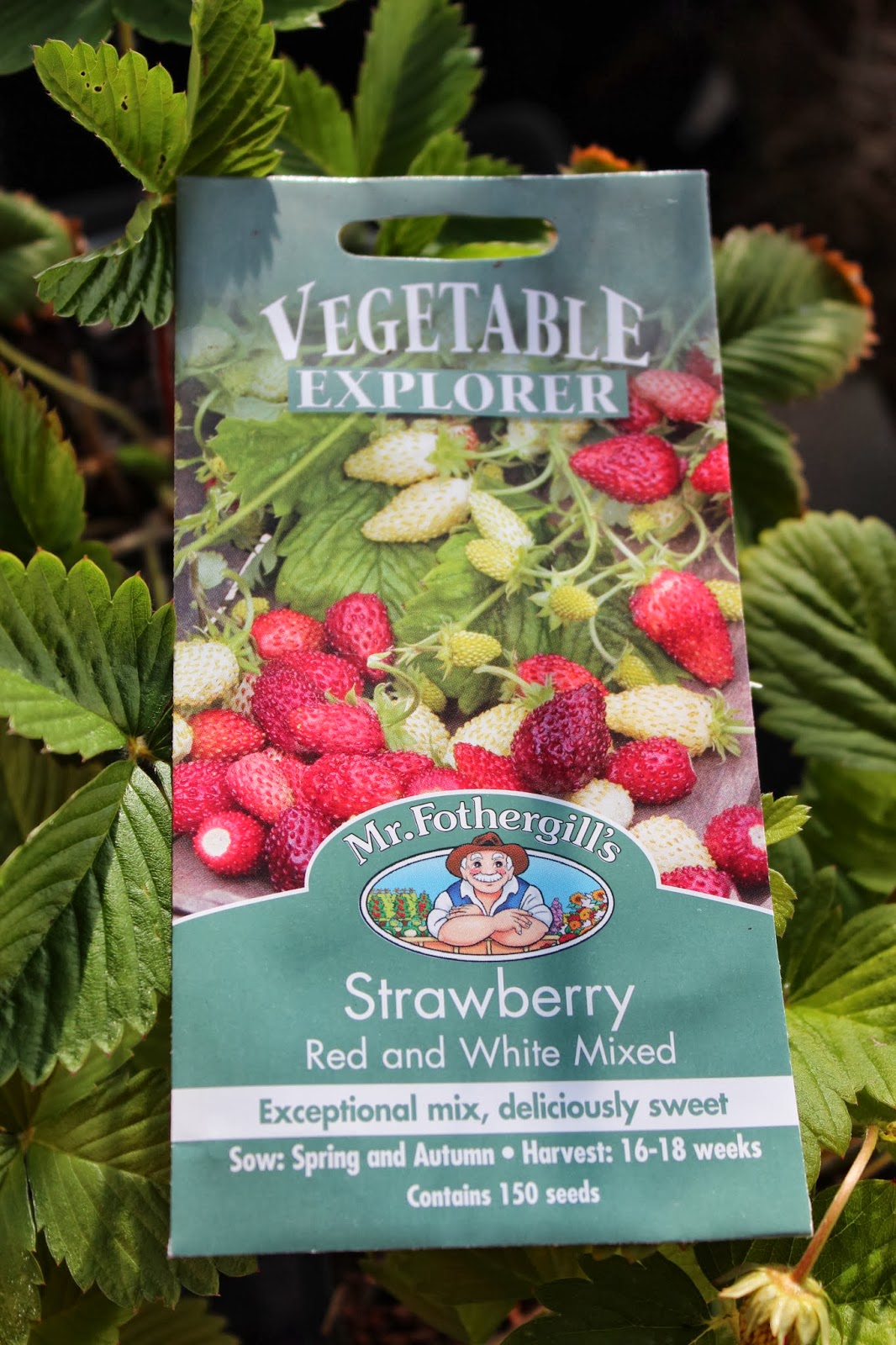
Le Fraisier des bois, woodland strawberry

 Woodland or alpine strawberry 
Fragaria vesca (Rosaceae)
I have been after the white fruited strawberry for years as it was once readily available at herb nurseries and then it disappeared from the garden scene. Now it has been included in a mixed strawberry seed packet in the Mr Fothergill's range of products. The white fruited variety is said to be less attractive to birds though I have had no trouble with birds pecking at the red ones as the fruit is often hidden under a leaf canopy and not easy to spot. The perfect forage fruit really as there is the thrill of the hunt involved in finding these tasty snacks.
Growing strawberries from seed is in the medium difficulty range. The seed is as fine as dust and just needs to be surface sown and kept evenly moist. Germination is usually very good but the little plants just sit there for ages with hardly any leaves while they put down long fine roots. Often you end up with a mass of young plants growing together. However they are actually fairly tough and I have separated tiny plants from a tangle of fine roots and they all survive and develop quite quickly. Once on their own in a pot or garden bed, they make a big spurt of growth and before you know it they are producing fruit. it is just in the initial month after germination that you think they are never likely to come to much.
Plants benefit from a bit of shade in the hottest months and towards the end of summer they can be sheared off at ground lever to refresh the plants and leaves quickly return with autumn rain. Regular applications of liquid organic fertilizer keeps them producing lots of fruit for many months. Of course it takes a lot of patience to harvest a lot of fruit to use in a dessert and they tend to be eaten in the garden and not make it inside to the table. These seeds are available from: Mr. Fothergill's Seeds & Bulbs