Showing posts with label winter annuals. Show all posts

Friday, December 20, 2013

Nasturtiums in pots

 While the garden bed Nasturtiums have long gone, shrivelled in the heat and dropping a load of seed, I have had more success in keeping them going in pots. One thing I did not realize is that they can be pruned back in a reasonably hard manner and they will regrow in a more compact and floriferous way. Container growing also makes it easier to control the amount of fertilizer they get as it is well known that excessive nitrogenous fertilizer will produce a mass of leaves with hidden flowers. Removing spent flowers stops them going to seed and thus shortening their life and though this takes a bit of extra effort there is no reason why these Nasturtiums will not keep on going all through summer and into autumn.
These 'Christmas red' ones will make a nice addition to the festive table in the coming days.

Sunday, December 1, 2013

Calendula 'Neon'


 Calendula officinalis 'Neon'
I am often running late in getting things planted out. These Calendulas  which I grew from seed planted back in autumn languished in a seedling tray for months, often drying out and looking fairly stunted until I finally got around to planting them . Calendulas or Pot Marigolds are at their best when flowering during winter here and by spring the plants become susceptible to mildew or rust and need to be pulled out. These later planted ones are proving me wrong as they have not succumbed to mildew or rust both diseases common in the variable weather conditions of spring. Theoretically you should be able to have Calendula flowers all year round if you live in a temperate climate as their very name is derived from the Greek word for calender, Kalends. Originating in the Canary Islands and in coastal Mediterranean regions it has been a popular flower in Europe for centuries and has been given interesting regional common names. In Italy it is Fioridi ogni mese; in France Soucis derived from solsequieum or sun follower and in Germany Todtenblumen.It seems likely that the plant followed the same trade routes as saffron in its journey to Asia as it was used as a dye plant in China.
I am impressed  with this variety 'Neon'. The flowers have burnished copper tips to the petals which also have a slight twist to them, while the buds are darkly sexy. They have the David Bowie Ziggy Stardust period look about them,with all those spiky orange petals.

Planted between Nasturtiums in an edible flower patch

"The marigold that goes to bed with the sun
And with him rises weeping: these are flowers
Of middle summer, and I think they are given
To men of middle age"
Shakespeare 
Perdita in ''A Winter's Tale''

Saturday, August 3, 2013

Carnations for amateurs

 Dutch express: 2013 Sunflor carnations from Hilverda-Kooij plant technology
These little fragrant carnations come with a label in five languages and have been shipped to Australia from The Netherlands, such is the way of the world now when marketing fresh produce. I leave the commercial growing of carnations to the big guys and grow a few just as a hobby. Now is the time of year to take cuttings of favourite ones and also to plant seed for summer flowering. Theory behind this mid winter process is that the seeds like a bit of freezing to act as a germination cue and the cuttings are less likely to die from collar rot and have more of a chance of establishing roots in a propagation medium.
Cuttings can be taken from the middle of the previous seasons flowering stem or from semi mature wood as per below. 


 I have an interesting book on carnation growing which dates from 1947, called Carnations for Amateurs by J L Gibson. The previous owner of the book earnestly wrote his name and address inside the front cover and that in itself tells a story. He lived in Richmond Street, Corinda in Brisbane. This street is on the Brisbane river flood plain and I wonder whether he had a market garden on that fertile strip of land tempered by a river breeze in summer from the worst of the humidity. Gibsons book is fairly comprehensive and has not really dated though his use of english is florid by today's standard. I love his humble words in the introduction 'Where I have floundered into pitfalls I have not hesitated to leave the red signal hoisted ,so that beginners need not blindly fall into like confusion.' He does go a bit strange when using the words 'sinister appellation' when referring to the French 'Malmaison' variety of carnation. Perhaps it refers more to the fate of Empress Josephine than anything else.
I would like to get my hands on some Malmaison carnations. These are the big fat 14cm across variety originally selected in 1857 and going strong well into the 20th century. In Britain they were assumed lost to horticulture but some were found in the 1990's in a Scottish glasshouse and these have since been cloned. They represent the 'Belle Epoque' for carnation fanciers, from the time when were at their most popular. 
Australian gardening books from last century mention the Malmaison but always with dire warnings about collar rot and other pests and diseases.
Perhaps their waning in popularity from the late 1950's onwards was about fashion. A few years after Marty Robbins had his 1957 hit A White Sport Coat (and a pink carnation), the fashion was probably turning away from adorning a buttonhole with a carnation for a dance at 'Cloudland' in Brisbane by a younger generation not wishing to emulate their parents and adopting a more Marlon Brando cool.
 I have included the Keith Urban Marty Robbins tribute below.
Carnations are still available in a good range of colours from mail order nurseries who advertise rooted cuttings. They do like a dry climate, are not fussy about fertilizers and like a bit of lime added to the soil. They are very successful when grown in pots but best treated as an annual in warm climates.


 Carnation sophistication: from 1933 exhibition 'Plant Form in Ornament'
Iznik carnation bowl displayed on Italian velvet
Department of Islamic Art, 'The Met' ,New York

Sunday, July 14, 2013

Nasturtiums on the march

Don't be fooled by those seed packets of compact growing Nasturtiums or the variegated variety 'Alaska' with its pretty marbled leaves, after a couple of years of self seeding they revert to the wild type and in mild climates they spend winter sending off long runners topped with large round leaves to cover as much ground as possible before the return of hot days which shrivels their leaves. By then, when those sweetly scented flowers have appeared, all is forgiven and you hardly notice that beneath the leaves there are hundreds of their large crinkly seeds littering the ground. They are usually light enough to float and in a summer downpour they may end up a long way from where they were originally planted. Clever evolution at work to ensure survival of a species.
Despite this 'weed potential' warning, the humble Nasturtium is much revered in French gardens, and in art for that matter, where it is know as Capucine.  In Monet's garden at Giverny a central walkway is roped off to allow them to spread across the path from both sides. In Marcel Proust's A la recherche.....a gardener is described pruning the leaves from ones allowed to grow up a trellis to window height against a wall. 'Fauve' artist Henri Matisse painted pagan rhythmical figures swirling around a central vase of nasturtiums in Capucines a la Danse .
Capucines a la Danse 1912
Henri Matisse (1869-1954)
'Danse' version 1,left, Metropolitan Museum of Art New York and 'Danse' 2 from the Pushkin Museum of Fine Art, Moscow.
 (As an aside about the Pushkin Museum, the recent sacking of the Director, Irina Alexsandrovana Antonova, at the age of 91, gives us all inspiration for a long and fruitful career in a chosen profession whatever the outcome.)

Weed or groundcover worthy of a place in the garden?

'Boulevard des Capucines'
Nasturtium bright colours in this French poster

Sunday, December 9, 2012

Calendula rust: Puccinia lagenophorae


Powdery orange rust, Puccinia lagenophorae on Calendula officinalis
Calendulas, which are sometimes give the name English marigolds, are at their peak of flowering from mid to late winter and into spring. The recent warm humid and showery weather means they are more susceptible to getting this rust disease, which is thought to originate in Australia on several native plant species, but is now fairly widespread across the world. The plants lose vigor and rapidly decline in appearance with leaves often turning black as the rust spores mature.
Nothing to be done but pull the Calendulas out and dispose of in the bin. One of the weed hosts of this rust is the common groundsel bush Senecio vulgaris. This weed is fairly common in horticultural crops and I was interested to read that the rust is being used as part of a new strategy in biological weed control in Europe. Scientific research papers can be viewed if you Google Puccinia lagenophora.

Monday, November 26, 2012

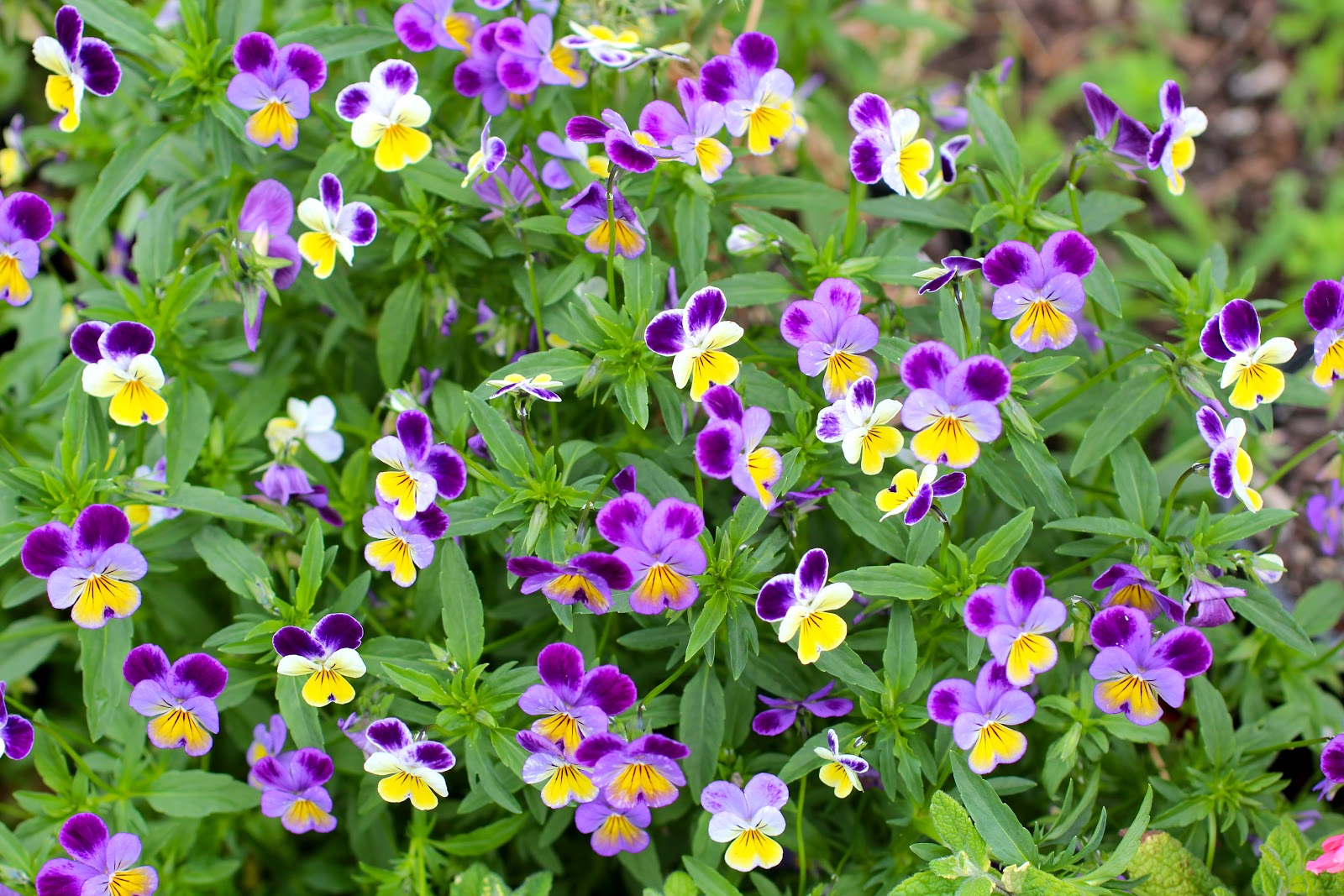
Viola tricolor, Heartsease


 The Violas go into panic mode at this time of year and put on a last hurrah of masses of flowers to ensure they leave enough seed behind to complete their life cycle. It is on dull cloudy days they look the best and the plants which grow in poorer soil in full sun have the most compact habit and more flowers. There are even tiny plants covered in flowers which grow through the cracks of pavement. However once the really hot days of December arrive it will be time to pull them out, though I usually scatter the spent plants around, as this most pleasant of 'weeds' is always welcome back in the garden. They usually don't make another appearance till winter, mainly in my vegetable garden. As soon as I see the young seedlings emerge I dig them up and nurture them in pots till big enough to plant out uncongested and where I want them to go. I love the many and varied common names given to this plant which include Johnny-Jump-Up, Call-me-to-You, Love-in-Idleness, Three-Faces-under-a-Hood as well as the most common one of Heartsease which may refer to use as a love- charm especially in a Midsummer Night's Dream. Good old Shakespeare loved his flowers.
The name Heartsease also refers to its many and varied uses in herbal medicine. These days the flowers are a favourite decoration on plates of food or added to salads. No episode of the series Masterchef was ever without these little beauties making an appearance and I assume that in the more temperate parts of the country they may just go on flowering for most of the year.


Wednesday, November 7, 2012

Hartweg's Lupin, Lupinus hartwegii

Today was drizzly and humid so the furry finger leaves of this annual Lupin collected raindrops in the centre of each 'hand' which made them shine like diamonds. I guess this water collection habit is an adaptation to the variable rainfall of its native Mexico, but it also makes it the easiest variety to grow in a warm climate. Mine drooped when running low on water but sprang back to life quickly when given a drink. I love the flower colours as they are so clear and bright...... sky blue, cobalt, pure white and pale to dark pink. I sowed seed in late autumn, treating the seed first with some hot water to break the hard seed coat. Germination was good and though it is recommended that they dislike transplanting after germination I did not notice any setback. Lupins like a fertilizer which is low in nitrogen as they 'fix' their own by producing it in nodules on the root system. This makes them a good plant to use in a vegetable garden and the whole plant can be dug into the soil following flowering. If you live in a cool climate the flowering season of this variety will continue well into summer if regular removal of old flowers is carried out. Plants normally reach about 45 to 60 cm in height when in flower.

Friday, July 20, 2012

Hyacinth. Hyacinthus orientalis

I am not sure whether to admit to having a real love for the sweetly perfumed hyacinth which are just coming into flower, given that they are now forever associated with the character created by veteran English actress Patricia Routledge, one Hyacinth Bucket (It's Boo-Kay dear) in the series Keeping Up Appearances. Every year in autumn I buy some different coloured varieties and pot them up, placing them in a cool shady spot while they put down roots and develop their flower spike. It is really too warm for them here as they need a temperature range of between 5 and 10 C to fully develop a flower spike of 30cm, however the strong perfume is there, even when just emerging from the soil and that is what counts for me.
Hyacinth originally came from the Middle East and were introduced to Europe around 1560 and it was Dutch nurserymen who did all the work on improving them over the centuries so that now they are more often known as Dutch Hyacinth or 'Florist's' type. The lovely primrose yellow cultivar 'City of Haarlem' which has received an 'AGM', award of garden merit from the RHS is named for the Netherlands city of Haarlem.
As they are quite formal looking plants, with the flower spike held stiffly erect, they have been often used in municipal plantings and spring display beds over the years. This aspect of their appearance was lampooned by English pop artist Sir Peter Blake when he set about to create a garden using Hyacinth for the record cover of the The Beatles, Sgt Peppers Lonely Hearts Club Band  when it was photographed at Chelsea Manor Studios in 1967. Hyacinth were used to spell out the name Beatles and, according to Blake, the nursery delivery boy made up a guitar using the flowers. It would be interesting to know whether the popular pink variety 'Princess Margaret' was included given that she was very much part of 'swinging London' of that time. The respectable municipal hyacinth were surrounded by Indian Gurus, Sri Paramahansa Yogananda, Sri Mahavatara Babaji etc, though record company EMI blocked out the image of Mohandas Karamchand Gandhi as it was possibly too sensitive to the British establishment.
Garden writers over the years are rarely kind about hyacinth. Louise Beebe Wilder in her book Adventures with Hardy Bulbs (1936, Macmillan, New York) describes them as 'obese, fat stalked, overstuffed, overscented and dedicated to pots or lozenge beds upon a suffering greensward'  Though 'when left in the ground for several years with no notice taken of them, until their starched pride is somewhat subdued, they acquire a slender grace and modesty that is most becoming to them'
More recently New York Times garden columnist Leslie Land waxed lyrical: Thinking of bulbs leads me to ask what you do about hyacinths? Got to be one of the ugliest flowers in all creation no matter where you put them or what you do with them, but then there is that perfume, without which there is no spring.'
Narcissus are very nice, (but) the scent of hyacinth is such as dreams are made on......

Thursday, July 12, 2012

Pansy 'Midnight Sun'

My camera can't work out what to do with something that glows like the sun at the centre and then turns dark purple at the edges. I have tried lots of different settings but this flower is difficult to capture at its best.This is an exceptional variety of pansy with good upstanding flowers on strong stems. There is a slight variation between each flower just to make it more interesting.

Friday, June 22, 2012

Pansy 'Black Beauty'

Pansy 'Black Beauty'
Before it opens to reveal a shining golden eye, this black Pansy looks very Gothic indeed with petals resembling the cape of Count Dracula. This variety has been around for some time but remains a real talking point as there are so few flowers that are so dark and spooky looking. It is difficult to place in a garden as the colour disappears close to the ground but it makes an interesting pot plant for a table where the flowers can be viewed up close. This one started flowering this week and has lots more buds to open over the coming months.
We have just passed the winter solstice and the wind chill factor makes it feel like the temperature is in the minus degrees right now.


Thursday, June 21, 2012

Viola 'Velour Blue Bronze'

Just coming into flower this is an exquisite new Viola I am growing this winter. The flowers are small and perfectly rounded with petals shaded purple blue above and russet bronze below.

Saturday, June 16, 2012

Chickweed, Stellaria media

Chickweed,  
Stellaria media (Caryophyllaceae Carnation Family)
Chickweed makes an appearance every winter in the garden and in potted plants. It forms quite a thick mat of loose succulent leaves topped by starry white flowers and seed capsules containing many orange seeds. Wild food foragers may be familiar with this universally occurring plant, using it as a tasty addition to salads and soups. I find the taste a bit bland and because the stems are covered with tiny hairs it is not always easy to swallow without inducing a coughing fit. As a herbal plant it is useful for making a poultice to sooth irritated skin. Apparently it is also possible to make a salve from Chickweed as well where it is mixed with beeswax so it can be applied for a longer period. I am not a regular user of herbal remedies but this one seems to work and from such a common garden plant.
As the common name suggests it is adored by chickens who love to scratch and pick out the oil rich seeds.

Saturday, June 9, 2012

Lachenalia aloides,'Soldier Boy'

 Lachenalia aloides
Bulbs can be tricky to grow if you buy them from a supplier who is based in a cool temperate climate.  You plant them at the recommended time in autumn and they immediately think wow this place feels like spring and bolt into flower almost immediately. Such was the case with these Lachenalia which are supposed to reach about 30cm before coming into flower in early spring. They do look quite cute and are certainly bright but they are dumpy and only a few centimetres tall and most disappointing.  The common name of 'Soldier Boy' is given because they usually stand stiff and to attention. Their other common name is Cape Cowslip which alludes to their South African origin.They come from an area of winter rainfall followed by a hot baking dry summer so in a garden situation they need to be dried off over summer or they may succumb to fungal disease and rot. The history and cultivation of this interesting genus can be found on the following site:
lachenalia

Monday, June 6, 2011

Potted Colour for winter

Pansy and Allysum in flower now

I always have one large container in the garden filled with whatever seasonal flowers are available. At this time of year I grow Pansies which are probably the most popular winter flower because the flowers are large, bright and cheerful. They need no special care other than removing spent flowers and being given an occasional dose of liquid fertilizer.

Wednesday, July 28, 2010

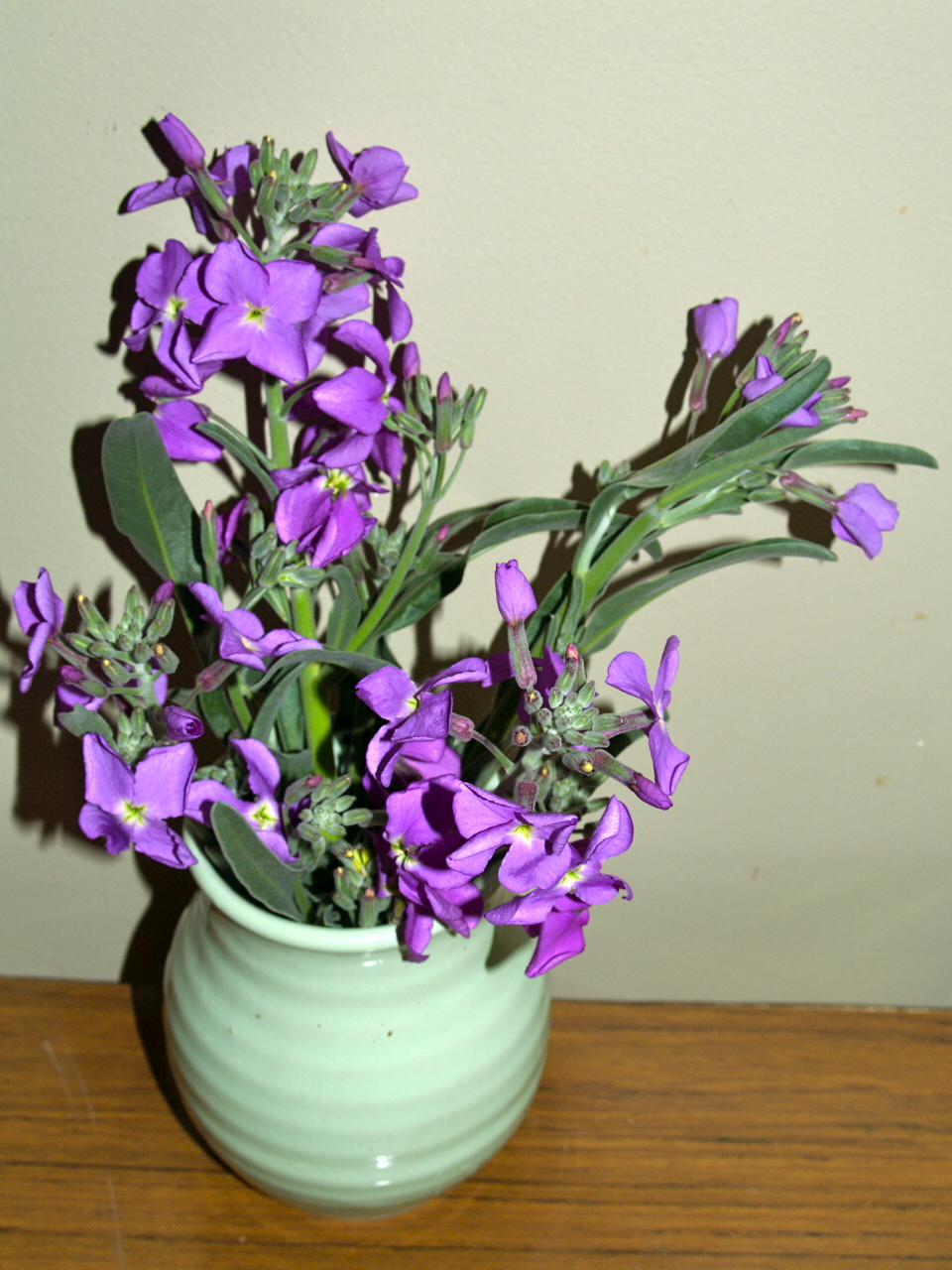
Matthiola incana, Stocks

Matthiola incana 'Giant Imperial Stock'

You know the days must be getting longer when the sweetly scented Stocks start to flower. This is supposed to be a double flowering form but as the double flower is a recessive gene the percentage of single flowering ones is often high. I prefer the single ones because I think the perfume is stronger and you can sometimes get 2 years out of a plant if you cut off the flowering stems in late Spring. It is worth saving the seed also as next years crop will include some double flowers. Double flowering plants don't set seed. This is a great cut flower with a good vase life but being in the cabbage family, the vase water turns putrid after a couple of days if you don't change it. It is a native of south west Europe.


Tuesday, July 27, 2010

Cineraria multiflora

This is one of my favourite winter annuals. I like them because the flowers are sweetly smelling and their colour ranges from deep rich purple and blue, through to white and pink, The dwarf compact forms make great container plants for placing on tables outdoors. They like lots of water and good rich soil and are prone to leaf miner if put under any stress. Cinerarias have been bred from wild forms of a Senecio found on the Canary Islands and in Portugal.

Saturday, July 24, 2010

Calendula 'Pacific Beauty'

Calendula 'Pacific Beauty'
Something to brighten the mid winter garden . This is a choice pastel orange form of this hardy annual and one worth saving seeds of.