Showing posts with label native trees. Show all posts

Friday, April 25, 2014

Springboarding


 Teaching the sport of springboarding
 In Germaine Greer's book 'White Beech - The Rainforest Years' (Bloomsbury 2014) we are given a remarkable historical account of the timber getting industry in South East Queensland as recalled by Bernard O'Reilly of 'Green Mountain' fame and the dangers associated with the use of the springboard which came to be used because trees were unable to be cut down from the ground owing to their flanged or buttressed trunks, a characteristic of many rainforest trees. The springboard is made of light wood, four foot long and a foot wide and it has at one end a steel tip which is inserted into a horizontal slot cut into the tree and "on this narrow rocking perch the settler swings his razor-edged axe, sometimes twenty or even thirty feet from the ground, then as the tree begins to go, he must descend swiftly, bringing not only his axe but his springboard."(O'Reilly) Many lost their lives or were seriously injured in the process. As Greer explains, "the O'Reilly boys all at one time or another sustained terrible injuries from their own axes. Ped and Herb both severed leg tendons; Pat buried his axe in his abdomen; Norb stitched a cut on his leg with needle and cotton.' By way of variation on the self-injury theme, Mick fell from his springboard and was impaled on a spike."
The wood chopping events held at Agricultural Shows across Australia are a reminder of these timber industry pioneers.

 White Beech timber from the rainforest tree Gmelina leichhardtii (Lamiaceae) It is 'highly resistant to decay in ground contact or in persistently damp or ill-ventilated situations' and in the early 1900's it was used for building frames, as well as flooring, lining, mouldings, joinery and cladding.'
'There is now no White Beech timber to be had anywhere' (Greer)

By Ashley Sewell
Department of Natural Resources Queensland, 1997

Thursday, September 5, 2013

Looking up at Trees

 The paintings of Australian artist William Robinson invite us to look at trees in a fresh way. They are not painted face on or in profile as we are used to seeing in traditional landscape paintings but from the inside looking up into the canopy and sometimes from above with a birds eye perspective looking down to earth. Their forms are lush and sinuous, writhing and jostling for space to grow.
These days many gardens have become too small to include large spreading trees so it is a delight to visit a botanic garden or park where you can gaze up into the branches and get an understanding of what Robinson is trying to convey in his work. 
 

Sunday, May 26, 2013

Coppiced Eucalypts


A coppiced Eucalyptus haemostoma 
 with lavender and Aloe
In the Bruce Beresford film Don's Party which is set in the fictitious suburb of Westleigh on election night 1969, the character Don Henderson, played wonderfully by the late John Hargreaves, is proud to show off his mini plantation of eucalyptus trees which he was carefully nurturing. Perhaps the film's screenwriter David Williamson was commenting on the fashion of that time for planting trees such as a Sydney Blue gum (Eucalyptus saligna) in the tiny garden of a terrace house in Paddington or Balmain. Many of these trees are still with us in the suburbs and have of course now reached maturity.  Earlier in the week there was a sad evening news story about a huge gum tree which had come crashing down onto the house of some elderly folk with the result being they were left virtually homeless. 
If you still like the inclusion of Eucalyptus species in a home garden, when grown for the foliage alone, the solution is to coppice them when they reach the sapling stage by cutting them off to a short trunk or close to ground level.
I did this earlier this year with a 'scribbly' gum and it has since sent up a flush of young branches. It works better if you have already planted some compatible plants, either native or exotic, close by so that the new foliage fills in the gap in a natural way. I like the transparent quality of the gum leaves and the shadows they cast on each other and the plants around them.
For more on the technical side of coppicing you may be interested in the following article:
 Managing Coppice in Eucalypt Plantations - Department of Environment and Primary Industries

Sunday, September 25, 2011

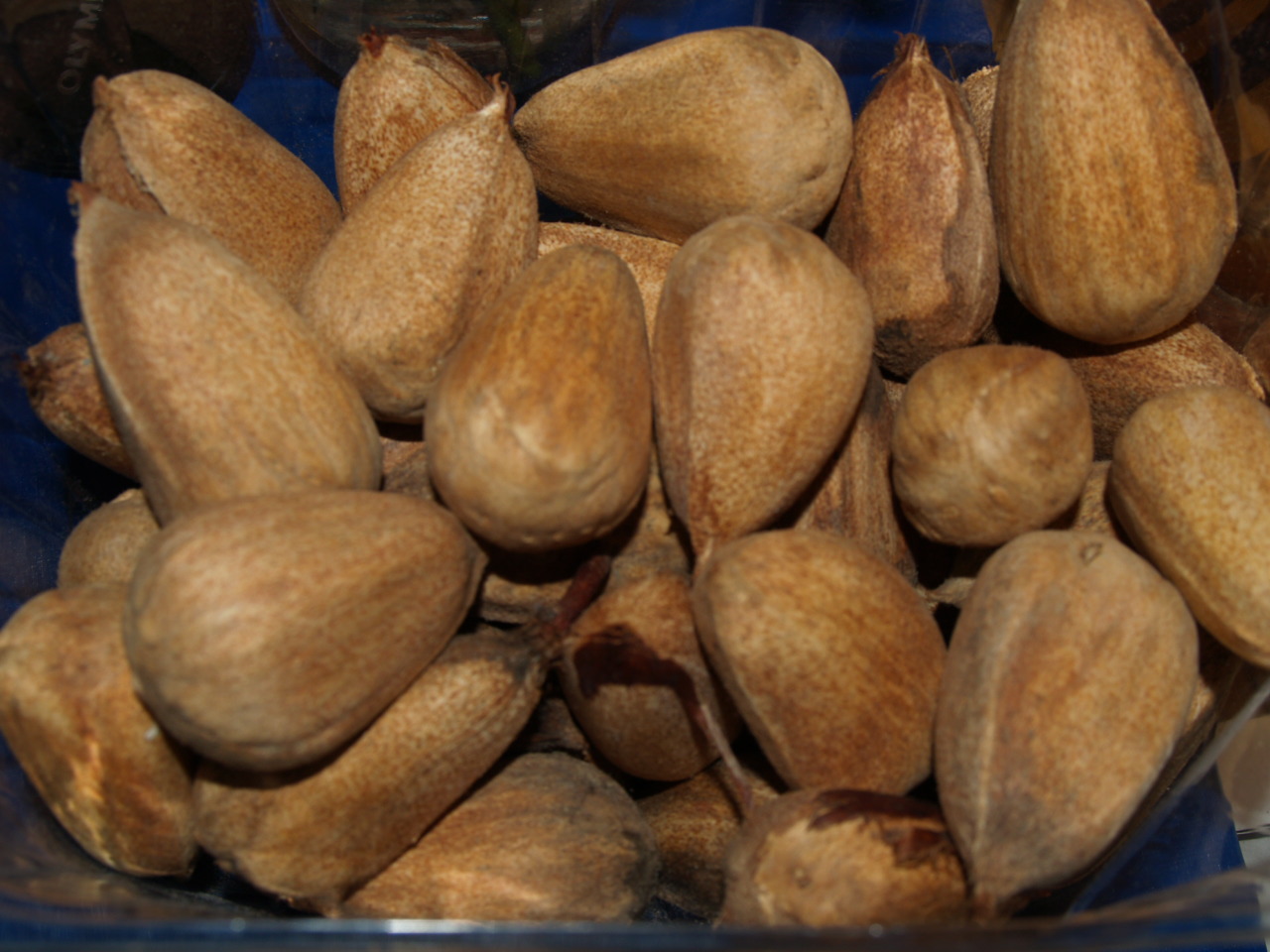
Bunya Nut, Araucaria bidwilli

Bunya Nuts from the tree Araucaria bidwilli

Local tree growing in a park
A friend has just given me some Bunya nuts which I have not eaten for years as they are not the sort of thing you find at the local supermarket. The process of cooking them involves boiling them in their shell for 30 minutes and then leaving them to cool for 4 hours after which time the shell can be removed with ease. They have a flavour not unlike chestnuts and can be used in both sweet and savoury dishes. They are apparently gluten free and high in complex carbohydrates according to Vic Cherikoff writing in his book Uniquely Australian: A Wildfood Cookbook. He gives a selection of interesting recipes using bunya nuts including one with crocodile steak....mmm
It is unfortunate that the tree is so tall and with such prickly leaves, it is unsuitable for city gardens or parks.The cones containing the nuts are so large (30 cm) round they could be deadly if one were to be hit on the head as they drop to the ground

Drawings by Betty Maloney of leaves and cone of Auracaria bidwilli (right) and A. cunninghamii (left)

Glenlyon Drive in Ashgrove, Brisbane lined with Bunya Pines
The most famous avenue of Bunya Pines is in the Brisbane suburb of Ashgrove . These trees marked the driveway to Glen Lyon estate, the farm of Scottish businessman Alexander Stewart who built a house there in 1876. The trees remained after the property was subdivided in 1918 and the house became the home of the Marist Fathers' Monastery from 1930.
I am not sure how popular the trees are with local residents who have to deal with the falling leaves and cones.

Wednesday, March 9, 2011

Agonis flexuosa and Eucalyptus diversicolour

Eucalyptus diversicolour
  Karri Tree of Western Australia
I have just finished reading the bitter sweet novel Breath by Tim Winton. The book was published in 2009 and has won a swag of literary awards, deservedly so. The main character, 'Pikelet' is very much aware of his environment, on both land and sea, and even spends a bit of time in the library reading books on plants when not distracted by conquering the surf. Two trees form part of the narrative and each represents a different aspect of his growing up in that southern region of Western Australia. The majestic Karri tree, one of the giants of the plant world is held in awe and the forest of these trees is a place of loneliness and fear, shunned by others in his community. Pikelet spends time amongst these trees to overcome his fear of some of the dangerous surf breaks he is yet to experience and to have alone time to contemplate and work out why his friends act the way they do.
The other tree is the coastal Peppermint or 'Willow Myrtle', Agonis flexuosa. In the book this tree is all sweetness and light, alive with honey eating birds while releasing an invigorating fragrance from its leaves in the hot sun to make the surf even more inviting for Pikelet and his friends.
Of all the wonderful trees from Western Australia, this is one which grows well on the east coast especially on coastal sands but also on difficult sites away from the coast in humid sub-tropic regions. It needs room however to reach its full potential and can reach 8 metres in height with a dense spreading crown of weeping willow type branches.The dwarf form A.f. 'Nana' only grows to 2.5 metres and makes an excellent windbreak or low hedge in coastal sands but has largely fallen out of favour since the rise and rise of the Lilly Pilly hedge of recent years. The coloured leaf forms, 'Variegata' and 'Fairy Foliage' are handsome small trees/large shrubs with dainty open habit and leaves tinged creamy yellow in the former and blush pink in the latter. Some shade is needed to stop the foliage from burning. Both are not easy to come by in the nursery trade perhaps due to their difficulty in propagation and slow growth habit. The cultivar 'After Dark' is more readily available and it fits the bill perfectly for the burgundy/black foliage colour mania which has been popular in recent years. It makes a decorative container specimen for even a tiny balcony garden.
Whenever I come across these trees in the future I will think of Tim Winton's terrific novel Breath

Willow Peppermint, Agonis flexuosa in the blinding white sand of WA
Photo:K.C. Richardson


Agonis flexuosa 'After Dark'
Breath is published by Penguin books

Tuesday, March 1, 2011

2 Rainforest Pioneer trees

Omalanthus populifolius 
 Native Poplar

Polyscias murrayi 
 Pencil Cedar

These two trees make an appearance from Gippsland in Victoria to Northern Queensland. They have evolved to be the first on the scene to fill a gap whenever a tree falls in the rainforest , land is disturbed bordering thick forest or a road verge is cleared of excess vegetation. The native poplar, which is also called bleeding heart is so successful in colonisation that it often appears in a variety of habitats and even makes an appearance in shady city gardens far from where you would expect to see it. It is a quick growing small tree, rarely growing more than 4 metres tall with a single trunk and bushy crown. It is the heart shaped red/orange leaves which appear throughout the year which gives it the bleeding heart common name and makes it quite distinctive when seen against the dark green of surrounding trees. The insignificant tassel like flowers followed by glaucous 10mm fruit are very attractive to birds which carry the ingested seeds and deposit them far and wide. Newly established trees are able to eek out a living in quite dry and inhospitable places though their leaves are often much smaller than those growing in better sites.
The Pencil Cedar is a more elegant tree with a beautiful silhouette when seen against the sky above surrounding vegetation. It is clever in establishing itself by means of a slender trunk to over 6 metres before deciding to branch. It grows a further 6 metres with an umbrella shaped crown of metre long pinnate leaves consisting of 30 opposite leaflets and one terminal leaflet. At this time of year it produces greenish yellow flowers on large branched panicles followed by small red fruit which are also attractive to birds.

The Catbird likes to eat the fruit of these trees.


Saturday, January 23, 2010

Brachychiton acerifolium, Illawarra Flame Tree

Brachychiton acerifolium, Illawarra Flame Tree
(growing beside the sugarcane fields of
the North Coast)
Flame tree flower detail

Seed pods

The term local legend or local hero is often applied to a sportsperson or entertainer who has had a successful career interstate or overseas, so perhaps the same could be applied to this tree from my district which has gained popularity far and wide. Brachychiton is derived from the Greek brachy meaning short and chiton meaning a covering or tunic, a reference to the seeds which are covered in yellow hairs. Acerifolium means the leaves are similar to a Maple leaf. This tree is unique in that it has a mind of its own as to whether it wants to flower or not. Normally it loses its leaves in late November and flowers in December and January. Sometimes it decides not to do this and sometimes half the tree retains leaves and displays half flowers. On the steep escarpment behind where I live and deep in the rainforest , the bright red flowers stand out like a beacon amongst all the dark green. The tree has made a successful transition to city gardens and is often planted alongside a Jacaranda which flowers at the same time. This year has been a great one for flowering so perhaps the rain fell at the right time to act as a trigger. When flowering does finish, the hanging seed pods are quite decorative also, being boat shaped and opening along one side they provide an opportunity to give an interesting nature lesson for children.

Sunday, December 6, 2009

Corymbia ficifolia, Scarlet flowering Gum

Corymbia ficifolia syn Eucalyptus ficifolia

This is one of the fantastic street trees in my neighbourhood.  There are 3 of them in a row and they were possibly planted by the owner of the house adjacent. What makes them an ideal street tree is that they rarely get too big to interfere with power lines and they are adaptable to poor soils. In recent years grafted specimens have been released in a range of other colours including pink, red ,and purple. Seed grown plants produce variable flower colour so this was a way of guaranteeing flower colour.


The "Gum Nuts" from this tree are decorative also


Growing in a Californian garden

Pictured on a stamp released in November 1982
(Designed by E Conabere)


A painting by May Gibbs (1877-1969) 1902
Art Gallery of Western Australia


Wednesday, November 11, 2009

Banksia serrata

Banksia serrata,Old Man Banksia as a bonsai
This is one of the first plants collected by Joseph Banks in April 1770 at Botany Bay in New South Wales. It occurs naturally along the coast and in the mountains from Queensland to Tasmania. As a garden tree it is long lived and develops a wonderful textured trunk and decorative "fruit"or "cones" from the old flowers which led to the common name of 'old man Banksia'. In the books written for children by Sydney author May Gibbs these cones were given a sinister edge and featured as 'big bad banksia men'. May Gibbs' garden and house is preserved and open to the public in the Sydney suburb of Neutral Bay.
Banksia serrata is very slow growing in the home garden and impatient gardeners may give up waiting for it to reach a reasonable size. It makes a great bonsai however and the attractive bark and gnarled form can be viewed in miniature.


Wednesday, July 8, 2009

Eucalyptus sideroxylon


Eucalyptus sideroxylon 
 Mugga Ironbark
This beautiful tree is in flower now and when you approach it all you can hear is the screech from hundreds of parrots which are feeding on the nectar laden flowers. The distinctive feature of this tree is the black furrowed bark which sometimes exudes an amber coloured gum. It is an ideal tree for parks ,streets and gardens as it rarely gets too big (about 15 metres) and does not shed limbs during storms. It will grow in quite poor soils, but in my experience, it does not tolerate coastal exposure and is liable to dieback if salt laden winds are prevalent.

Sunday, June 14, 2009

Bottle Tree, Brachychiton rupestre

The Bottle tree, Brachychiton rupestre is a remarkable tree from the sub coastal regions of Queensland. It has a conspicuous large swollen trunk.Though much of its native habitat has been cleared for cattle grazing, many fine specimens have been saved.The tree once formed an important part in the diet of Aboriginal people.The roots contain a valuable source of water in a very dry part of the country.The mucilaginous exudate from wounds in the trunk was eaten as well .The bark fibre was also used to make twine for weaving baskets. The Bottle tree is mentioned by early explorers of the region. In 1846 Major Mitchell made a jelly from wood shavings of the bark and Ludwig Leichhardt wrote that the young wood 'containing a great deal of starch between its woody fibres was frequently chewed by our party'.When cattle were introduced to the area, the soft tree trunks became a good stock food during times of drought.
  Standing under a Bottle tree in Dalby,Queensland

Brachychiton rupestre 
Bottle Tree in Wollongong Botanic Gardens

Sunday, April 26, 2009

Syzygium australe , Brush Cherry

Rainbow LorikeetSyzygium australe, Brush Cherry fruit

Often I am woken in the morning by a screeching noisy flock of rainbow lorikeets who, with their persistent raucous chattering are clambering through the bottle brush flowers outside my window. The other day I was surprised to see a large group on the ground working their way through the fallen fruit of a Brush Cherry. This is one of the most fruitful of the now common Lilly Pilly trees and some care needs to be taken as to where to plant one. If you park your car under one during the fruit season to will be covered with pink polka dots in no time. They can also be messy if planted near paved areas or pathways. It is a very attractive tree for larger gardens and is guaranteed to attract a variety of wildlife. Growing up to 9 metres it is a hardy tree over a range of climates.

Tuesday, April 21, 2009

Alphitonia excelsa , Red Ash


Dead trees are rarely left in landscapes or parks as they are deemed a safety risk, even though they provide an important bird habitat such as a nesting sites for parrots or as a vantage point for birds of prey.The tree below is an example of one such beauty which has been left, for the time being . It has strength and presence like the spires from work by Spanish architect Antoni Gaudi (1852-1926)

Antoni Gaudi (detail)


Worimi Dates sculpture from Red Ash (Alphitonia excelsa)
in Hunter Region Botanic Garden
This large dead tree has been used by sculptor Worimi Dates to depict the life the Garuahgal people of Raymond Terrace in New South Wales.

Alphitonia excelsa Red Ash leaf detail
The Red Ash is a good small tree for gardens on the east coast reaching a manageable size of about 6 metres.It is noted for the conspicuous silver on the underside of the leaves which becomes more noticeable when the tree is blown by the wind.
2017 update: I used to grow this but no longer have plants for sale.


Monday, February 23, 2009

Backhousia citriodora ,Lemon Myrtle


Backhousia citriodora
  Lemon Myrtle
Lemon Myrtle leaves have become a familiar and mainstream additive to a diverse range of products such as marinades, teas, yoghurt and soap. In its native habitat of Queensland it grows as a tall rainforest tree but is adaptable to a range of climates and can be sheared as a hedge plant or grown in a container. It makes a good pot plant if you want to have a few leaves on hand close to the kitchen .As a young plant it can be a bit straggly with a very open habit but soon becomes more compact with regular tip pruning. It is really one of those essential garden plants as you can never get tired of crushing a few leaves in your hand to release that warm citrus aroma.
2017 update: I currently don't have any stock available.