Showing posts with label Herbs. Show all posts

Sunday, February 1, 2015

Jasminum sambac 'Grand Duke of Tuscany'

 Jasminum sambac 'Grand Duke of Tuscany' (Oleaceae)
'Gardenia Jasmine'
How sweet it is...This is the Italian form of the Arabian jasmine which has button-hole perfect white flowers like mini Gardenias which become stained with purple on the outer petals as they age. The flowers are scattered through straggly angular stems embraced with quilted oval leaves and the resulting bush of a metre or more will never win a prize for being neat, clipped and tidy. It makes a good pot plant and table centre piece when in flower and growth is generally quite slow. The flower buds of the single form are used to make jasmine tea especially in the Philippines.
 I bought this one from the Growing Friends Nursery at the Royal Botanic Gardens in Sydney earlier last year.

Sunday, August 24, 2014

Pelargonium 'Snowflake'

 Pelargonium 'Snowflake'
Just to confuse everyone,there are three or probably more scented leaf Pelargoniums which have the 'Snowflake' title. This is the Australian version which was bred by the late Mr Ted Both of South Australia who was a horticulturist and plant breeder of some renown by all accounts. It is a small shrubby plant and has large 'trilobed crenate' leaves which are well marked and flecked with creamy white. They have a fresh minty rose scent when crushed.
The American, Logee's Snowflake' is more of a spreading plant as it has the groundcover species capitatum as a parent, while 'Atomic Snowfake', also from the USA, has leaves edged with cream or yellow. It originated in Camden, Maine at the famous Merry Gardens Nursery of Mary Ellen Ross who specialized in scented Geraniums and herbs.

Sunday, July 27, 2014

Plants for Aromatherapy

 Aromatherapy, Massage Oils and simple home remedies in Maria M Kettenring book published by www.joy-verlag.de
(Aroma-Gesundheitsparktikerin ,Dufttrainerin und Autorin zahlreicher Bucher)

I am not good at self-promotion but it was a real thrill to have my photo of Palmarosa grass (Cymbopogon martinii var motia) included in this book and be given credit as an 'Australien'.
Now if only there was a bit of demand for Palmarosa plants locally as I failed to shift more than a few units of it over last summer.
A couple of  Aussie plants which are making an impact in Europe, included in the book are, 'Teebaum', Melaleuca alternatifolia , or what we know as tea-tree oil, and Cajeput from Melaleuca  leucadendron var. cajeputii.


Tuesday, May 13, 2014

Winter savory, Satureja montana

 Satureja montana (Group) Lamiaceae
'Winter Savory' , 'Sarriette',  'Ajedrea'
The great American botanist and garden writer, Helen Morgenthau Fox (1884-1974), details her 'discovery' of this herb in her 1952 essay 'Notes on a Few Savories'.......(botany meets herbes et aromates de Cuisine) While Mediterranean herb plants were difficult to procure in the first decades of the 20th century she was lucky enough to be sent seed of different Satureja species from a Swiss Nurseryman, Henri Correvon, though the resulting plants were to have their species status stripped from them and instead were later just grouped under S. montana. 
This prostrate form which is sometimes given the name 'Nana' is similar to S. spicigera though the latter has longer leaves. It is a terrific herb for slow cooked winter dishes, say, 'le cassoulet' with plenty of beans. Just a pinch though as the flavour is strong.
What I really like about this plant however is its venerable shape similar to an old arching tree. Of course this makes it the perfect candidate for a bonsai pot.

Sunday, April 27, 2014

Sweet Cicely, Myrrhis odorata

 Sweet Cicely 
 Myrrhis odorata (Umbelliferae)
I have Buckley's chance of being able to grow this herb well but it is worth a shot. I bought this at the recent Collectors' Plant Fair and a lady next to me who was buying one also told me she was from Bathurst so she has a much better crack at growing it successfully.
 Sweet Cicely is a European shade loving perennial which is stimulated to grow well by a certain amount of snow cover over winter. Move to Scotland I hear you say? Snow has the effect of scarifying any fallen seed thus aiding germination and when the snow melts the trigger for growth is manifest. It is said to be the last herb to die down before winter with the foliage first reacting to the cold by turning purple. As a flavouring herb Cicely has a mild sweet flavour of aniseed or liquorice. All parts are edible including the roots which can be cooked as a vegetable. I have a 'food memory' of it from over thirty years ago. When visiting Madge Hooper at Stoke Lacey Herb Farm in Bromyard, Herefordshire, I was given the green seeds to chew on. They were sweet and very pleasant tasting. It has been a long wait to finally get my hands on a plant for however long I am able to keep it alive.

Wednesday, March 19, 2014

Pelargonium carnosum

With the Collectors' Plant Fair vibe in the air (April 12 &13) it is time to fess up and admit to being a collector of obscure plants of one genera or another. One of my favourite nurseries at the Fair is that of Robyn Bible who specializes in all things Geranium/Pelargonium. I like this group of plants because many species have scented leaves and they are able to survive on very little water or attention. Pelargonim carnosum resembles a bonsai tree, a deciduous one at that, and is given a common name of 'fleshy-stalked pelargonim' .It occurs in semi desert regions or karroid vegetation localities of South West Africa, Richterveld, Namaqualand, South Western Cape and dry areas in the Eastern Province.
The flowers are an unfortunate shade of pus yellow/green with inflamed streaks on the upper petals.They are quite delicate and demand closer inspection with a hand lens to appreciate their form. Inflorescence 'tech heads' take note that the peduncles are usually branched to bear several pseudo-umbels with 2 to 8 flowers each.


Saturday, March 15, 2014

Allium 'Millenium'

 Allium nutans x senescens 'Millenium'
This onion family member (Alliaceae/Liliaceae) has been in flower for about six weeks with its lavender coloured spheres carried on strong stems emerging from a clump of strap shaped leaves which resemble garlic chives, though they are more glossy green than chives in appearance. I am anticipating it will have some 'down time' during the cooler months ahead with the foliage shriveling or turning yellow and needing a haircut at ground level. As this is a cool temperate climate bulb tolerant of snowy winters ,originating from Allium breeder Mark McDonough in the United States, it remains to be seen how it will perform in the coming year. I am hoping it may find a place as a flamboyant substitute for Tulbaghia, the 'society garlic', which has smaller flowers.
2017 update: I am currently sold out of this.


Tuesday, March 11, 2014

Orange-Peel Thyme, Thymus richardii spp. nitidus

Thymus richardii spp. nitidus 
 Orange Peel Thyme
If you bury your face in a pot of this prostrate thyme your senses are assaulted by a fragrance of bitter oranges and pine, not a combination which endears it for use in the kitchen in a culinary foray, but more a scent one would expect to find in a men's cologne.
I grow this in a pot because the closely packed leaves and dense habit make it susceptible to fungal rot in late summer humid days. It perhaps needs to clamber through some rocks or across paving so as to avoid this habit of up and dieing for no apparent reason in a mild coastal climate. It also fails to flower for me so maybe needs a cold winter trigger to implement this though no matter as the it is worth growing for the unique scent alone.

 'What time the mighty moon
Was gathering light
Love placed the thymy plot
of Paradise'
Alfred Tennyson

Saturday, January 4, 2014

Origanum dictamnus 'Dittany of Crete'

 Origanum dictmamnus 'Dittany of Crete'
As the 'Holy Grail' for herb enthusiasts and something of a 'literary celebrity' in its own right, I was pleased to finally get my hands on this plant recently, though who exactly imported it, or the seed, would be interesting to know, as often such information in the Australian horticultural trade can be a closely guarded secret. While recorded as growing in European gardens as early as 1548 by herbalist William Turner, who wrote in his The Names of Herbs that he had seen it growing in Venice and Antwerp, he did not record its presence in English gardens until his 1568 Herball in which he wrote: " I have seen Dittany growing in England in Maister Riches garden naturally, but it groweth nowhere else that I know saving only Candy" ( the old name for Crete) The Hortus Kewensis confirms Turner and lists Dittany of Crete as "cultivated in 1551 by Mr John Rich". 
Fast forward to the early 20th century, in the US, the records of The Herb Society of America pinpoint its arrival there to the year 1936, brought over from Crete by one of its members, Mrs Ellery Sedgwick. who had procured a plant there from a woman who had been her cook in New York. Up until then herb growers had only been able to see what this ancient herb looked like from the specimen in the Gray Herbarium of Harvard University which had been collected in 1846 by Theodor Von Heldreich, Director of the Athens Botanic Garden. As Mrs Sedgwick recalled "The herb was some five inches high and had five or six little labiate flowers with protruding stamens at the ends of its branches, and resembled exactly the pictures of the specimens of Dittany at the Gray Herbarium of Harvard. Interest in the plant had also been sparked by the publication of the findings by British archaeologist Sir Arthur Evans (1851-1941) in his four volume Palace of Minos at Knossos (Macmillan Co. Publishers) where it was depicted on a fresco of birds perched amongst Cretan plants, this Caravanserai gave a window into the civilization of 1500 B.C..Sir Arthur was obviously a sharp eyed plantsman for he had already seen the wild plant growing in the crevices of rocks and described it as having 'rounded leaves like Pennyroyal ...lilac veined and covered with soft downy hairs, with a flower of a delicate purple hue emerging from a cluster of overlapping bracts 'and 'answering Virgil's description' In Virgil's Aeneid (29BC-19BC) Bk X11 tells of Venus helping to heal the wound of Aeneas.
"A branch of healing Dittany she brought
Which in the Cretan fields with care she sought.
Rough in the stem, which woolly leaves surround.
The leaves with flowers, the flowers with purple crowned.
Well known to goats; a sure relief
To draw the pointed steel and ease the grief."
The poem references goats which had long been observed nibbling on 'this sacred herb of Crete'  when wounded as an aid in their recovery.
So getting down to the nitty gritty of growing it in a climate which is just not like Greece in any way shape or form is a challenge. I am growing it in a pot in a mix of sand and perlite, not watering it much and keeping my fingers crossed that it survives the coastal humidity this summer. Taking cuttings to ensure a backup supply is advised for those like me who struggle to grow plants out of their comfort zone.
2017 update: Sadly lost my plant of it.

The Partridge Fresco from Pavilion of Caravanserai 
 Palace of Minos at Knossos, Crete

Theophrastus (371 BC - 287 BC)

Friday, December 20, 2013

Nasturtiums in pots

 While the garden bed Nasturtiums have long gone, shrivelled in the heat and dropping a load of seed, I have had more success in keeping them going in pots. One thing I did not realize is that they can be pruned back in a reasonably hard manner and they will regrow in a more compact and floriferous way. Container growing also makes it easier to control the amount of fertilizer they get as it is well known that excessive nitrogenous fertilizer will produce a mass of leaves with hidden flowers. Removing spent flowers stops them going to seed and thus shortening their life and though this takes a bit of extra effort there is no reason why these Nasturtiums will not keep on going all through summer and into autumn.
These 'Christmas red' ones will make a nice addition to the festive table in the coming days.

Tuesday, December 10, 2013

I (can't) grow sage

Garden Sage, Salvia officinalis affected by root rot
Out of my current batch of a hundred or so sage seedlings I am hoping to get at least a few which go on to reach maturity and become large healthy bushes. I think the trick is to avoid overhead watering if possible as moisture around the base of the plant and on the leaves creates ideal conditions for the spread of the fungus which causes the rot. (Fusarium solani and Rhizoctonia solani) Living in a cool dry climate with zero humidity also helps, as well as providing an alkaline, gritty, free draining soil.
The old Arabian proverb "How can a man die who has sage in his garden?" and the fact that sage is traditionally the herb which has a centuries old track record for helping shield against declining faculties and failing memory has stirred me into the task of growing it
successfully.   Sharp as a tack at eighty you bet....
 I am also growing the red leaf sage (S. officinalis 'Purpurascens') pictured below. It is a bit of a gloomy looking plant, though in a good light the leaves have that purple bloom of a summer sugar plum.
The name Salvia is from the Latin salveo or "I am well" and the colloquial corruption of the name became sange in old French and sauge in old English. Midwives in France were known to use sage leaves macerated in a liquore to be given "aux femmes qui vont prochainement accoucher." Expectant fathers probably needed a swig as well.

Monday, December 9, 2013

African Blue Basil

 Ocimum kilimandscharicum x Ocimum basilicum 'Dark Opal' 
Tradescantia pallida in background
This is a big shrubby perennial basil growing to over a metre in height which has matte green leaves coloured on the reverse side a dusty purple. It originated in an American herb garden as a chance seedling and is a sterile hybrid, not setting any viable seed. It flowers for most of the year and is one of the best bee attracting plants that I have grown. As basils tend to be shallow rooted it is advisable to stake this variety as it is very susceptible to blowing over in a strong wind. Mine did in August and though it kept growing after being propped up I eventually hauled it out. I took cuttings which struck fairly readily and now the new plants are off and running into flower with the bees back in force. Plants can also split down the middle often under the weight of all the flowers which elongate and keep on going seemingly forever. A once over with hedge shears is a good way of keeping a trim and compact bush. You could do this in stages if you are worried about depriving the bees of some food. Plants require very little water and will tolerate light frosts.
There is a bit of debate around about the edible qualities of the perennial basils (there is a plain green type as well). It does contain quite a bit of camphor oil which makes it pungent so err on the side of caution when using in the kitchen.


Thursday, December 5, 2013

Golden Lemon Balm,Melissa officinalis 'All Gold'

Melissa officinalis 'All Gold'
Lemon in colour and flavour and a great plant for a shady corner, this variety differs from the closely related Melisa officinalis 'Aurea' (syn.'Variegata') , the variegated lemon balm, which has leaves splashed and speckled with yellow. The interesting thing about 'All Gold' is that it can spend quite a bit of the year with green leaves, at least from autumn till late spring, though some say this is a response to overly rich soil which favours the green leaves. This year when I trimmed back my plant in late winter I took cuttings which I just layered into the soil in the vegetable garden .These soon struck and turned golden while the mother plant sat with a dull green face. Given too much sun the leaves can quickly bleach white then scorch brown. Overall this variety is less vigorous than the common green lemon balm and is a very worthy addition to an ornamental shady garden or herb patch.
The lemon balms are good bee plants and the name 'Melisa' is synonymous with the Greek word for bee and they are kept happy within a hive from the use of this plant growing thereabouts. It also has a long history of culinary use and can be used in any way where a zesty lemon flavour is required. As it grows wild in the southern parts of France, the French were inventive in using it in all manner of ways. The celebrated Eau de Carmes or Carmelite water was a popular tipple in the seventeenth century. You can make a modern version by adding the flowering tops of balm to a litre of brandy along with a few twists of lemon peel and aromatics such as angelica root, cloves, nutmeg, coriander seeds and cinnamon sticks.Left for a week or so to let the flavours infuse and then strained, you have yourselves a cordial tonic to uplift the spirits.

Sunday, December 1, 2013

Calendula 'Neon'


 Calendula officinalis 'Neon'
I am often running late in getting things planted out. These Calendulas  which I grew from seed planted back in autumn languished in a seedling tray for months, often drying out and looking fairly stunted until I finally got around to planting them . Calendulas or Pot Marigolds are at their best when flowering during winter here and by spring the plants become susceptible to mildew or rust and need to be pulled out. These later planted ones are proving me wrong as they have not succumbed to mildew or rust both diseases common in the variable weather conditions of spring. Theoretically you should be able to have Calendula flowers all year round if you live in a temperate climate as their very name is derived from the Greek word for calender, Kalends. Originating in the Canary Islands and in coastal Mediterranean regions it has been a popular flower in Europe for centuries and has been given interesting regional common names. In Italy it is Fioridi ogni mese; in France Soucis derived from solsequieum or sun follower and in Germany Todtenblumen.It seems likely that the plant followed the same trade routes as saffron in its journey to Asia as it was used as a dye plant in China.
I am impressed  with this variety 'Neon'. The flowers have burnished copper tips to the petals which also have a slight twist to them, while the buds are darkly sexy. They have the David Bowie Ziggy Stardust period look about them,with all those spiky orange petals.

Planted between Nasturtiums in an edible flower patch

"The marigold that goes to bed with the sun
And with him rises weeping: these are flowers
Of middle summer, and I think they are given
To men of middle age"
Shakespeare 
Perdita in ''A Winter's Tale''

Saturday, November 30, 2013

German Chamomile, Die Echte Kamille, Matricaria recutita

 Matricaria recutita syn Matricaria chamomilla (Asteraceae)
It's harvest time for my German chamomile flowers though I have yet to meet anyone who shares my enthusiasm for this herb. The flowers are alive with insects which are probably attracted to the nose twitching scent. No wonder they call this annual 'stinking mayweed' as it is very much a part of a northern hemisphere spring.
 I sow seed in winter in trays, separating out the seedlings once they are large enough. It could also be sown direct in vegetable garden plots or in any open sunny spot with not overly rich soil. Seedlings can be slow at first but grow quickly during the first warm or hot days of early spring eventually sending up flowering stems to 30cm or more. When all the flowers are out and the petals are not downward facing I cut them, placing the flowers in containers and putting them straight into the freezer. They stay quite separate after freezing and it is easy to get out a small handful for later use. I use chamomile for herbal tea, mixed with peppermint, and as a garden fungicide spray against damping off in seedlings. Terrific stuff from an easy to grow plant.
Worth looking out for and very helpful to use on calloused gardening hands is this chamomile handcream from Germany.


Tuesday, November 26, 2013

Scented Geraniums

 Scented leaf geraniums (Pelargoniums) are ideal low maintenance plants because of their  water use and fertilizer requirements, small root system and, in some spreading or cascading habit. The varieties pictured here, clockwise from top, include fine leaf 'Royal Oak', lime scented, variegated peppermint-rose, apple, peppermint, lemon and nutmeg in centre.

Sunday, November 3, 2013

Cooking with Michael Pollan

This is the time of year when all the new books hit the shelves in time for the Christmas market and when you start to think about the relaxing days of summer ahead with reading or dozing in the shade of a tree during the hottest time of the day high on the list of the day's agenda. Earlier this year the thought proving American author Michael Pollan released a book called 'Cooked: A Natural History of Transformation' It is on my must read list having sampled the PDF introduction available online. The quote I always remember from Pollan  is "Eat food. Not too much. Mostly plants.", and in this new book he deals with the philosophy behind four elements which have shaped culture through cooking and food, namely fire, water, air and earth. In fire he writes about cooking whole animals over an open fire. In water he deals with cooking in a vessel by boiling or braising. Air is about baking and earth is about fermenting, the process used for cheese making and brewing.
So my humble poached chicken from the other night has taken on a whole new meaning when it is described thus :"The pot dish, lidded and turbid has none of the Apollonian clarity of a recognizable animal on a spit but is a primordial Dionysian soup" as the "marriage of plant and animal foods in a liquid medium is preferable to cooking either food over direct fire" with the added "onions, garlic and herbs containing powerful antimicrobial components  which are able to survive the cooking process" and which are therefore very beneficial to health and well being. While I am on the right track here and enjoy cooking I am also an eater of the microwavable frozen convenience meal, the very thing Pollan rallies against in his books, because they have been made by a huge corporation and you have absolutely no idea what is in them and where those ingredients come from, for, in the long run "You are what you eat eats".


Thursday, October 24, 2013

Angelica pachycarpa

Flower of Angelica pachycarpa

Ripening seed of Angelica pachycarpa
This is not the herb Angelica but the glossy leaved biennial plant which is noted for its wonderful structure, especially the way the leaves clasp the stem and fan out from it, as well as the starry plate like flowers which appear in spring. Like many plants affected by a changing climate this species is skipping the normal slow growth of two years before flowering and instead is bolting ahead and flowering within its first year. When I grew it in the garden I let my plant go to seed and then dug up the seedlings which appeared underneath some time later. Trouble is I only ended up a few plants and I want more so I can have some plants available for sale, as, in its juvenile stage it makes a terrific pot plant or striking garden specimen. Saving seed of any plant can be both frustrating and rewarding. In this case the seed is ripening unevenly with individual seed cases turning brown and appearing ready to collect while their nearest neighbours are still green. What to do? Place a catcher or tray underneath the plants which means the seed could end up blowing away or stolen by insects, or place little muslin bags over the entire seed head so that the seed has something to fall into? Whatever seed I end up with I will store till next autumn before planting and hopefully have some nice plants ready by next spring.


Monday, September 16, 2013

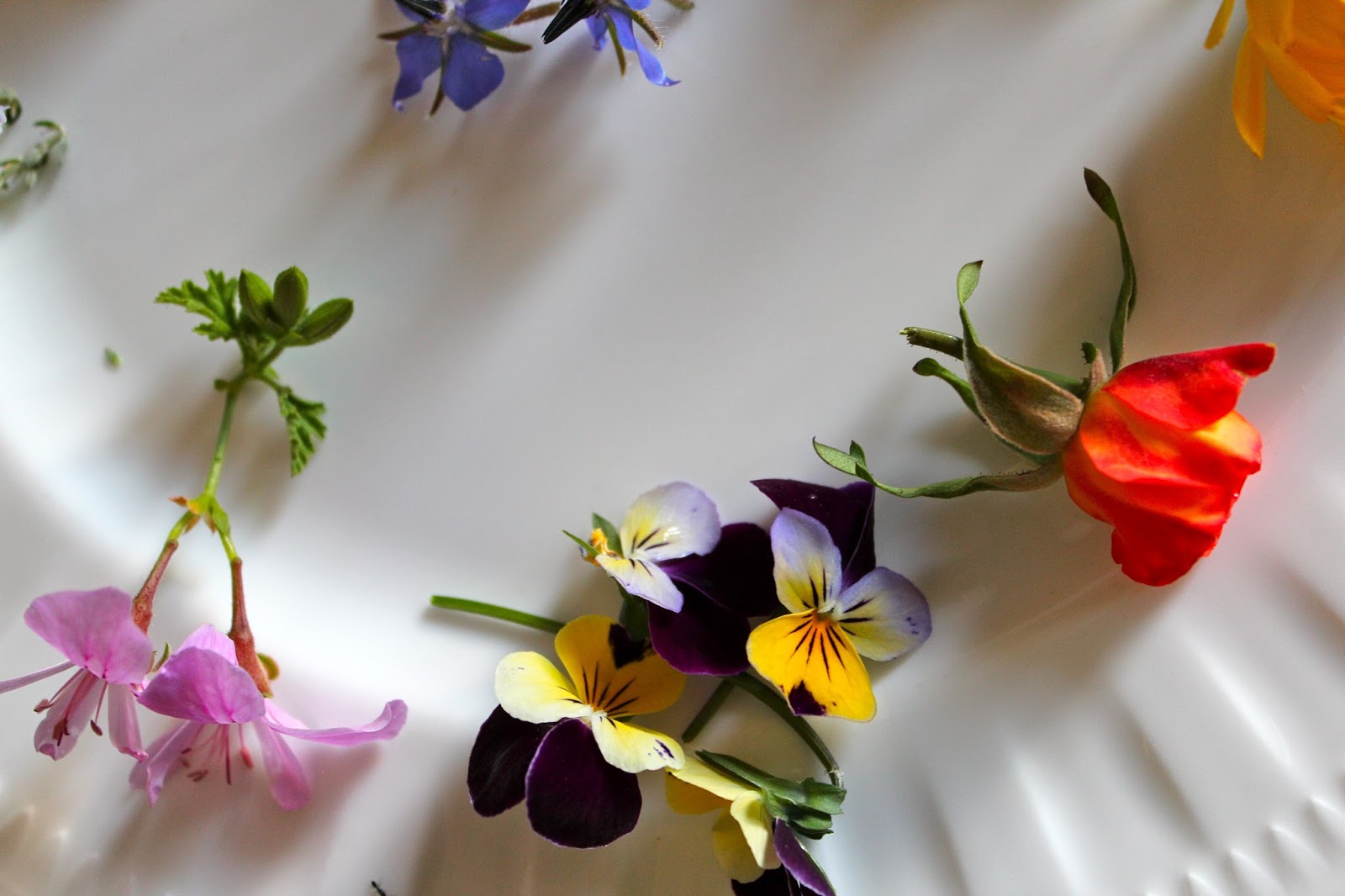
Microgreens & edible flowers:Art on a plate.

Edible flowers(clockwise from top): Dianthus, Star flower, Calendula, Rose, Viola, scented Geranium, Rosemary, Nasturtium, and Borage in centre
A quick walk around the garden and it is easy to find a selection of flowers which can be used for special occasion meals or for using day to day in a salad or vegetable dish. My tip is to use whole flowers as decoration and just petals if they are going to be eaten. Some flower flavours are quite strong. Nasturiums are hot and peppery, Star flowers taste strongly of garlic, while Borage can be coarse and bristly if you leave any stem in place. Moderation is the way to go and if you are uncertain about whether a flower is edible best avoid it , however pretty and decorative it may look. I'm thinking of the very poisonous Oleander flower as an example.
Microgreens have finally gone mainstream after years of being the exclusive preserve of fine dining chefs. A few weeks back I was reading Gardening Australia magazine in the newsagent, as you do, and noticed a small pack of Mr Fothergill's Microgreens Seed attached to the cover. I didn't have time to find out whether there was a story in the mag on them as I was given one of those 'this-is-not-a-library-mate' looks from the guy behind the counter. "Yeah OK mate I'm just a ten cents a dance nurseryman" I thought as I put the mag back.
I have to admit to being a bit sceptical about the taste of Microgreens given that they have been marketed as a newer and better version of sprouts and originate from their spiritual home of southern California. I have never been a huge fan of sprouts having eaten too many takeaway salad sandwiches crammed full of sour tasting ones of the alfalfa or mung bean variety.(Snowpea sprouts are OK) However once you try Microgreens with their clean fresh taste and crunchy texture you are hooked. If they have not been given the tag of 'superfood ' then they certainly deserve it.
Mr Fothergills have several different packs available including 'Mediterranean Flavours' of Italian Basil ,Rocket and Sunflower and 'Flavours of Western Europe' which includes Cress, Pea 'Morgan' and Red Amaranth. They also offer a tray kit so you don't need to muck around with soil to grow them in.

The kit consists of a plastic tray which sits on top of a reservoir which is filled with water. You need to place the seeds on a damp piece of tissue paper and as the seeds germinate the roots grow down through the tray into the water. The seeds need to be sprayed with a fine mist of water to keep them moist until they germinate. Now this is where I came unstuck and got it wrong. My horticultural "expertise" went out the window and I tried growing three different types of seeds at the same time, forgetting the basics about different rates and times of seed germination. So in this case the cress was up and running after a couple of days followed by the peas by which time I had already snipped off the growing cress, while it is not really warm enough yet to grow the Amaranth as it is a true summer plant.


Don't be alarmed if the tissue on which the seeds germinate turns brown. This is just stain from the tannins in the seed coat as it is cast aside when the first 'cotyledon' leaves emerge.
The tray growing kit is ideal for apartment dwellers who don't want to muck around with soil and it also has the advantage of being able to be placed directly on a meal table allowing guests to snip off the fresh leaves if they so desire. It would certainly be a real talking point.
So my microgreens education has only just begun and I hope to perfect the art of growing them over the coming months with more photos to add to this post.
The link to the Mr Fothergills web page is below.

Seeds, Vegetable Seeds, Flower Seeds and Herb Seeds