Showing posts with label climbers. Show all posts

Sunday, April 9, 2017

Antigonon leptopus, 'Chain-of-Hearts'


             Antigonon leptopus (Polygonaceae)
With all the autumn rain, this climber has taken off and has scrambled over everything in its path. I don't have the heart to cut it back right now as the flowers are a magnet for bees. The flowers grow out from the tendrils at the end of long trailing stems and are the most vivid shade of hot pink. Being in the buckwheat family, the seeds are said to be edible if you fancy going through a long collection and winnowing process. The tuberous roots are also claimed to be edible. This root system allows for cutting back the entire plant to ground level during winter, which I do knowing it will re-shoot as soon as the warm weather returns. Treating it as a summer annual climber seems to be the way to go but I am just hoping nothing has been smothered under all that lush growth.

Sunday, March 12, 2017

Jasminum officinale, 'Poets Jasmine'


       Jasminum officinale, 'Poet's Jasmine'
This has always been my favourite species of Jasmine and it took me awhile to locate a plant of it to start propagating it again as it has almost disappeared from the nursery trade. A gardening friend from the Sydney suburb of Paddington had it growing along a wall mixed in with Jasminum nitidum and old roses. She also showed me where a giant plant of it was cascading over a local lane way wall so perhaps it is an inner urban plant of yesteryear.
Overall it is an untidy lax shrub and not strictly a climber as it rambles and scrambles its way over things flowering almost non-stop in a mild frost free climate. Training it as a single trunked specimen against a sturdy metal post is often the way I have seen it growing in the gardens of Italian-Australians where it holds special significance. In Italy the flowers were entwined with orange blossom to form a bridal headdress assuring the bride of constancy and love; a tradition derived from the country expression of 'she who is worthy of being decorated in jasmine is rich enough for any husband'.
 I currently have plants available in 100mm / 4 inch pots at $7.50.

Friday, February 17, 2017

Solanum wendlandii, Blue Potato Vine

Solanum wendlandii  
Paradise Flower, Blue Potato Vine, Divorce Flower
(Flowers described as lavender coloured, showy terminal panicle of cymes up to 20cm long)
Fading flowers set against a Golden Robinia Tree

Dense climbing branches up to 4 metres long covering a pergola
I have been admiring this climber in my neighborhood for years . It grows across a pergola walkway at the entrance to a townhouse complex. This plant could be considered a cool tropical as it native to mountainous areas of Central and South America, and therefore tolerant of a wide climate range. It was first collected by German botanist and horticulturist Hermann Wendland (1825-1903) in Costa Rica in 1882. He sent seed from the Royal Garden of Herrenhausen in Hanover to Kew Gardens where it was subsequently described in the Curtis' Botanical Magazine of 1887. Debate has raged ever since as to an exact species description and habit. The leaves are variable in shape and can be entire and ovate or deeply lobed. Leaf and stem prickles can be present or few and absent. So I hit the jackpot with this plant as it has very prickly leaves. When I went to take a few cuttings, the leaves attached themselves to my fingers like Velcro hooks and also to each other so I was left with a tangle of stems clinging to my hands. As climbing roses can be thorny I guess this should not be a deterrent from growing it. In Australia there are only male plants so seed does not appear and it must be propagated vegetatively. It appears on weed lists in Queensland but this may be because it goes absolutely rampant in the sub-tropics not because it throws off loads of seed which invade bushland.
2017 update: I have limited stock available.

Sunday, February 1, 2015

Jasminum sambac 'Grand Duke of Tuscany'

 Jasminum sambac 'Grand Duke of Tuscany' (Oleaceae)
'Gardenia Jasmine'
How sweet it is...This is the Italian form of the Arabian jasmine which has button-hole perfect white flowers like mini Gardenias which become stained with purple on the outer petals as they age. The flowers are scattered through straggly angular stems embraced with quilted oval leaves and the resulting bush of a metre or more will never win a prize for being neat, clipped and tidy. It makes a good pot plant and table centre piece when in flower and growth is generally quite slow. The flower buds of the single form are used to make jasmine tea especially in the Philippines.
 I bought this one from the Growing Friends Nursery at the Royal Botanic Gardens in Sydney earlier last year.

Friday, April 25, 2014

Allamanda cathartica 'Floreoplena'

 Allamanda cathartica 'Floreoplena' (Apocynaceae)
This double flowered Allamanda has been in flower for months and is showing no sign of slowing down in bud production. It seems to like growing against a brick wall which retains some heat long after the sun has set. I grow a number of different varieties grouped together in pots and they remain happy to grow in this way without becoming stressed by being pot bound. The double form has a number of cultivars including 'Halley's Comet' and 'Stansill's Double', though most seem to be lumped together under the name 'Williamsii' which is described as being both a semi double or a large single. Please explain? It is also described as having fragrant flowers though this is too subtle for me to notice.Perhaps more noticeable at night?

Wednesday, February 19, 2014

Allamanda 'Creme Caramel'

Allamanda 'Creme Caramel'
This climber may be the perfect gift for a food obsessed person or someone with a sweet tooth? Topically MKR? 
Allamandas love the muggy weather we are having at the moment with new flowers opening every other day. The shiny caramel coloured buds on this one open to lovely custard petals infused with more caramel at the centre of the flower. It certainly glows but perhaps it may be too subtle for those used to the bright daffodil yellow flowers of the typical form.
It is deciduous in cooler climates outside the sub tropics but is generally hardy preferring it on the dry side over winter. It likes a hot site against a western wall and needs to be tied onto a support as it will not climb with tendrils but merely sends out arching branches topped with sprays of flowers. It is perfectly happy when grown in a large pot.

Monday, December 16, 2013

Two double Bougainvilleas

Bougainvillea ' Klong Fire'
Bougainvillea 'Pagoda Pink'
Ok so they look remarkably similar in the photos but 'Klong Fire' starts out as a rich dark red and ages to hot pink while 'Pagoda Pink starts out hot pink and fades to a softer pink. Both are just as vigorous as the single flowering varieties but the flower heads of 'bracts' are denser and there seems to be more of them. Both make good container grown specimens and they can be kept dwarf and compact with ease and flowering for most of the time as well. I must say I like to grow Bougainvilleas without stakes. Most are sold tied up like Joan of Arc in a stiff manner but if left untied and pruned as a compact shrub they are more versatile as to their ultimate use, either as a container or planter box specimen or to be espaliered against a wall or made to cascade over an embankment or grow up over a pergola. Leave off the stakes please growers.....

Dwarf Red Bougainvillea 'Temple Fire'

Bougainvillea 'Temple Fire' with Antignon 'Coral Creeper'
  "You little beauty" is all you can say about this plant. Only growing to about a metre it seems to be always in flower and needs minimal trimming ,water or fertilizer. It is a good "Boug" to grow in a planter box under the eaves of a dwelling, in full hot western sun or on a balcony where rain can't reach. Overall however growth can be slow to reach that maximum spread and very few Nurseries offer mature plants in a large size pot ,but it is worth the wait if planting a small one. I am combining the 'Temple Fire' with the climber Coral Creeper or Chain of Hearts (Antignon leptopus) which sends off long shoots which are amenable to being draped over other plants as flowers on it appear at the tips over summer.  More cultural notes can be found on this website:
Dwarf Red Bougainvillea (Bougainvillea 'Temple Fire') (Department of Natural Resources and Mines)

Saturday, October 5, 2013

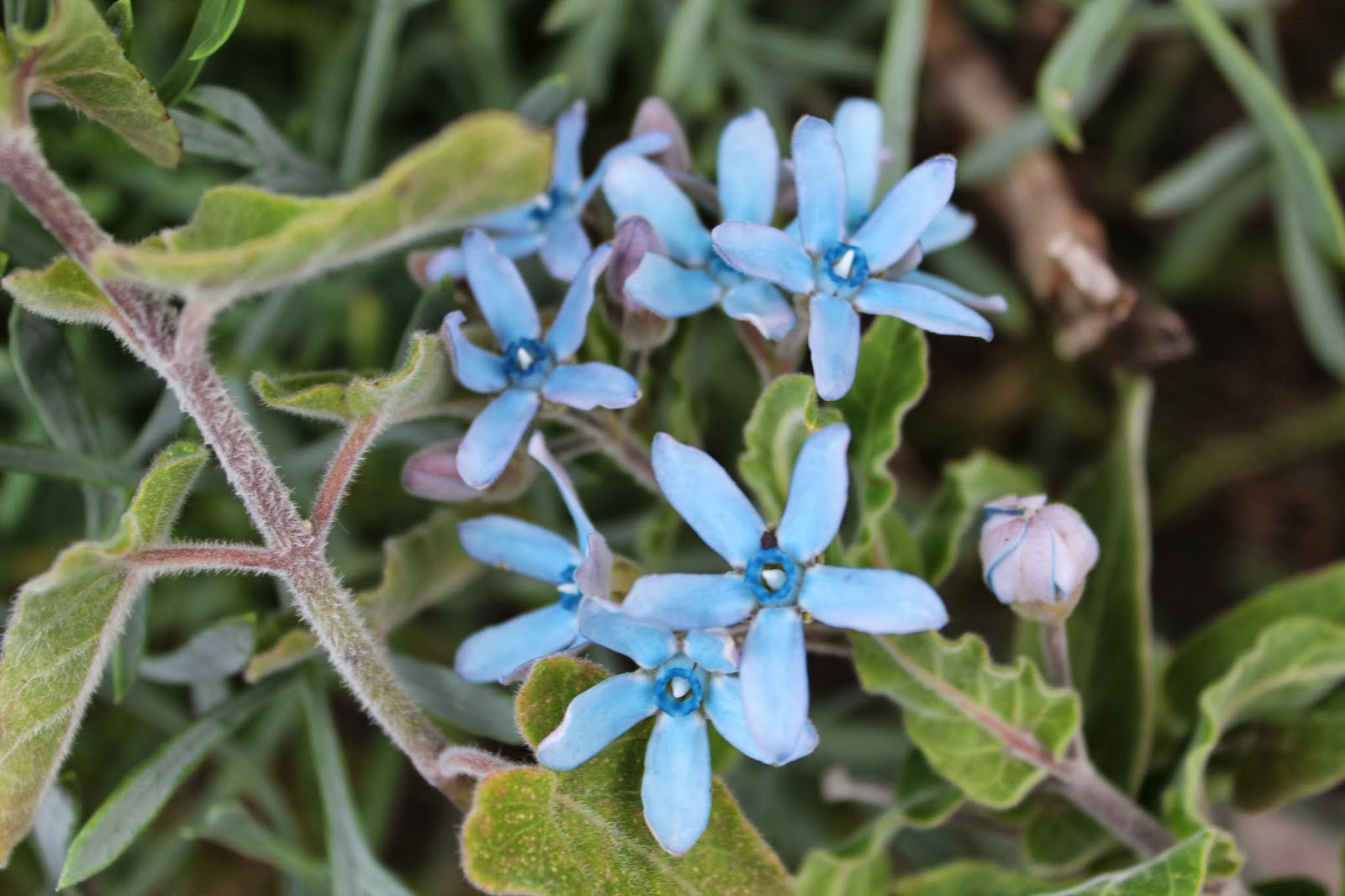
Tweedia caerulea

 Tweedia caerulea syn Oxypetalum caeruleum ( Asclepiadoideae, Apocynaceae)
Neither a shrub nor a climber, Tweedia is hard to place in a garden. It grows as a few lax stems to about 90cm topped with the most beautiful cerulean blue flowers from spring to summer. Though worth growing for that unique flower colour alone, it is the soft as velvet arrow shaped leaves and stems which make it a candidate for inclusion in a garden for the visually impaired, perhaps as an 'edger' spilling over a garden wall where visitors are able to stroke the leaves. In some parts of the world Tweedia is grown as a summer bedding plant. It is frost tender and though mine did not lose its leaves, I kept it in a warm spot out of the cold and a little on the dry side over winter. It is one of those plants which tolerates dry conditions quite well, having milky sap, though it shares this characteristic with a couple of trouble maker cousins, namely the dreaded Moth vine (Araujiia hortorum) and Balloon or Swan plant (Asclepias physocarpa). It originates from southern Brazil and Uruguay
 The colour, pale Cerulean blue, was made famous in the film The Devil Wears Prada when  Miranda Priestly, played by Meryl Streep, corrects her assistant Andrea Sachs, played by Anne Hathaway, over this far from ordinary shade of blue.

For me the most interesting aspect about this plant is that it celebrates the life of the great Scottish gardener and plant collector John Tweedie (1775-1862). At age fifty he uprooted his wife Janet and their six children from the banks and braes o' bonnie doon and set sail aboard the Symmetry, in May 1825, from the port of Leith bound for Argentina (arriving in August) with 200 fellow passengers, all having been persuaded by the enterprising Robertson brothers John and William Parish, of Kelso to help settle a new Scottish colony at Monte Grande some 30km south of Buenos Aires. (1825 was also the year Britain granted recognition to Argentina as a nation and established diplomatic relations.)
By all accounts the voyage was a bit of a hoot with much merriment and singing from Tweedie's fellow passengers who were all at least half his age and full of enthusiasm for the new life ahead at what became known as the Santa Catalina Farm. The colony was very successful for a few years until civil war broke out and the residents dispersed with Tweedie setting up shop, literally, in Buenos Aires while travelling throughout Latin America on plant hunting expeditions, the booty from which he sent back to Britain to botanical institutions and wealthy patrons, as well as describing and assessing the local flora for his growing band of Argentinean followers. He is remembered for the introduction of species of Petunia and Verbena which were used in the development of modern hybrids we know today as well as for Pampas grass which became hugely popular in Victorian England.
In Argentina, John Tweedie is much revered today for his contribution to botany and horticulture. He became known there as Juan Tweedie and has a street named after him in the district where he lived and gardened. In the English speaking world, which, in Britain at least, still remains hung up on status and class, we await the publication of Northampton University Professor Jeff Ollerton's book: 'A considerable collection of new things: the life and travels of John Tweedie, gardener and plant collector' to give us a greater insight into the life of this famous Scot.
The Santa Catalina farm where he first gardened and apparently grew the most delicious peaches is now an eighty hectare Agricultural College. The pictures below show its transformation from Juan Tweedie's time to the present day.


Thursday, March 28, 2013

Manettia bicolor, 'Brazilian Firecracker'

Manettia bicolor ,'Brazilian Firecracker' (Family Rubiaceae)

There are not many climbers which are small and dainty enough to be planted safely amongst shrubs, used as a ground cover or placed in a hanging basket or decorative container and be continually in flower. This is one such plant and I was fortunate enough to be given a cutting of it a year ago. Though originating from South America and suited to warm climates it will tolerate a few degrees of frost and can be grown successfully on a windowsill indoors. The tubular flowers which are only about 20mm long, are a brilliant scarlet with vivid yellow flared lobes at their apex.
 For those who remember their childhood firecrackers, the flowers remind me a bit of 'Tom Thumbs'  which were about the same size and were attached to each other by a string so they went off in succession with quite a punch.
This plant is named for Italian botanist Savero Manetti (1723-1785) who spent time as supervisor of the Botanic Garden in Florence at a time when such gardens contained herbal plants or "simples", associated with herbalism or herbal medicine.

Saturday, December 15, 2012

Calabash / Bottle Gourd

 A Burmese Australian friend has introduced me to the Calabash or Bottle Gourd as a food plant. I have had a couple of carved ones for years and always thought it was just an ornamental plant. One the carved ones pictured above has been decorated with oak leaves, acorns and snowflakes so the carver may be of English origin.
Bottle gourd, Lagenaria siceraria
The plant is a very rampant summer vine of tropical and probably African origin. It has that hot climate habit of producing large tissue paper like flowers which bloom at night to attract moths and bats. Hand pollination is recommended to ensure a good crop as the night life pollinators are not always active or in large numbers. During the day the flowers appear brown and wilted.
 
 The fruit is best used when young, in ways as you would with squash or zucchini. The Burmese deep fry pieces to make the snack boo-thee kyaw. In Japan, ribbon like strips of the flesh (yuugao) are dried and used as an edible tie for sushi. In fact most Asian countries use it as a cooked vegetable in curries, soups and stir fried.
Burmese snack boo-thee kyaw

Friday, September 28, 2012

Wisteria brachybotrys


I picked up this wisteria on a sale table at a large hardware store at the end of last year. It was looking a bit worse for wear and was barely alive, however, it has come good and is looking a picture at the moment. Though it was named as Wisteria brachybotry 'Okayama' it does not match the description of a dark mauve or mallow coloured flower. Wrong tag in pot quite possibly? There are three different species of Wisteria in general cultivation:W. sinensis (Chinese wisteria) W. floribunda (Japanese wisteria) and this one, though even it is sometimes confused with the American native species W. macrostachya and W. frutescens which are most often found in Missouri, Tennessee and Texas.
In his book Wisterias: A Comprehensive Guide (Florelegium Books), Peter Valder  says it is the last species to flower and that it flowers more reliably in its younger years without demanding a regular pruning regime for best flowers. I have planted it in a decorative pot and am hoping for some more 'spot flowering' in the summer months. I came across the photo below of a specimen trained as a shrub with low clipped box as ground cover around it. It looks very elegant. It is in The Education of a Gardener by Russell Page.
 

Monday, September 10, 2012

Wisteria as standard

 In one of the wide treeless streets of my neighbourhood someone has planted a wisteria which has been trained as a standard. This is quite a good option for growing this climber given its reputation for damaging roots and habit of getting away and climbing twenty metres or more up the nearest structure. This one has developed quite a thick trunk already and is even sprouting a few of the pendulous raceme flowers along its length. It has broken the white concrete circular edging around its base but as it is a lawn specimen any sucker growth or side shoots would be cut down as soon as they emerge. No doubt it requires a bit of work to keep it looking good with regular pruning of the new stems which sprout once the flowers are finished. Wisterias used to flower in October which is when spring really got going and now it is not uncommon to see them in bloom from late August.

Tuesday, July 31, 2012

Solandra maxima 'Variegata', Cup of Gold

I grow this large sprawling shrub/climber in 30cm. pots, and, for the past week or so, a large bud at the top of one plant has remained in suspended animation, like a half blown up pale creamy yellow balloon. At this time of year it may be too cold for it open and reveal the coconut scented 'cup of gold' style flower but it provides a wonderful contrast to the new leaves below it which are vibrant purple as they emerge before turning ivory white and pale green on maturity.
This plant is native to Mexico and like other members of the Solanaceae Family it is poisonous , though this should not be a deterrent from growing it. While the plain green form is a vigorous climber to 20 metres or more and needing a large garden or sturdy structure where it can spread to its hearts content, this variegated form is less rampant especially in milder climates. Severe frost will cause most of the leaves to drop off and stems may die back and blacken but growth returns quickly when the weather warms up. As a pot plant it is a bit ungainly and forms a network of thick untidy branches which can never be  pruned to a neat shape, so, if used in this way it needs a foreground plant of neat and rounded appearance to hide its 'legs'. It is otherwise very forgiving of neglect and has low water and fertilizer requirements.
2017 update: I have some plants available.

Thursday, May 3, 2012

Bouvardia longiflora humboldtii

Bouvardia longiflora humboldtii (Rubiaceae)
Sweet Bouvardia (Mexico)
The BBC series World's Most Dangerous Roads which aired here on SBS was quite a good armchair adventure. Though last nights 'team' of Ben Fogel and Hugh Dennis looked as if they could barely stand to be in each others company on their journey through Peru. What was interesting to see was the German settlement deep in the Amazon jungle dedicated to the great naturalist Alexander Von Humboldt. Humboldt travelled through Latin America between 1799-1804. He spent time in Mexico and this sweetly perfumed flower, which is related to the Gardenia, was named after him.
I grow mine in a pot as it is not a particularly robust plant. It is a small shrub with lax stems  weighed down by the terminal clusters of pure white flowers. The flowers are a popular addition to wedding bouquets. It flowers all summer and is semi deciduous or completely deciduous over winter. Like most plants from Mexico, it is tolerant of dry periods and in my case this usually means it has missed out on watering and has forgiven me and just kept on flowering after a brief sulk and flower drop.I took cuttings over summer and wait to see how many have taken.
Alexander Von Humboldt (1769-1859)
Portrait from 1843 by Joseph Karl Stieler


Monday, April 30, 2012

Devil's Ivy, Epipremnum pinnatum 'Aureum'

This is a very 1970's Brisbane photo.The orange flowering tree in the background is an African tulip tree, Spathodea campanulata which now has the dubious title of 'Class 3 declared pest plant under Queensland legislation'. What caught my eye however was the climber growing up the palm trees. It goes by the common name of Devil's Ivy being a popular houseplant worldwide. I have a large tub of it in a glasshouse and it is liking it so much it is climbing the walls, relishing the heat and humidity. It is still in the juvenile stage with the leaves measuring about 15cm long. As it grows the leaves get bigger and become irregularly divided and can reach about 80cm long as shown here. Botanically it has undergone quite a few name changes and is often referred to as Scindapsus, Pothos or Rhapidophhora. For the time being it is now officially Epipremnum pinnatum 'Aureum' and a member of the Aroid family. The plain green form originated in the Solomon Islands and this golden coloured form is a sport thought to have originated in nursery cultivation.Various cultivars are available and are often sold as basket plants and these include 'Golden Queen' with mainly yellow leaves, 'Neon' with chartreuse foliage and 'Marble Queen' with white variegated leaves.They are extremely tough plants and before moving my plant into a favourable spot I had neglected to water it or care for it at all for many months. Though most of the leaves had dropped off it responded quickly to a bit of TLC and is now thriving. Most of the rope like climbing stems produce roots at the nodes so cuttings are easy to strike and it is even quite happy to grow in a jar of water on a windowsill.

Wednesday, October 12, 2011

Bougainvillea Pergola

Quite a bit of work is involved in training a Bougainvillea to grow up and over a structure. As the plant gets older its thorns get longer and more hook shaped making it difficult to work with. New growth wants to grow skywards and these can snap off if left too long to train or tie down. Cross beams on this structure have been widely spaced so that flowering side branches can hang downwards or be seen with the sun shining through the bracts. It makes for a delightful and inviting entrance to the house.

Monday, June 13, 2011

The Choko, Sechium edule

Ready for picking now Choko fruit on vine, Sechium edule

From Tasmania to far north Queensland, the much maligned choko was once a feature of most backyards, covering fences and outhouses and climbing 30 metres up trees if allowed and always capable of producing an abundance of fruit . Last year I planted one to try and out-compete a Morning Glory vine which is growing from a neighboring property. It is doing a good job so far and has just produced its first crop which has sent me on a search for ways to cook with them. I have always liked what Sam Orr aka Richard Beckett had to say about the choko in his book The Gourmet's Garden. He said it produced fruit in such enormous quantities that it 'frightens you out of your wits' and that 'because of this over-production people attempt to find virtues for the choko where none exist, producing such execrable concoctions as choko jam and choko chutney. He recommends that it is boiled whole 'so that any taste it has doesn't escape into the water' and nice with cheese sauce or melted butter and a lot of pepper so that in this way you taste either cheese sauce or butter or pepper. You'll never taste choko as it doesn't. The choko is one of nature's little jokes.' Harsh words indeed.
So one interesting way of cooking them I have found is in a Caribbean cook book where the choko is given the French name of christophine. A Gratin of Christophine involves cooking choko in milk for about ten minutes, pureeing them and then adding egg yolk, butter, cream, chives, ginger, salt and pepper. This mix is placed in a baking dish and topped with breadcrumbs and Parmesan cheese and baked for about 20 minutes until golden and bubbling. Sounds like just the dish for a cold winter night.

Choko Illustration from Curtis Botanical Magazine
London 1917


Tuesday, May 24, 2011

Postcard from Nafplio

Brilliant Bougainvillea in Nafplio, Greece 
Received this e-card from Greece this morning. Just the thing to bring a bit of warmth to a cold day. I like the look of that pale blue ocean in the distance.

Saturday, March 19, 2011

Climbers as weeds

Bittersweet Celastrus scandens

When I got a request for the climber 'Bittersweet' from an expat American living in Thailand, I soon found out after a quick net search that it is one of the worst weeds of North America and it is responsible for displacing and spoiling the habitat of the similar indigenous species Celastrus orbiculatus, which also produces a bright display of berries though not along the stem as in the case of the one above which is from Asia. Weedy climbers are my least favourite plants as they are just so hard to reach and get rid of successfully. One I do battle with on a regular basis is Madeira Vine (Andredera cordifolia) which, I noticed this morning is just coming into flower with its characteristic "lamb's tail" tassel like flowers. This climber deserves a post on its own so I can rant and rave about how horrible it is to deal with. Some others which are also evil are pictured below and I may come back to these again at a later date. A few brief comments for now...

'Turkey Rhubarb'
 Acetosa sagittata

Flowering now and ready to shed a million papery seeds which are easily wind blown away, this climber has the added "advantage" of producing tubers or yams underground which break off easily when the plant is removed thus ensuring its regrowth soon after.

Balloon Vine, left (Cardiospermum grandiflorum) and Moth Plant (Araujia hortorum) competing for space in bushland in a climbing frenzy
Balloon vine is so named because of the shape of the casing surrounding the seeds. It can parachute down to earth from trees or drop into a stream and float for miles to a new location. One of the extraordinary images I recall of this climber was in a garden in a prestigious Sydney suburb where the vine had covered and smothered every single tree and shrub in the entire garden with the property owner seemingly oblivious to the environmental damage caused.
As for Moth plant, rarely a day goes by when I am not pulling out a rogue seedling which has taken advantage of a tiny gap in pavement to grow well. Its other common name is 'Cruel plant' as the moths or butterflies which come to pollinate it get their proboscis' trapped in the flowers when feeding. This semi-carnivorous habit is interesting evolution.  Do the dead moths fall to the ground after doing their pollination work to provide extra fertilizer for the host? The plant has all bases covered as the large pear like fruit which are produced have a poisonous milky latex and hard outer shell . When ripe they break open to release a million silky threaded seeds which float or blow away easily. More ranting weed hating posts soon.....
Pear like fruit of the Moth Plant high up in a tree