Showing posts with label succulents. Show all posts

Wednesday, April 6, 2022

Aloe distans 'Variegata'


 Aloe distans 'Variegata'
 
Variegated forms of plants often have slower growth rates { It's a lack of chlorophyll in the leaves thing} which can be an advantage when growing succulents such as this one as the plain green form is more likely to sprawl over the sides of the pot and develop unsightly dead leaves along an elongated stem in no time.
Avoiding a position full sun is probably advisable for this plant as it can be prone to leaf scorch but is otherwise easy care and can be left to its own devices with the occasional water as required.
As for the species name 'distans' , it may also be known as A mitriformis

Sunday, November 14, 2021

Agave isthmensis


 Agave isthmensis: Dwarf Butterfly Agave

Having a shadowy zigzag imprint on its powdery grey leaves gives this small 30cm Agave a distinctive look. It is easy to grow requiring little water and though slow growing, there are few congested "pups" around the base to detract from the neat rosette shape.
Hardy to -3C and worth considering for decorative container growing or semi shaded garden position under trees. 


Wednesday, March 21, 2018

Cephalophyllum sp


Cephalophyllum sp
This small South African "pigface" family succulent came to me with a wrong name and after a bit of searching I came across a good match as to what it might be.
I used 'The Timber Press Guide to Succulent Plants of the World' by Fred Dortort as reference.
Pinning it down to a species is proving more difficult and at the moment it is a toss up between alstonii, stayneri or framesii. 
There are about 30 species in the Genus and they display a wide range of jewel like flower colours. Growth occurs mainly in winter, no doubt as a response to rainfall.
The parent plant has spread to about 30 cm across and is quite decorative even when not if flower as the leaves resemble small grey green birthday candles with bright pink tips.
These flowers came out during the last few days and I like the way they stand above the leaves on short stems.

Sunday, February 25, 2018

Platykelba insigne

Platykelba insigne (Ascelepiadoideae)


Simplicity itself is the appeal of a plant which goes through life as a mass of cascading stems while producing (allegedly) perfumed flowers. I have yet to see any flowers so I can't comment on that and it is always a little annoying when you read about a perfume with no description of the fragrance. Coconut? Vanilla? Honey? keep me guessing.
This is an easy care hanging basket or vertical garden plant and probably better in shade as mine has thrived under shade cloth. The hanging basket version is a bit lopsided as it was kept on a shelf for too long.

Orbea variegata

Orbea variegata syn Stapelia variegata
Developing seed pods in "V for Victory" mode

This spreading ground cover succulent has fleshy stems which resemble in size and shape crinkle-cut potatoes. Container grown plants quickly fill the space with these stems/leaves and new growth tends to hang upside down over the edge of the pot. These can be trimmed off and used to propagate new plants if required.
I have not tried growing it in a garden bed but I imagine it would form a dense weed suppressing mat and would be ideal to grow in a dry spot under trees particularly ones providing summer shade and winter sun.
The 8cm diameter flowers resemble puffed balloons in bud and when open exude the characteristic carrion smell to attract  flies as pollinators. Working close by to them I often forget this unfortunate aspect of their being and assume there is a dead rat somewhere under the bench.
The purple striped seed pods produced even while new flowers are still in bud are most attractive. Eventually they turn brown and scroll back to release fluffy seeds in much the same way as its cousin the Oleander does, both being in the family Apocynaceae.
Container grown plants can be brought indoors and placed in a bright location though this is not recommended during the summer flowering season. It is definitely a winter thing especially if you live in a frost prone location.


Saturday, May 20, 2017

Senecio barbertonicus


                     Senecio barbertonicus
I have been growing this succulent sub-shrub for about a year now and it has reached posssibly its mature height and spread of about a metre. The pointed leaves are an unusual colour green, changing from chartreuse in winter to olive green in summer. The daisy like flowers are said to be perfumed though I will have to wait and see as none have been produced as yet. Senecio flowers tend to be fairly insignificant daisies which end their life as balls of fluff at the end of the stems. 
The species name relates to the region of South Africa where it hails from, with its more famous cousin being the Barberton daisy or Gerbera.

Sedum adolphii 'Firestorm'


           Sedum adolphii 'Firestorm'
This Mexican groundcover succulent is putting on a display of intense orange and red leaves at the moment. The other two forms of this Sedum, the more familiar 'Golden' and 'Pat's Pink' are equally appealing but just not quite so bright.
As a trailing plant, leaves are prone to drop off exposing bare stems as it matures. If this is not appealing pruning back closer to the centre of the plant will result in a more compact specimen. New plants can be propagated from these stems or from the leaves themselves if placed on the surface of potting soil.

Wednesday, May 17, 2017

Agave weberi 'Arizona Star'


              Agave weberi 'Arizona Star'
This Agave was in need of a repot which also gave me the opportunity to remove some of the smaller plants growing around its base. Easier said than done when it comes to handling Agaves as it is often difficult not to damage the soft succulent leaves and get spiked in the handling process. The plain green form of this species has always been a slow grower for me so I was surprised at just how quickly this variegated form filled out the pot. Though it looks similar to an A americana the leaves are certainly much thinner and have that 'Grey Nurse' shark skin texture to them. 
This cultivar originates in the United States as the name suggests.
I don't have any plants of it for sale at present but will do at some stage in the future. 

Sunday, May 7, 2017

Senecio haworthii


                          Senecio haworthii
Some succulent plants refuse to budge and are very slow growing. This Senecio is one of them and it is probably the reason it is rarely offered for sale except as a collector's plant.
A common name given to it of 'Cocoon Plant' refers to the resemblance the leaves have to silk covered insect pupae cases. This 'silk' has a traditional African use of being collected to use as tinder and it does peel off the leaves revealing a pale green underside (just visible in this photo).
Silver foliage plants can be tricky to keep going during periods of high rainfall or humidity so I have incorporated lots of grit and perlite into the potting mix of this plant to make sure it is free draining.

Sunday, April 2, 2017

Epiphyllum anguliger, the rick-rack cactus


                    Epiphyllum anguliger
When this flowered a couple of months ago I didn't think to stick my nose up close to indulge in the scent. It was only after reading the perfume being described as 'delicious' by horticulturist Edward Kemp (1910-2012) (Yep he lived to 101) curator of the RBG Edinburgh from 1950 to 1971, that I knew I might now have to wait a whole year to experience that treat.
Kemp's description of this species is in his occasionally off kilter translation from the German of Das praktische Kakteenbuch in Farben by Walther Haage 1961 , 'Cacti and Succulents' Studio Vista 1963.
Apparently 'Epi' cactus have been around since 1689 when they were described by Dutch botanist Herman Boerhaave (1668-1738) at the Hortus Botanicus Leiden. Hence from him epi = upon and phyllum = leaf. 
Growing it gives the usual challenge of finding a sturdy enough, large enough container in which to place it. Branches grow every which way and arch down to ground level presenting that temptation to passing snails which they can hardly resist. While relatively small in root system, the branches carry quite a bit of weight and as the plants require a light free draining orchid style potting mix, it is worth placing some stones around the base of the plant to keep it from being wrenched out of the ground in windy conditions. Though I have grown it successfully from cuttings, many have succumbed to rot from over-wet conditions. So a spot with summer shade and a warm dry bright position over winter would suit it best, with the occasional dose of liquid fertilizer to keep it healthy.

Echeveria 'Icycle'


                     Echeveria x 'Icycle'
A plant breeder with a sense of humour ! For years I called this 'Icicle' assuming that the frosty looking silver leaves were named with that in mind. A cycling enthusiast reminded of Mont Blanc more likely ?
This is a hybrid between Echeveria agavoides and Echeveria leucotricha and grows to about 150mm across. Having as a parent E. agavoides gives it a certain toughness with the ability to withstand the occasional knock if weeding around it or when moving a pot grown specimen; as well as good rainy weather resistance with water not hanging on foliage as it may do on the flatter rosette shaped hybrids, which often results in stem rot and fungal problems.
I remove the one or two offsets and flower stems which appear each year so that the main plant is able to grow large and more sturdy. It forms a handsome and dramatic looking specimen with added appeal when contrasted with some silvery ornamental grasses.
I always have some small plants available for sale. 

Saturday, March 11, 2017

Epiphyllum hybrid 'Ivan the Terrible'


 Epiphyllum hybrid 'Ivan the Terrible'

Not wishing to become a collector of these beauties I have settled for growing just a few of the hybrids as well as some of the species. When this one flowered a couple of months ago I was amazed how big the flower was and how luminescent it appeared to be having both bright red and fuchsia pink petals. While very easy to care for and undemanding as to watering, I am forever lifting up the pots which topple over in the slightest breeze. The whole plant becomes quite top heavy with its long arching branches and needs a strong support on which to grow. Resting against a tree trunk or placing them in a giant wire hanging basket may be the solution to positioning them in the garden. They prefer a spot which is semi shaded though I have seem them flower in full shade and even full sun though yellowing leaves are an indication of too bright a light.
 Mention should also be made of snails which are very attracted to the fleshy leaves and stems and their damage is noticeable for a long while afterwards.

Sunday, March 5, 2017

Aloe cooperi


                             Aloe cooperi
I have been waiting years for this so called 'Grass Aloe' to flower, so long in fact I have forgotten from where or from whom I originally got it.
It is a South African species discovered by British plant hunter and naturalist William Burchell (1781-1863) around 1815 though it was named for professional plant collector Thomas Cooper who rediscovered it later.
It grows in both dry rocky locations as well as wet marshy ones in KwaZulu-Natal and Mpumalanga so in a garden situation it needs friable soil with some moisture. Perhaps this water requirement is the reason it took so long to flower for me as I had assumed it was not requiring such conditions.
The distinctive two ranked V shaped leaves are white-spotted near the base and the cone shaped inflorescence is salmon pink with individual flowers being green tipped.
This is a cold tolerant Aloe so should be tolerant of some frost.
I am hoping this will set seed as it is mostly grows in solitary rather than clump forming way.
 

Sunday, June 14, 2015

Crassula arborescens 'Bluebird'

Crassula arborescens 'Bluebird' (Crassulaceae)

Crassula arborescens subsp. undulatifolia

  For many years I have been successfully growing the wavy leaved form of the 'silver dollar jade' 'undulatifolia' which forms a compact neat shrub to about 60cm. I now grow the 'Bluebird' variety after seeing its used in a bold and effective way by a landscape designer.
I currently have stock in 140 mm pots.
  

Sunday, November 16, 2014

Bulbine frutescens

 Bulbine frutescens (Asphodelaceae)
This grassy onion leafed succulent is a recent find for me and one I see adding to the range of commercial plants I grow in time. Plants with attractive bright flowers which are able to tolerate dry shade are always welcome in my book. This 30cm high clump forming perennial groundcover is found growing in South Africa to Mozambique but has been much used in xeriscaping in Arizona, Texas and dry gardening communities in the US. A mention of it in a garden forum from a South Australian resident shows it does have a small fan base here, and the comment from that person praised its use as a sun burn cure in a similar way to Aloe vera.The 'tiny tangerine' flowers with their fluffy yellow stamens are carried on tall stems up to 60cm in length and are produced in succession up the stem from spring onwards.
2017 update: Failed to sell in the nursery trade market.

Sunday, November 2, 2014

collecting succulents

Starting out with Succulents
David L Jones
New Holland publishers Australia 2012

David Jones' name is synonymous with native plants so it was a surprise to find out he was a collector and enthusiast of succulents and bulbs, though the inclusion of native "succulents" eg Doryanthes makes this book true to form.  
As he lives on the south coast of NSW the information here is local and there is a terrific range of plants included. 
Because of their relative ease of propagation succulents often pop up at market stalls, usually without names, and with this book identification via photos and descriptions are made a whole lot simpler. I try and not collect too many plants these days but am always interested in trialing new plants to see if they have the potential to cross over from "collectible" to a commercial landscaping or garden specimen. Many make better container grown subjects and the little Cotyledon pictured below is a good example. I like the torpedo shaped leaves and the tiny stems carrying what will be bell shaped flowers. It's quite a cutie and as the flower stems are quite sticky perhaps it may have that ability like some other plants originating from nutrient poor soils of being able to trap tiny insects for a bit of extra food.
Cotyledon papillaris (Crassulaceae)

Sunday, October 26, 2014

Ledebouria petiolata


Ledebouria petiolata syn. Drimiopsis maculata
(Hyacinthaceae)
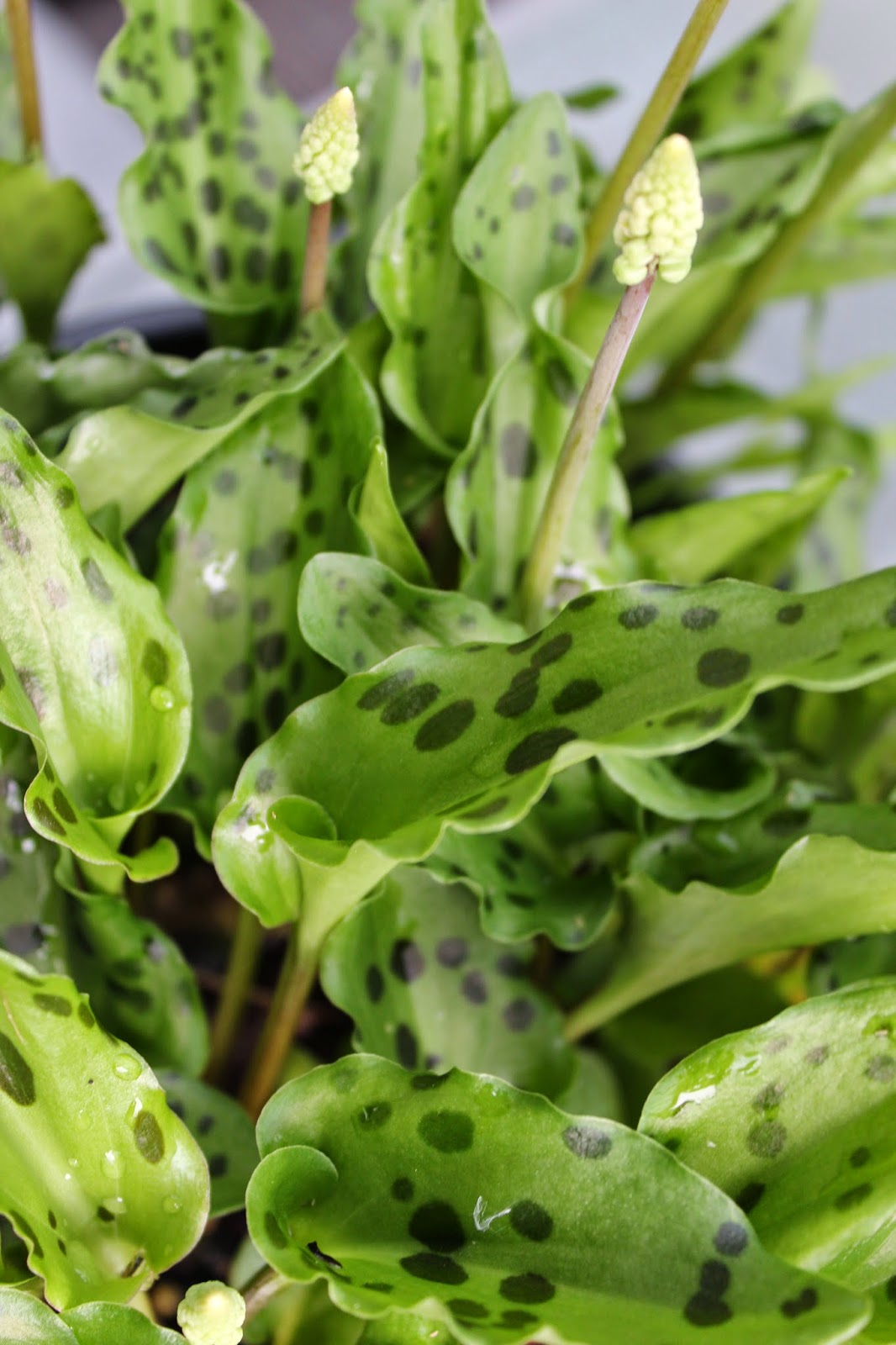
The good folk at Larkman's Nursery in Victoria bought this to my attention recently as they market it as an 'African Hosta'. Unlike the Japanese Hosta this plant thrives in poor soil and with minimal water but it is equally loved by snails and slugs which generally spoil its appearance as soon as your back is turned. At this time of year it produces masses of short stemmed white flowers which resemble miniature Hyacinth but without the perfume. It grows from a series of fleshy bulbs which protrude slightly above the ground.These can be easily divided to form new clumps of plants. I am in two minds about this plant; one could consider it as a "novelty" item or as a serious contender for a difficult garden site of dry shade under trees where not much would grow and where it would be quite at home. Otherwise it makes a terrific pot plant which can be brought indoors when in flower or if you like things a bit dotty/spotty.

Senecio radicans


 Senecio radicans (Asteraceae)
'String of Bananas'
  I am growing this popular succulent for use in vertical gardens and this specimen has already grown down 1.5 metres, with little red spur-like roots protruding from the stems along the way which are obviously in search of a some soil.
 There are two forms of this succulent ground-cover from South Africa ,one with grey leaves (glauca) and a plain green form. Leaf form can also vary from banana or fish-hook shape to globe shaped. Tiny shaving-brush like flowers appeared a month or so ago and these were attended by some beneficial insects which is a bonus when you are growing any plant these days.In cool climates this plant is grown indoors and it adapts well to shady or low light conditions.
2017 update: I no longer grow this succulent. 

Thursday, October 16, 2014

Euphorbia enopla

 Euphorbia enopla (Euphorbiaceae)
Cactus for indoors? Certainly and this would be a good candidate as it only grows to about 1 metre. This is frost hardy species which originates from South Africa has very attractive long reddish spines which turn to black as they age. When I look at this specimen I can see that the side branches could be removed and used as propagation material to grow new plants thus changing the shape to a more central column.

Saturday, October 11, 2014

Calibanus hookeri, Mexican Boulder

 Calibanus hookeri (Asparagaceae)
This scruffy, wiry stemmed clump of leaves emerge from a round 'boulder' like base at ground level. The base is covered in rough corky bark, hence the common name. Clipped Buxus it ain't, so a plant as untidy looking as this may not have huge appeal. However the leaves have a pleasing blue grey appearance and the plant seldom needs extra water to keep it looking healthy. The leaves can be trimmed back to expose the boulder or caudex base and this may eventually reach 30cm across. I am still waiting for the appearance of flowers which are said to be tiny and white and are carried on a rigidly stiff panicle 10 to 20cm long. Flowers means seed so I may eventually have some plants for sale.