Sunday, March 13, 2011

Edible Seaweeds

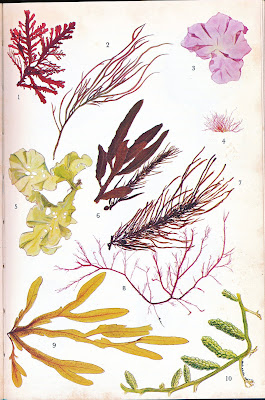
Edible Algae, Seaweeds of Australia: Sea grapes, Sea lettuce and Sea-string.

The sea can be cruel. It is shocking to see the devastation caused by the earthquake and resulting tsunami in Japan. The unfolding story is revealing total destruction of communities who live close to and derive their livelihood from the ocean. Large areas of their coast are set aside for the cultivation of seaweed which is an important food plant and essential part of the diet of the people. I often buy seaweed salad, imported from Japan, and it is delicious to eat. I am also familiar with wakame, nori, and kombu. Kombu (Laminaria japonica) is boiled with katsuobushi (Bonito flakes) to make dashi, a stock essential in Japanese cuisine.
In Australia there has been very little use of our native seaweeds in the food industry. During colonial times ladies made milk jellies from species such as Eucheuma speciosum of Western Australia and later this was used in the meat canning industry during the second World War when imports were restricted.The giant brown alga, Macrocystis pyrifera from Tasmania's east coast has also been used for the extraction of sodium alginate which is used as a stabilizing agent in foodstuffs such as icecream. Sea grapes, Caulerpa racemosa, which I often come across when exploring tidal rock pools, is easy to identify by the creeping stem with bulbous 'grapes' attached. It is cultivated in the Philippines for use as a popular salad vegetable mixed with tomato and onion and dressed with vinegar. Sea lettuce (Ulva lactuca) is another type which you may come across on rocky shores at low tide. The plants appear as green sheets about 15cm long and can be eaten raw in salads or added to soups. Sea string (Gracilaria species) is sometimes called Chinese Moss as this plant is used in China for a special dish celebrating New Year. It is found in bays and estuaries and consists of cylindrical or flattened stems up to 2 metres in length. It can be eaten raw or boiled but also can be dried for later use to make milk jellies. After washing in fresh water to remove any marine animals it can be dried in the sun for a week or so with constant turning.
The image of seaweed for use only as a garden fertilizer needs to change but it will take a celebrity chef with an eye for the unusual to create an interest in it and for it to become part of our diet as in Japan.


Archontophoenix cunninghamiana, Piccabeen Palm

Archontophoenix cunninghamiana, Piccabeen Palm

The first topic of conversation amongst gardeners is invariably the weather and this week was no exception. It has been very muggy with not a breath of wind and the horizon has that brown smudge of pollution which only a good sou' wester is going to shift. Up north there is way too much rain again but here the clouds build up in the afternoon, followed by a few thunder claps and then nothing. I want rain before planting some carrot seed and the brassica plants need a good kick along which only a gentle shower can give them.
This palm in flower caught my eye this week as the curtain of flowers looked wonderful set against blue black thunder clouds. It gets called Bangalow palm as well as Piccabeen palm. The common name is derived from the aboriginal word
Pikki which refers to the expanded leaf base which was used to carry water. It is a hardy and attractive 'self-cleaning' palm.

Wednesday, March 9, 2011

Agonis flexuosa and Eucalyptus diversicolour

Eucalyptus diversicolour
  Karri Tree of Western Australia
I have just finished reading the bitter sweet novel Breath by Tim Winton. The book was published in 2009 and has won a swag of literary awards, deservedly so. The main character, 'Pikelet' is very much aware of his environment, on both land and sea, and even spends a bit of time in the library reading books on plants when not distracted by conquering the surf. Two trees form part of the narrative and each represents a different aspect of his growing up in that southern region of Western Australia. The majestic Karri tree, one of the giants of the plant world is held in awe and the forest of these trees is a place of loneliness and fear, shunned by others in his community. Pikelet spends time amongst these trees to overcome his fear of some of the dangerous surf breaks he is yet to experience and to have alone time to contemplate and work out why his friends act the way they do.
The other tree is the coastal Peppermint or 'Willow Myrtle', Agonis flexuosa. In the book this tree is all sweetness and light, alive with honey eating birds while releasing an invigorating fragrance from its leaves in the hot sun to make the surf even more inviting for Pikelet and his friends.
Of all the wonderful trees from Western Australia, this is one which grows well on the east coast especially on coastal sands but also on difficult sites away from the coast in humid sub-tropic regions. It needs room however to reach its full potential and can reach 8 metres in height with a dense spreading crown of weeping willow type branches.The dwarf form A.f. 'Nana' only grows to 2.5 metres and makes an excellent windbreak or low hedge in coastal sands but has largely fallen out of favour since the rise and rise of the Lilly Pilly hedge of recent years. The coloured leaf forms, 'Variegata' and 'Fairy Foliage' are handsome small trees/large shrubs with dainty open habit and leaves tinged creamy yellow in the former and blush pink in the latter. Some shade is needed to stop the foliage from burning. Both are not easy to come by in the nursery trade perhaps due to their difficulty in propagation and slow growth habit. The cultivar 'After Dark' is more readily available and it fits the bill perfectly for the burgundy/black foliage colour mania which has been popular in recent years. It makes a decorative container specimen for even a tiny balcony garden.
Whenever I come across these trees in the future I will think of Tim Winton's terrific novel Breath

Willow Peppermint, Agonis flexuosa in the blinding white sand of WA
Photo:K.C. Richardson


Agonis flexuosa 'After Dark'
Breath is published by Penguin books

Tuesday, March 8, 2011

Bac Ha

Taro leaf

Bac ha is the name used in Cambodia and Vietnam for celery stem Taro which I wrote about in the last post. Here is a link to a site with a recipe using it in the cuisine of those countries:
Bac Ha Recipes - Pham Fatale

Friday, March 4, 2011

Celery Stem Taro, Xanthosoma brasiliense

Xanthosoma brasiliense syn Colocasia gigantea
Tahitian Spinach / Celery Stem Taro / Callaloo / Belembe


I have planted this variety of taro in my community garden plot and it is one which is grown for its edible leaves and leaf stem (petiole) and not for the tuber or yam as in other varieties. There is confusion over the botanical name with some sources listing it as Xanthosoma and others including it with Colocasia. The vernacular French name callaloo or calalou has its origin in the Caribbean (it's also called Carib cabbage) and a soup of that name is very popular in the West Indies. It is also eaten like spinach in Puerto Rico, Haiti, the Lesser Antilles, southern Brazil and Hawaii. The leaf stems and leaves are also used throughout Asia and the Pacific Islands and as a cooked green it provides an excellent source of vitamin C (142mg per 100g), vitamin A, calcium, potassium, phosphorous and iron. It is also rich in protein (4.4mg per 100g) with most of the essential amino acids present. It is important to note that taro leaves and stems should never be eaten raw and a long cooking time is recommended to eliminate the acrid "twang" of calcium oxalate crystals contained in the plant which can cause irritation to the mouth and throat. Asian food expert Charmaine Solomon gives a first hand account of her experience of eating undercooked taro leaves as 'the sensation of a hundred red hot needles in my throat'. Only the Japanese have the technique for using it raw, finely sliced with sushi and given the name of zuiki. The experience and itching sensation on the mucous membranes described as egumi (mi meaning taste).
Taro is easy to grow as long as it gets lots of water and is provided with a humus rich soil. It may go dormant in cool climates over winter though its origin as a jungle plant means it can tolerate the short days and low light levels of winter.
I have yet to experiment with cooking it but have found an excellent Indian recipe from the  blog of Soumya's kitchen. In India taro is called arvi or patra. Here is the link:

Thursday, March 3, 2011

Sedum 'Autumn Joy'


Sedum 'Autumn Joy'

Great mushroom heads of flowers are starting to form on this Sedum. This is the first time it has stayed compact and together over the summer. My criticism of this plant in the past is that the stems collapse under the weight of the developing flowers and it looks a mess.

Tuesday, March 1, 2011

2 Rainforest Pioneer trees

Omalanthus populifolius 
 Native Poplar

Polyscias murrayi 
 Pencil Cedar

These two trees make an appearance from Gippsland in Victoria to Northern Queensland. They have evolved to be the first on the scene to fill a gap whenever a tree falls in the rainforest , land is disturbed bordering thick forest or a road verge is cleared of excess vegetation. The native poplar, which is also called bleeding heart is so successful in colonisation that it often appears in a variety of habitats and even makes an appearance in shady city gardens far from where you would expect to see it. It is a quick growing small tree, rarely growing more than 4 metres tall with a single trunk and bushy crown. It is the heart shaped red/orange leaves which appear throughout the year which gives it the bleeding heart common name and makes it quite distinctive when seen against the dark green of surrounding trees. The insignificant tassel like flowers followed by glaucous 10mm fruit are very attractive to birds which carry the ingested seeds and deposit them far and wide. Newly established trees are able to eek out a living in quite dry and inhospitable places though their leaves are often much smaller than those growing in better sites.
The Pencil Cedar is a more elegant tree with a beautiful silhouette when seen against the sky above surrounding vegetation. It is clever in establishing itself by means of a slender trunk to over 6 metres before deciding to branch. It grows a further 6 metres with an umbrella shaped crown of metre long pinnate leaves consisting of 30 opposite leaflets and one terminal leaflet. At this time of year it produces greenish yellow flowers on large branched panicles followed by small red fruit which are also attractive to birds.

The Catbird likes to eat the fruit of these trees.