Sunday, December 8, 2013

Hibiscus rosa-sinensis 'Hiawatha'

 Hibiscus rosa-sinensis 'Hiawatha'
Not from Tahiti or Hawaii but from the beautiful tropical island of Sri Lanka where it originated in the Peradeniya Botanical Garden at Kandy. In Sri Lanka, Hibiscus are known as 'shoe-black' as the flowers were used to polish shoes and as a dye. Crushing the hand sized flower releases a mucilaginous substance perfect for polishing shoes.
The 'amaranth red' flowers of 'Hiawatha' are ruffled with a fused recurved style and are produced in great abundance over the warmer months on what is a very hardy tall growing shrub. Leaves are small and glossy. This variety seems fairly resistant to pests such as Hibiscus beetle which favours  lighter coloured flowers.


Spiraea japonica 'Anthony Waterer'

 Spiraea japonica 'Anthony Waterer' (Rosaceae)
This delightful metre high deciduous shrub is native to China and Japan, though this form was developed in Europe many years ago.  In China the wild form is known as Fenhua Xiuxianju. The curious thing about it is that it occasionally throws up a a stem of leaves which have no colour and are pure blonde with some pink tips. These leaves are not happy in the sun and may burn easily. Choosing a spot in the garden which is semi shaded is the best option if you want to avoid this, otherwise it is a remarkably hardy shrub which flowers from spring right through summer. Pruning off spent flowers helps keep it neat as some branches tend to be wayward. Suckers may also appear around the base of the plant but it is certainly not invasive or a garden nuisance. The small sprays of flowers are a bright magenta pink and these start off from buds which resemble a pin cushion head.
Spiraea are hardy across a range of climates from sub-tropical to cool temperate. In warmer climates they may not become completely deciduous over winter.
2017 update: I no longer stock this plant.


Justicia carnea 'Radiant'


 Justicia carnea 'Radiant' syn 'Huntington Form' (Acanthaceae)
My thanks go to two Sydney gardeners, Helen from 'Tropical Breeze' and Deirdre from iGarden who pointed me in the right direction as to the correct name of this form of the 'Brazilian Plume' shrub. When I bought a plant of it at a garden show earlier in the year it was unnamed and I was attracted to the purple maroon leaves and stems. However it is not that uncommon as just this week I saw dozens of this form for sale at a plant trade market.
Unfortunately it does what a lot of the Justicia species do and that is it has spindly open growth with just a plume of flower at the top. The way around this habit is to plant several together, preferably in a shady warm spot or just keep tip pruning it from a young age to make the shrub more bushy. Pruning and fertilizing after flowering also helps. This tendency of Justicias of showing off the flowers and not hiding them amongst foliage is to attract birds which they do quite well, especially the honey-eaters. This form grows to about a metre or so unlike the straight species which can reach two or more metres.
Justicia is named to commemorate the horticultural legacy of Scot James Justice (1698-1763) who was a principal clerk at the Court of Sessions in Edinburgh before pursuing his horticultural career and publishing The Scots Gardiners' Director (sic) in 1754.
Quite eccentric by all accounts and very extravagant, he was the first man to grow pineapples in Scotland.

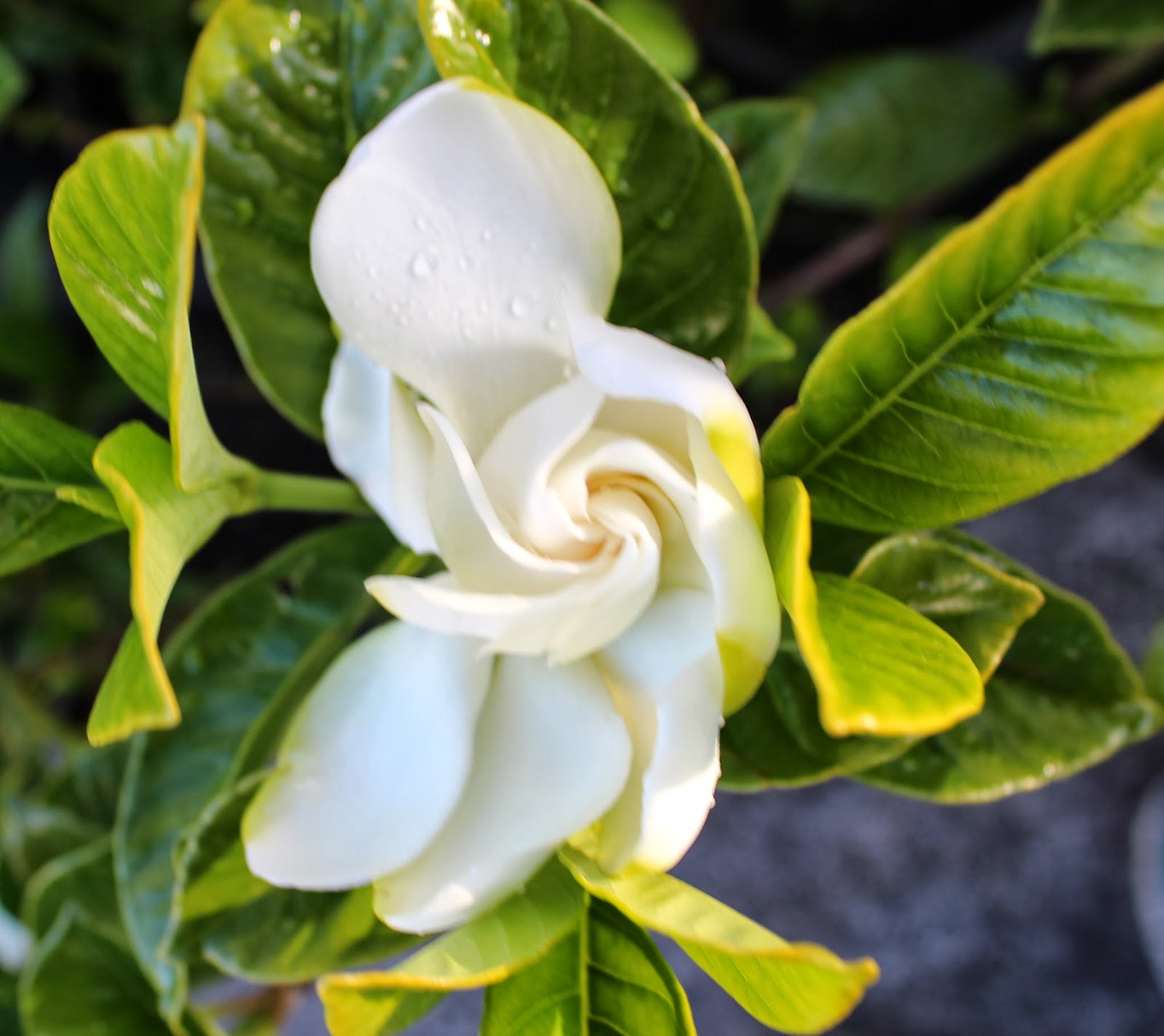
Gardenia augusta 'Magnifica'

 Gardenia augusta 'Magnifica' (Rubiaceae)
How quickly do Gardenia flowers turn from pure white to the colour of an old newspaper, well almost overnight it seems, but all is forgiven when you have a plant which scents the air with a wonderful perfume. All this week I have been working alongside some left over plants which are waiting to be cut back and potted on as soon as they finish their flush of flowers.
Gardenias are not the most sustainable of shrubs as they require generous amounts of water and fertilizer to perform well, and, though established plants in old gardens will often reach tree like proportion, they need regular pruning to keep them from becoming ungainly. During the peak flowering time it is almost impossible to avoid the mass of brown spent flowers covering the bush unless you are diligent at removing them on a daily basis.
I prefer this large flowered variety over the many smaller ones such as the 'Florida' types and even the leaves of 'Magnifica' tend to be larger and glossier.
Gardenias have been worn as hair ornaments for centuries particularly in China from where some species originate, though it is the jazz/blues singer Billie Holiday who made them her own in the 20th Century.


Thursday, December 5, 2013

Golden Lemon Balm,Melissa officinalis 'All Gold'

Melissa officinalis 'All Gold'
Lemon in colour and flavour and a great plant for a shady corner, this variety differs from the closely related Melisa officinalis 'Aurea' (syn.'Variegata') , the variegated lemon balm, which has leaves splashed and speckled with yellow. The interesting thing about 'All Gold' is that it can spend quite a bit of the year with green leaves, at least from autumn till late spring, though some say this is a response to overly rich soil which favours the green leaves. This year when I trimmed back my plant in late winter I took cuttings which I just layered into the soil in the vegetable garden .These soon struck and turned golden while the mother plant sat with a dull green face. Given too much sun the leaves can quickly bleach white then scorch brown. Overall this variety is less vigorous than the common green lemon balm and is a very worthy addition to an ornamental shady garden or herb patch.
The lemon balms are good bee plants and the name 'Melisa' is synonymous with the Greek word for bee and they are kept happy within a hive from the use of this plant growing thereabouts. It also has a long history of culinary use and can be used in any way where a zesty lemon flavour is required. As it grows wild in the southern parts of France, the French were inventive in using it in all manner of ways. The celebrated Eau de Carmes or Carmelite water was a popular tipple in the seventeenth century. You can make a modern version by adding the flowering tops of balm to a litre of brandy along with a few twists of lemon peel and aromatics such as angelica root, cloves, nutmeg, coriander seeds and cinnamon sticks.Left for a week or so to let the flavours infuse and then strained, you have yourselves a cordial tonic to uplift the spirits.

Monday, December 2, 2013

Sweetpeas going the distance


It is marvellous what a little rain will do and a run of cooler days. My sweetpeas did not really take off and reach the top of the trellis till a week or so ago and now they have decided to flower well out of their normal peak flowering time. The flowers are not prize winners by any stretch of the imagination but I may just be able to pick a bunch at Christmas time.

Sunday, December 1, 2013

Calendula 'Neon'


 Calendula officinalis 'Neon'
I am often running late in getting things planted out. These Calendulas  which I grew from seed planted back in autumn languished in a seedling tray for months, often drying out and looking fairly stunted until I finally got around to planting them . Calendulas or Pot Marigolds are at their best when flowering during winter here and by spring the plants become susceptible to mildew or rust and need to be pulled out. These later planted ones are proving me wrong as they have not succumbed to mildew or rust both diseases common in the variable weather conditions of spring. Theoretically you should be able to have Calendula flowers all year round if you live in a temperate climate as their very name is derived from the Greek word for calender, Kalends. Originating in the Canary Islands and in coastal Mediterranean regions it has been a popular flower in Europe for centuries and has been given interesting regional common names. In Italy it is Fioridi ogni mese; in France Soucis derived from solsequieum or sun follower and in Germany Todtenblumen.It seems likely that the plant followed the same trade routes as saffron in its journey to Asia as it was used as a dye plant in China.
I am impressed  with this variety 'Neon'. The flowers have burnished copper tips to the petals which also have a slight twist to them, while the buds are darkly sexy. They have the David Bowie Ziggy Stardust period look about them,with all those spiky orange petals.

Planted between Nasturtiums in an edible flower patch

"The marigold that goes to bed with the sun
And with him rises weeping: these are flowers
Of middle summer, and I think they are given
To men of middle age"
Shakespeare 
Perdita in ''A Winter's Tale''