Sunday, May 15, 2011

Ginger Harvest

Freshly dug Ginger (Zingiber officinale)
I planted ginger rhizomes last September and though they were slow to shoot at first, they grew at an incredible rate over summer. They are now ready to be dug as the green tops are just starting to die down. I am leaving some of the clumps in the ground and laying off on the watering so the plants don't rot if we get a really cold wet winter. The ginger left in the ground will be dug towards the end of the year so that the young pink tender rhizomes can be harvested.The young ginger is my favourite sort as the skin peels off easily and the flavour is not as strong. With this harvest I am going to freeze some and the rest I am going to peel and cut into knobs, place them in a jar and cover with dry sherry or Shao Xing Hua Diao wine which will keep it fresh for weeks.

Saturday, May 14, 2011

Burgundy 'Iceberg' Rose

Burgundy Iceberg Rose in Wollongong Botanic Garden with Arctotis daisy

Floribunda Rose 'Burgundy Iceberg'
Just when you think roses are about to go dormant for winter, this dark coloured sport of the standard white 'Iceberg' throws out a whole flush of new buds which will flower on the cold dark days of June ahead. If you want a hardy trouble free rose this is one to go for. If you select a standard form, it needs a good couple of metres on either side of it as it can get quite large. I made the mistake of planting this one close to a path which it started to block in no time. It takes to moving quite well if you make this mistake and mature specimens can be lifted with ease. Burgundy Iceberg looks good under- planted with silver foliage plants or soft catmint as a contrast.

Monday, May 9, 2011

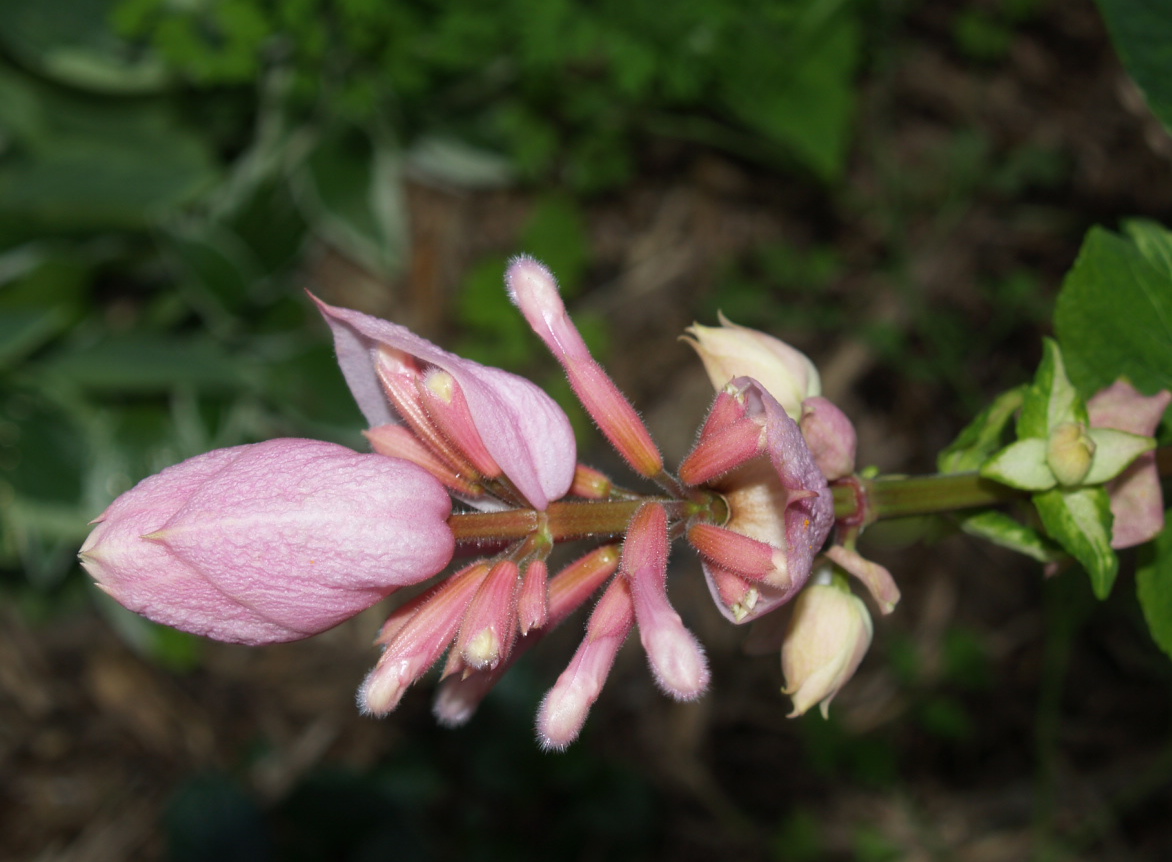
Salvia 'Pink Icicles'


Salvia involucrata 'Pink Icicles'

The week is starting off in a pink kind of way with my local bakery selling pink iced buns to raise money for a breast cancer charity. Cycling fans are not left out as the Giro d'Italia is underway with the leader's jersey of each stage being hot pink in colour.
This Salvia is aptly named as the flowers are enclosed in bracts which are a delightful frosty pink colour and the emerging flowers are just a shade darker. The flowers are terminal and quite heavy as they weigh down the branches. It is a somewhat ungainly shrub with stems going in all direction and these can be quite leafless at the base. This is the first time it has flowered for me so perhaps with a good cut back after flowering it may become more compact with age. It does not seem to object to growing in the shade as the autumn sun no longer reaches the part of the garden where it is growing. Eventual height will be around 1.5 to 2 metres.
2017 update:I am currently out of stock.

Thursday, May 5, 2011

Radicchio


Lustrous crimson leaves of Radicchio
Last winter my Italian-Australian friends at the community garden introduced me to that confusing tribe of vegetables variously known as Chicory, Radicchio and Endive. I was familiar with curly Endive whose pale frissy leaves catch at the back of your throat in a salad mix and the Belgian Witloof which is wonderful baked with ham and cheese but I had never tried Chicory pan di zucchero or the bright red radicchio rossa di Verona or palla rossa. I have just planted seed of the latter which should be ready for picking in about 12 weeks though there will be plenty of baby leaves in the meantime. Glancing at an Italian cookbook I like the sound of Radicchio con purea di fagioli which uses the leaves dressed with vinaigrette and topped with a cooked bean puree.


Tuesday, May 3, 2011

Salvia oppositiflora

Salvia oppositiflora

Plants with tiny flowers and soft lax growth don't get much attention and are not the first choice with buyers in garden centres in an age of big and bold plants, hedges and grasses. Add to that sensitivity to frost and the appeal diminishes further. I like this small growing Salvia for the unique colour and shape of the flowers which could best be described as narrow tubes of pastel orange appearing opposite each other on thin stems (hence the species name.) I picked up this plant at a garden fete and have yet to see it offered as a commercial plant in the Nursery trade.
It has been in cultivation for some time having been discovered in its native Peru in 1798 by Hipolito Ruiz and Jose Pavon who went on to include it in their Flora of Peru. It has been in cultivation in the Northern Hemisphere as a conservatory plant since the early part of the 19th century. It is thus ideal for growing as a container specimen and perhaps even kept on a bench where the delightful flowers could be viewed at close range.
2017 update: I no longer have this Salvia unfortunately.

Monday, May 2, 2011

Stinking Roger, Tagetes minuta

Stinking Roger, Tagetes minuta

It is not often I go out of my way to cultivate a weed but this one has many uses. Of all the species of marigolds (Tagetes sp), this one is the least decorative but apparently the most effective companion plant for use in the control of 'root knot' nematodes (eel worms) in vegetable gardens or amongst fruit trees and as a general weed suppressant. It is a fairly common roadside weed here and I didn't have to go far from home to find some small plants. At this time of year masses of small creamy yellow flowers appear at the ends of branches and the whole plant become quite sticky. This fact is a curse for dairy farmers as this exudate can adhere to a cow's udder and readily taint milk. On the north coast of New South Wales, the plant can grow quite tall and reach well over 3 metres . In its native habitat of South America...... Chile, Argentina and Brazil, it is much more respected and widely used as both a medicinal herb and harvested for the production of flavouring oil used in the food and drink industry.
The active insecticide property in the root of the plant is a sulphur compound called Thiophene which inhibits the growth of nematodes in the soil.The leaves have a similar action if scattered around vegetable plants to dispel cabbage white butterflies and other insect pests.
Tagetes is named for the Etruscan prophet Tages who sprang from the earth and revealed the art of water divining to ancient farmers.
2017 update: I do not grow this plant for sale.


Sunday, May 1, 2011

Petty Spurge, Euphorbia peplus


Petty Spurge, Euphorbia peplus growing through a crack in concrete

Hardly a week goes by when I don't have to pull out some of this weed. Common in gardens throughout Australia, it is usually found around buildings or in shady spots. It is native to Europe and Asia but it grows worldwide in settled areas. The milky juice from cut stems is corrosive to tender skin and mucous membranes and may cause severe gastro-intestinal irritation if swallowed. As it often appear in vegetable gardens it may inadvertently become mixed amongst the green leaves of a salad mix so it is best to keep it under control where food plants are grown. It will also cause hens to go off the lay if it becomes mixed with their green pick feed.