Saturday, October 19, 2013

Une Saison en Enfer

Clouds of smoke from fires in the distance

 'Et le printemps m'a apporte l'affreux rire de  l'idiot
Ah! j'en ai trop pris:----- Mais, cher Satan, je vous en conjure, une prunelle moins irritee!'

And spring brought me the idiot's frightful laughter.
Ah! I'm fed up:-----But dear Satan, a less fiery eye I beg you! 
Arthur Rimbaud (1854-1891)
from A Season in Hell/Une Saison en Enfer


Sunday, October 13, 2013

Insect pests: Flea Beetle and 26 Spotted Ladybird


 Every second year or so I grow a small crop of potatoes, last time it was 'Red Pontiac' , as above, and this year it is 'Dutch Cream'.
 They are just coming into flower but as it has been a hot dry spring a couple of insect pests are starting to make their presence felt.
 The 3mm metallic flea beetle (Xenidia picticornis ,Halticinae) pictured here, has very stout femora of the hind legs which means it is able to jump out of the way when disturbed. They leave tiny shot holes in the leaves but do not reduce crop yields. Other edible plants which are more seriously affected by flea beetles include beans, basil, mint and rhubarb as well as ornamentals such as Plectranthus species. They lay their eggs on the stems of plants and the resulting larvae may bore into the stem when feeding resulting in wilting of the affected parts. They require a systemic insecticide for adequate control and to break the life cycle.


The twenty-six spotted ladybird (Henosepilachna sparsa vigintisexpunctata) and the closely related twenty-eight spotted ladybird (Henosepilachna virgintiopunctata) are garden villains active from October to April. They relish the leaves of potatoes, cucumbers and rockmelons as well as ornamentals such as Brugmansia or members of the family Solanaceae. These beetles are oval in shape and about 6mm long making them larger and  easily distinguishable from the small 'good guy' ladybirds which feed on aphids.Their larvae feed on the underside of leaves and they are covered in burr like spines.They may be present at the same time as the adult beetles feeding on the upper surface and if the infestation is severe the leaves may appear as if burned and collapse.
If your crop is small, as is mine, they are easy to remove by hand as they don't budge when
approached. Too busy producing the next lot of offspring as is the case in the middle photo above.

Saturday, October 12, 2013

Le Fraisier des bois, woodland strawberry

 Woodland or alpine strawberry 
Fragaria vesca (Rosaceae)
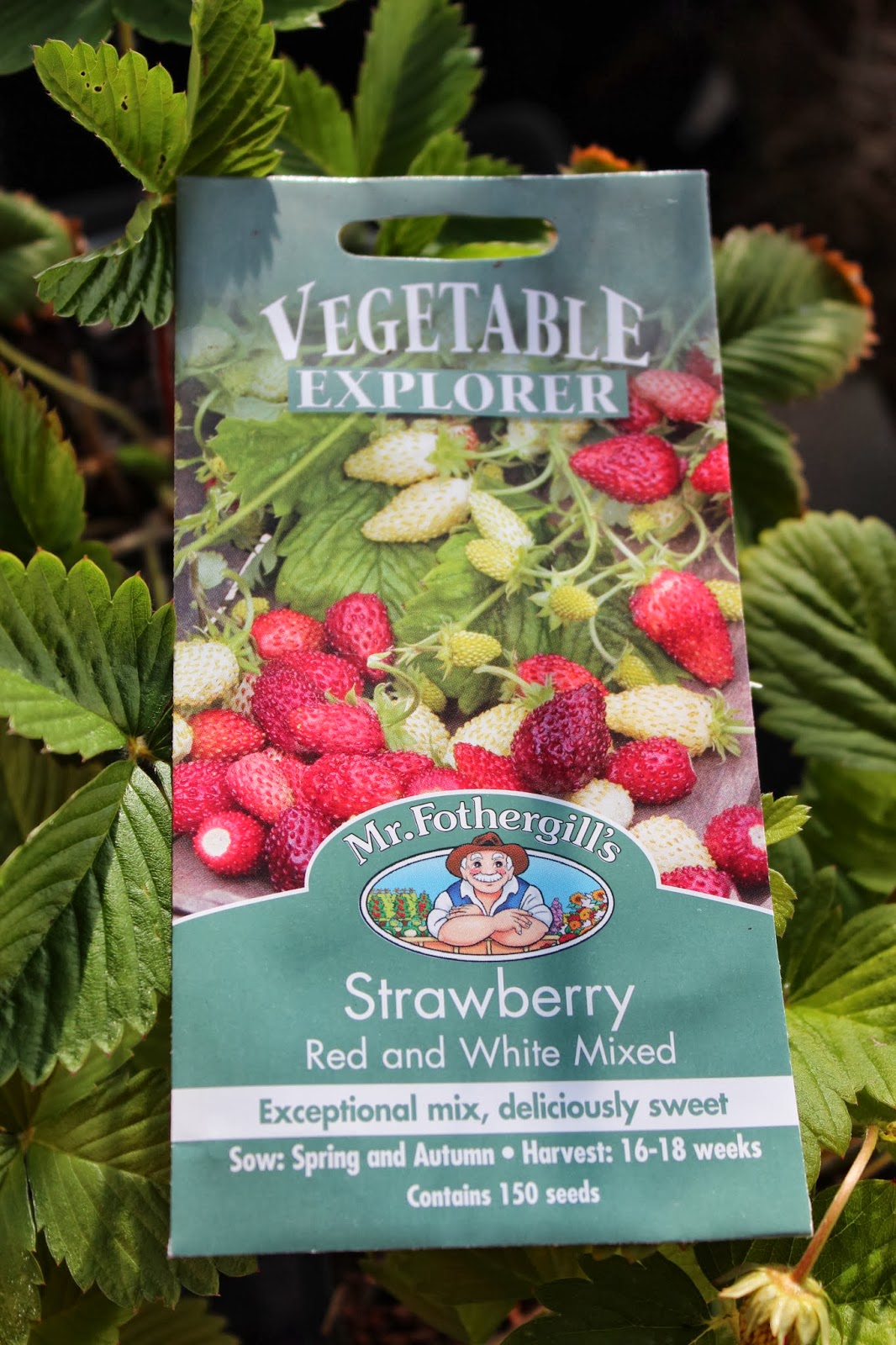
I have been after the white fruited strawberry for years as it was once readily available at herb nurseries and then it disappeared from the garden scene. Now it has been included in a mixed strawberry seed packet in the Mr Fothergill's range of products. The white fruited variety is said to be less attractive to birds though I have had no trouble with birds pecking at the red ones as the fruit is often hidden under a leaf canopy and not easy to spot. The perfect forage fruit really as there is the thrill of the hunt involved in finding these tasty snacks.
Growing strawberries from seed is in the medium difficulty range. The seed is as fine as dust and just needs to be surface sown and kept evenly moist. Germination is usually very good but the little plants just sit there for ages with hardly any leaves while they put down long fine roots. Often you end up with a mass of young plants growing together. However they are actually fairly tough and I have separated tiny plants from a tangle of fine roots and they all survive and develop quite quickly. Once on their own in a pot or garden bed, they make a big spurt of growth and before you know it they are producing fruit. it is just in the initial month after germination that you think they are never likely to come to much.
Plants benefit from a bit of shade in the hottest months and towards the end of summer they can be sheared off at ground lever to refresh the plants and leaves quickly return with autumn rain. Regular applications of liquid organic fertilizer keeps them producing lots of fruit for many months. Of course it takes a lot of patience to harvest a lot of fruit to use in a dessert and they tend to be eaten in the garden and not make it inside to the table. These seeds are available from: Mr. Fothergill's Seeds & Bulbs

Dianthus chinensis, Chinese Pink

 Dianthus chinensis ,Chinese Pink (Caryophyllaceae)
In flower now and not bothered by extreme weather conditions, the Chinese pink is a short lived perennial but is better grown as a spring or summer annual. It is easy to grow from seed but is also available as seedlings or as 'potted colour' from nurseries. The small crimped edge flowers are delightful and look as if they have been hand coloured with a paint brush as they are often streaked with darker lines or veins.The colour range is vibrant red, purple or pink and white.This is a good filler plant either mixed with other flowers in pots or in between summer perennials which have not got up to speed for their later flourish.The Chinese Pink has been grown for centuries and is recorded as having been introduced into Europe in 1702 where it was used in the development of new hybrids and varieties including a double form.
In China it is known as Shizhu or stone bamboo as it is grown as a rock garden plant and the leaves and conspicuous nodes on the stems give it a resemblance to a miniature bamboo.


Wednesday, October 9, 2013

The Blue Cactus, Piloscereus

 Pilosocereus species
I have had this blue cactus for years growing in a large pot. It is now about three metres tall and shows no sign of stopping growing .The roots have come away from the base of the pot and are spreading in all directions. For the first time it has produced a single flower which just appeared as a purple fig-like funnel shaped object projecting from the trunk. Around its base there are tufts of what looks like fur. The flower opened last night but was still open this morning to be captured by the camera. Pilosocereus cactus are native to Brazil and threatened with extinction in the wild due to habitat loss.


Saturday, October 5, 2013

Tweedia caerulea

 Tweedia caerulea syn Oxypetalum caeruleum ( Asclepiadoideae, Apocynaceae)
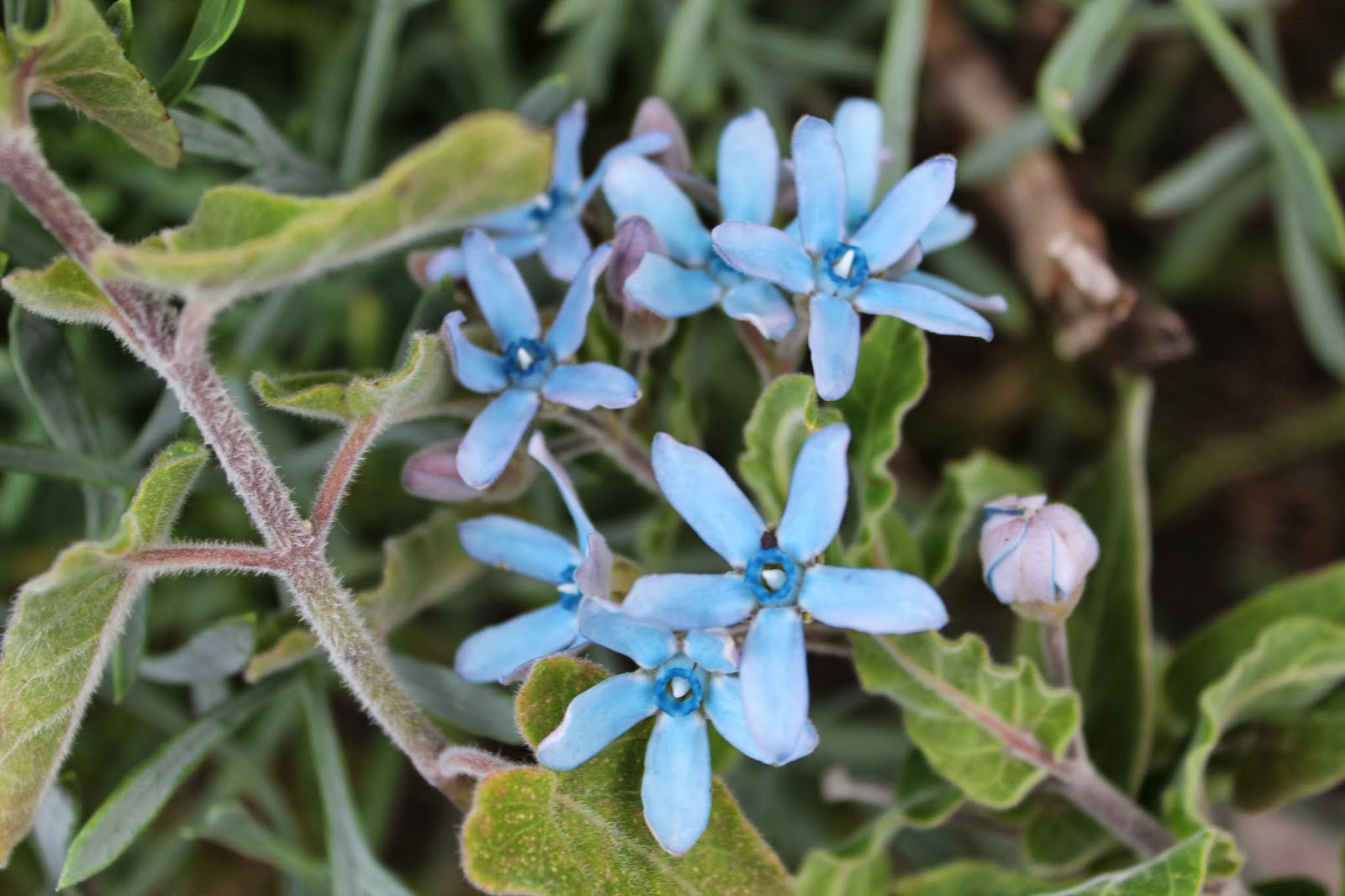
Neither a shrub nor a climber, Tweedia is hard to place in a garden. It grows as a few lax stems to about 90cm topped with the most beautiful cerulean blue flowers from spring to summer. Though worth growing for that unique flower colour alone, it is the soft as velvet arrow shaped leaves and stems which make it a candidate for inclusion in a garden for the visually impaired, perhaps as an 'edger' spilling over a garden wall where visitors are able to stroke the leaves. In some parts of the world Tweedia is grown as a summer bedding plant. It is frost tender and though mine did not lose its leaves, I kept it in a warm spot out of the cold and a little on the dry side over winter. It is one of those plants which tolerates dry conditions quite well, having milky sap, though it shares this characteristic with a couple of trouble maker cousins, namely the dreaded Moth vine (Araujiia hortorum) and Balloon or Swan plant (Asclepias physocarpa). It originates from southern Brazil and Uruguay
 The colour, pale Cerulean blue, was made famous in the film The Devil Wears Prada when  Miranda Priestly, played by Meryl Streep, corrects her assistant Andrea Sachs, played by Anne Hathaway, over this far from ordinary shade of blue.

For me the most interesting aspect about this plant is that it celebrates the life of the great Scottish gardener and plant collector John Tweedie (1775-1862). At age fifty he uprooted his wife Janet and their six children from the banks and braes o' bonnie doon and set sail aboard the Symmetry, in May 1825, from the port of Leith bound for Argentina (arriving in August) with 200 fellow passengers, all having been persuaded by the enterprising Robertson brothers John and William Parish, of Kelso to help settle a new Scottish colony at Monte Grande some 30km south of Buenos Aires. (1825 was also the year Britain granted recognition to Argentina as a nation and established diplomatic relations.)
By all accounts the voyage was a bit of a hoot with much merriment and singing from Tweedie's fellow passengers who were all at least half his age and full of enthusiasm for the new life ahead at what became known as the Santa Catalina Farm. The colony was very successful for a few years until civil war broke out and the residents dispersed with Tweedie setting up shop, literally, in Buenos Aires while travelling throughout Latin America on plant hunting expeditions, the booty from which he sent back to Britain to botanical institutions and wealthy patrons, as well as describing and assessing the local flora for his growing band of Argentinean followers. He is remembered for the introduction of species of Petunia and Verbena which were used in the development of modern hybrids we know today as well as for Pampas grass which became hugely popular in Victorian England.
In Argentina, John Tweedie is much revered today for his contribution to botany and horticulture. He became known there as Juan Tweedie and has a street named after him in the district where he lived and gardened. In the English speaking world, which, in Britain at least, still remains hung up on status and class, we await the publication of Northampton University Professor Jeff Ollerton's book: 'A considerable collection of new things: the life and travels of John Tweedie, gardener and plant collector' to give us a greater insight into the life of this famous Scot.
The Santa Catalina farm where he first gardened and apparently grew the most delicious peaches is now an eighty hectare Agricultural College. The pictures below show its transformation from Juan Tweedie's time to the present day.


Burnt Orange Safari

 One of the last Ranunculus to flower this spring is the one pictured above. It is a true burnt orange colour and from my understanding of the colour palette, this is orange with burnished copper and brown overtones. It is a colour which can be used to describe aspects of the Australian landscape, especially the outback.


 It is a reminder to plant the summer annual Portulaca . They are terrific to plant amongst succulents or in planter bowls. They do well in pots which are quite shallow as they have a fairly small root system and don't need much water to keep them looking good.

 Bougainvillea 'Bambino Miski' is one of the dwarf varieties which is in flower at the moment. When not in flower it is almost leafless, but when leaves do form, this one has attractive cream and grey variegated foliage. I grow one in a pot and place it on a table in a prominent spot when it is in flower.