Tuesday, August 31, 2010

Lavandula dentata 'Pure Harmony'

Lavandula dentata  'Pure Harmony'
White French Lavender

This species of Lavender has a profusion of flowers at this time of year and the batch I have grown looks fantastic massed together. However despite the great cultivar name, I don't think you can beat the plain species with the lavender/mauve flowers. 'Pure Harmony' is just as hardy as the traditional form of French Lavender and would make a great addition to a garden where white flowers are chosen as the theme.
2017 update: i no longer grow this form.

Friday, August 27, 2010

Sideration:The use of green manure

White Lupin 
Lupinus albus

Fenugreek
Trigonella foenum-graecum

This winter I grew these plants as green manure on my plot at the community garden. Both are just starting to come into flower and are at the perfect time for turning into the soil. According to my well thumbed copy of Rodale's How to grow vegetables and fruit by the organic method, green manure plants are one of the best soil conditioners ever discovered. 'They cost little, take little time to use and provide the answer to good soil tilth'. Every gardener who may not have time to make enough compost for the whole garden area can get the fertility build-up, biological activation and disease and insect resistance by planting green manures.
I am tempted to save some seed of the Fenugreek as it is such an aromatic Indian spice. In Hindi it is called methi and is a traditional ingredient in the spice mix panch phora . The "Greek" part of the name foenum-graecum means Greek hay.


Tuesday, August 10, 2010

Plant pathology: Problems with peas

Downy Mildew
 Peronospora viciae
This fungal disease causes the upper surface of the leaf to turn yellow while beneath the leaf a grey brown furry growth develops. This is worse during humid weather. Watering late in the day should be avoided.
Powdery mildew fungus (Erisphe pisi) showing as white powdery coating on leaves while parasitic fungi 'black leg' (Mycosphaerella pinodes) and 'chocolate spot' (Ascochyta pisi) cause brown or black marks or spots on the stems and leaves.
In Australia, the pea variety Greenfeast, a New Zealand selection from Lincoln, has long been regarded as having good disease resistance though it may not be entirely free from an attack by powdery mildew. It is a recessive gene in peas so that even wild peas from which the modern cultivars have been developed are sensitive to it.The theory behind this is that mildew is encouraged by the plant as it attracts beneficial insects such as ladybirds which appear to feed on the fungal colonies, thus protecting the peas from a worse insect invader.
Other resistant varieties include the American bred Knight, Kodiak, Mayfair, Rascal, dwarf Oregon Snow Pea and the sugar snap variety Super Sugar Mel. Not all these varieties are available here.
A degree of control of fungal diseases in peas can be achieved by spraying with potassium bicarbonate or by using a sulfur powder.

Plant Pathology:Black root in radish


Radish 'black root' Aphanomyces raphani
This fungal disease of radish causes dark patches to appear on the root which eventually splits open. Spores remain in the soil for many years and are spread by running water. A degree of control can be achieved by improving soil drainage and practising good crop rotation.

Onion Thrips


Damaged foliage with silver grey flecks and twisted bent growth indicate onion thrip.
Onion thrips, Thrips tabaci are important because they carry the disease spotted wilt which affects a wide range of plants including tomatoes and ornamental such as dahlias. This insect is found in all onion/leek/garlic growing areas of the world and is mainly a problem during warm dry weather and less of a worry during cool rainy periods. Thrips can be hard to detect at first as the young wingless creatures, which are pale yellow, congregate in the throat or 'chit' of the plant feeding on the newly unfolding leaves. The adults spend their time on the exposed upper surface of the leaf where they feed by piercing the the tissues and sucking on sap.The clever female thrips are able to reproduce without mating resulting in many generations being produced within a season. The female is a tiny light or dark brown insect about 1.3mm long with two pairs of narrow wings fringed around the margins with fine hairs. The male is smaller. Both are strong fliers and are easily carried by wind to infect a large area. Control can be achieved by inspecting the throats of young plants for early signs of infestation and spraying appropriately. Removing broad leaf weeds where thrips may lurk and providing good irrigation during dry weather helps keep this pest at bay.

Bolting in seedlings

When growing vegetables at this time of year,and as the days lengthen and the temperature fluctuates, you can encounter the problem of bolting , plants going to flower and seed before producing any leaves. Asian greens ,Brassicas for example , such as this Chinese Broccoli are particularly susceptible to this. In this case I left the seedlings for too long in the tray, they became drawn and stressed from not enough moisture and nutrients. After planting them out they went into transplant shock and the low night temperatures accelerated their demise.
Joy Larkcom goes into more detail about bolting in her excellent book, Oriental Vegetables The complete guide for the gardening cook. Her suggestion of growing seedlings in a module so that individual plants are able to develop a good root system is one way of overcoming the problem as well as germinating seeds at at reasonably high temperature of 18C degrees -25C. Low temperatures in the early stages of growth is the single most important factor leading to the initiation of flowers instead of leaves. Young plants need to clock up a certain number of heat units to prevent bolting : once this has been done they can be subjected to lower temperatures without damage.

Sunday, August 8, 2010

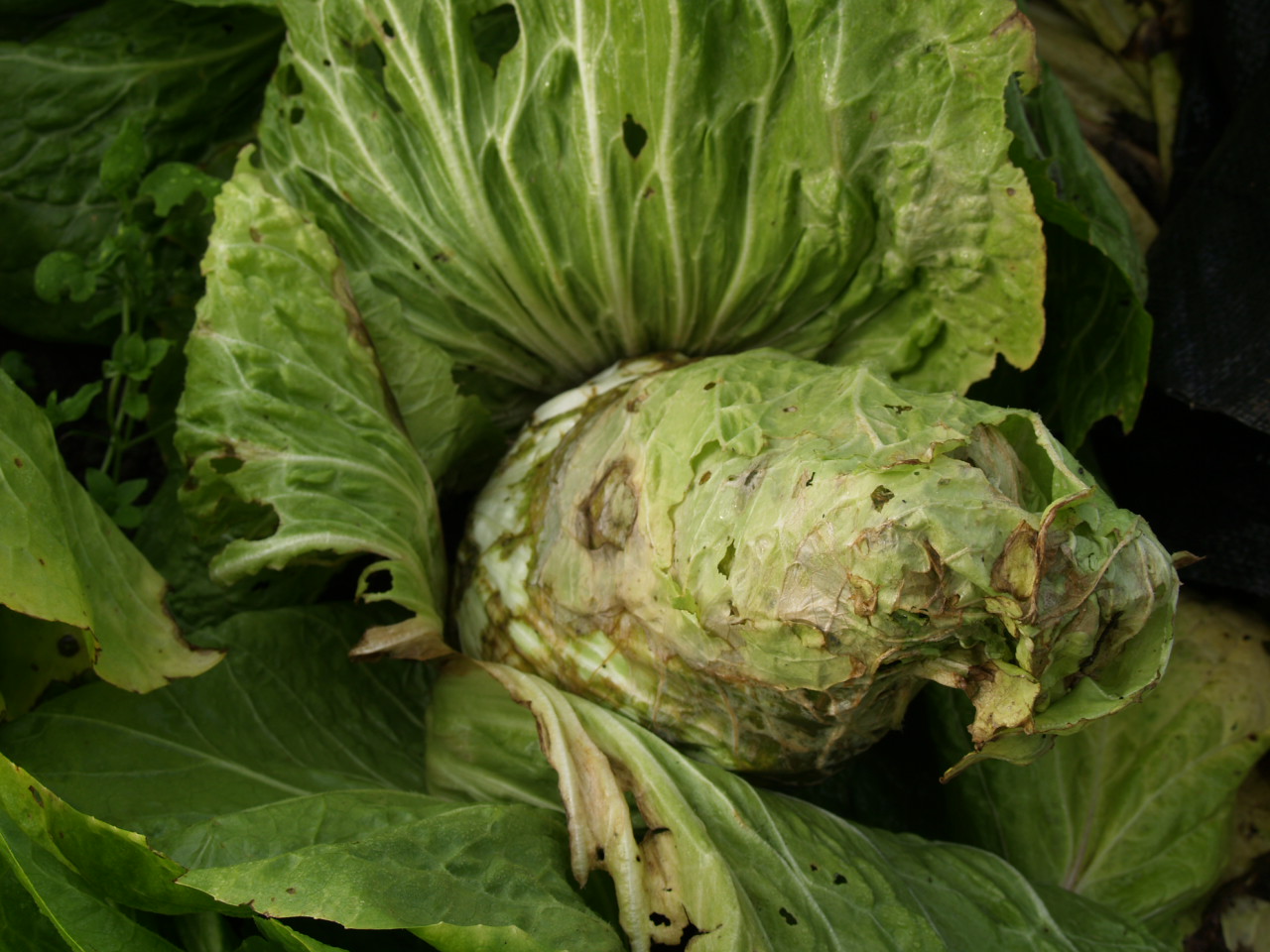
Plant pathology:Grey Mould on Italian Chicory.

Cicoria pan di zucchero
Grey Mould (Botrytis cinerea) is a fungal disease which is more common during cool wet weather such as what we have been experiencing lately. Brown rotted areas appear at the heart of this Italian chicory variety and this can be accompanied by greyish furry growth. The plant will eventually collapse but should be removed at the first sign of any damage and placed in a bin.