Sunday, September 25, 2011

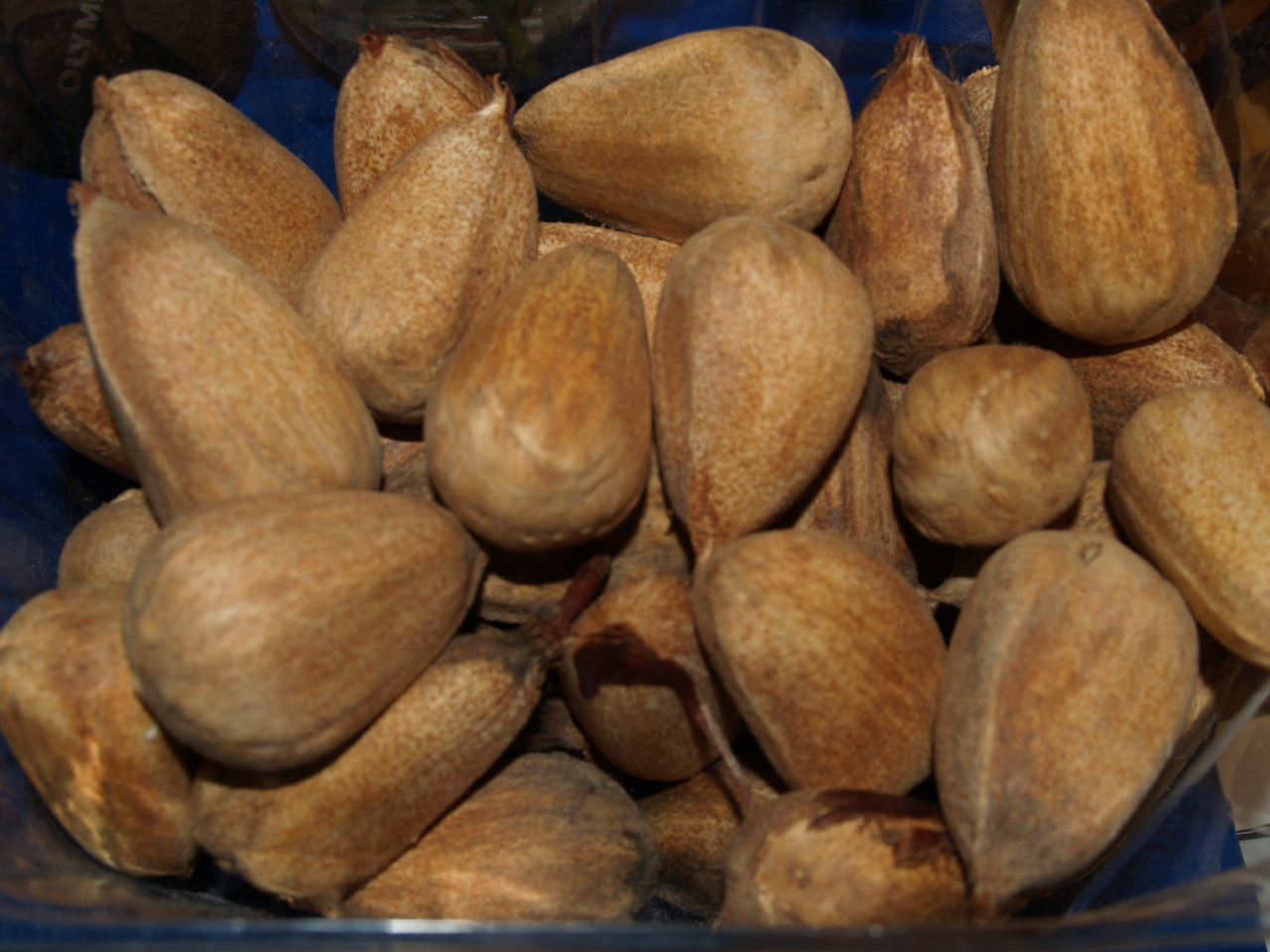
Bunya Nut, Araucaria bidwilli

Bunya Nuts from the tree Araucaria bidwilli

Local tree growing in a park
A friend has just given me some Bunya nuts which I have not eaten for years as they are not the sort of thing you find at the local supermarket. The process of cooking them involves boiling them in their shell for 30 minutes and then leaving them to cool for 4 hours after which time the shell can be removed with ease. They have a flavour not unlike chestnuts and can be used in both sweet and savoury dishes. They are apparently gluten free and high in complex carbohydrates according to Vic Cherikoff writing in his book Uniquely Australian: A Wildfood Cookbook. He gives a selection of interesting recipes using bunya nuts including one with crocodile steak....mmm
It is unfortunate that the tree is so tall and with such prickly leaves, it is unsuitable for city gardens or parks.The cones containing the nuts are so large (30 cm) round they could be deadly if one were to be hit on the head as they drop to the ground

Drawings by Betty Maloney of leaves and cone of Auracaria bidwilli (right) and A. cunninghamii (left)

Glenlyon Drive in Ashgrove, Brisbane lined with Bunya Pines
The most famous avenue of Bunya Pines is in the Brisbane suburb of Ashgrove . These trees marked the driveway to Glen Lyon estate, the farm of Scottish businessman Alexander Stewart who built a house there in 1876. The trees remained after the property was subdivided in 1918 and the house became the home of the Marist Fathers' Monastery from 1930.
I am not sure how popular the trees are with local residents who have to deal with the falling leaves and cones.

Wednesday, August 24, 2011

Monet's Nasturtiums at Giverny

"One had to pick one's way along the main walk to avoid treading on the freely trailing Nasturtiums" Jean-Marie Toulgouant
"I perhaps owe having become a painter to flowers", said Monet in 1924 "My garden is slow work, pursued with love and I do not deny that I am proud of it. Forty years ago, when I established myself here, there was nothing but a farmhouse and a poor orchard.....I bought the house and little by little enlarged and organised it ....I dug, planted, weeded myself; and in the evenings the children watered."


Wednesday, August 3, 2011

Grevillea 'Royal Mantle'

Grevillea 'Royal Mantle'

Planted as a grafted standard, this Grevillea has exceptional vigor and produces masses of flowers throughout winter and spring.


Monday, August 1, 2011

Hakea bucculenta

Hakea bucculenta

I came across this spectacular shrub at the Illawarra Grevillea Park on the weekend.The park was having one of their open days and every time I go there I always see native plants which I have never come across before or ones which are not well known in cultivation. This red flowering Hakea is from the Geraldton region of Western Australia. The Latin name bucca refers to the seed pods which resemble fat cheeks. If you have a garden with very well drained sandy soil or a site with sloping ground where water can rapidly drain away, it would be worth trying to grow this beauty in a home garden situation.Flowering normally occurs during the winter months


Sunday, July 31, 2011

Late for the Sky


The days are finally getting longer and warmer. On a late afternoon walk near the lake everything turns to blue just before it gets dark.

Thursday, July 28, 2011

Bark like satin


Largerstroemia indica 
Crepe Myrtle
One of trees which really shines in the winter sunlight is the Crepe Myrtle. The satin smooth bark reflects light onto the surrounding garden and contrasts well with the sombre green clipped star jasmine planted underneath.

Tuesday, July 26, 2011

Carex testacea

c
Alstroemeria aurea dwarf cultivar


Carex testacea Orange Sedge
with Cape Daisy (Osteospermum ecklonis 'Nuanza' Copper Purple

The New Zealand native sedges/grasses which are shaded brown usually get politely called bronze, orange or tan coloured and can be an acquired taste if you are not used to seeing them planted as garden ornamentals. The reaction when first seeing them is that they must be dead and indeed can look so if planted in groups on bare ground or just surrounded by mulch. Perhaps they evolved this colour so as to appear unpalatable to grazing animals. When used in a garden they make a terrific foliage contrast with silver leaved or purple plants as well as with warm coloured flowers with orange tones. I like to use them with the bright Cape daisies or the richly coloured dwarf Alstroemeria aurea, pictured above, which is just coming into flower.
The other New Zealand Carex species to look out for in this colour range include Carex buchananii (Leatherleaf sedge), Carex comans 'Bronze" and Carex petriei. The latter takes on a wonderful soft pink tone at certain times of the year. All are frost hardy and suitable for container growing and deserve a place in both large and small gardens.